Figures from the past have modern appeal







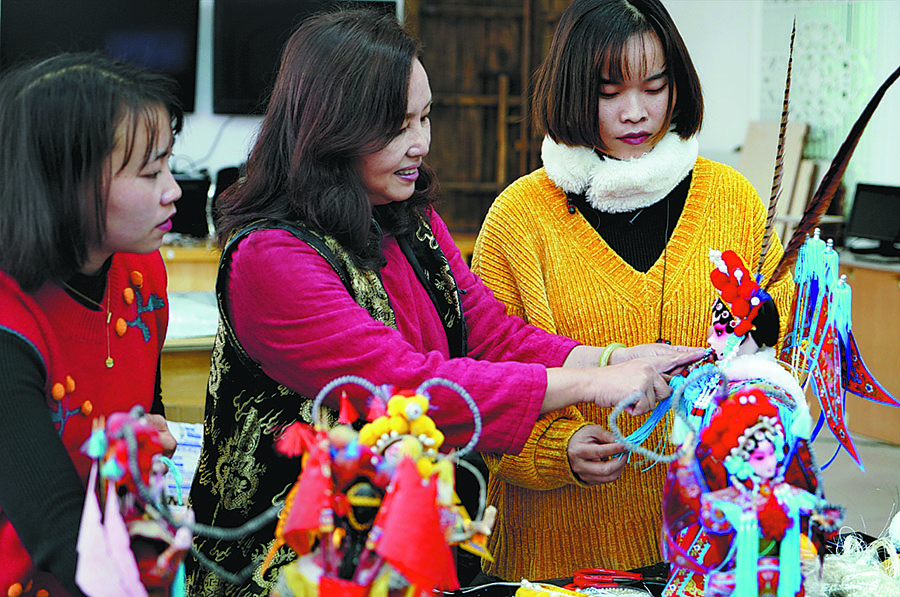
Diverse styles
The distinctions are easily seen, as the costumes are displayed right next to one another.
"The clothing of the Tang Dynasty (618-907), in comparison (with the Han Dynasty), is particularly vibrant in color, and the patterns are magnificent," Tang explains.
By the time of the Song Dynasty (960-1279), clothing became relatively more tailored, while during the Qing Dynasty (1644-1911), there was a significant use of embroidery in clothing, she adds.
"So, in essence, a small doll embodies the costume culture of various dynasties throughout history," Tang says.
Additionally, juanren integrates multiple examples of intangible cultural heritage. For example, the figurines from the Peking Opera have such elements in their headdresses.
"The silk part on the headdress comes from the art of filigree inlaying, while the patterns on the costumes are hand-painted," she says.
She says every time she makes a silk figurine, it feels like she travels back to ancient China and is able to experience their way of life and the cultural atmosphere firsthand.
"Behind each silk figurine, there is a fascinating story, so it also carries the history and culture of that time," Tang says. Now in her 60s, she has been fascinated with dolls since childhood.
"My mother gave me an old cloth doll. I couldn't keep my hands off it, and I sewed a floral skirt for the doll," she recalls.
"Since then, I have developed an inseparable bond with cloth dolls, to the point of what I can call an obsession."
This early interest resurfaced after Tang built a successful software engineering business in the early 1990s. "I had to find business projects and socialize to build relationships, but it was not the life I enjoy," she recalls.
It was during a trip to a shopping mall in the capital city that Tang first laid eyes on juanren, and was instantly drawn to its delicacy and smooth texture, rekindling a dormant passion.
In 1997, Tang decided to let her husband take over the software engineering business as she pursued her dream.
She first sought apprenticeship with Yang Naihui, the second-generation successor of juanren.
"It was when the traditional craft was at a low ebb, with sluggish market demand and very few people dedicated to carrying it forward," she recalls.
It was during her training that she came to realize there are over 100 steps, big and small. "The craftsmanship is complex and requires mastering everything, such as high-level artistic skills and endurance," she says.
Traditional figurines are made of three layers of fabric. The first two layers are an elastic veil, and the last layer is silk. Then, each layer is pasted one by one, ensuring each is naturally air-dried before pasting the next one.
As such, the production cycle for making a head alone is usually seven to 10 days.
"The most challenging parts are the faces and hands. The fingers of our tiny silk figurines can move, since they have five iron wires inside, wrapped up in cotton and then covered with silk on the outside."
The hand-painted makeup is also demanding, since it's difficult to paint on the three-dimensional silk gauze.
"And, if you make even a slight mistake, everything has to start over," Tang says.
The biggest figurine at the museum stands at 1.2 meters and features a flying, flute-playing fairy that was inspired by the murals at the Mogao Caves in Dunhuang, Gansu province.
"Creating such a dynamic character using silk is particularly challenging, especially when it comes to the face. For a large-faced silk figurine, the demands and tension on the silk are significant, as well as the requirements for craftsmanship," she says.
However, just as Tang started to master the craft, the market response threw cold water on her dream.
"I didn't sell any of the first batch I made," she says, adding that the failure was due to the high price of the dolls, each of which was generally priced between 2,000 yuan ($278) and 3,000 yuan.