Clean energy powers China's green future








The first time I saw a wind turbine was in the late 1980s when I was on a study tour of Europe with a group of mid-career journalists from developing countries at the invitation of an international organization. I was so impressed by the gigantic fans that helped produce clean electricity that I prayed that someday my country, too, would have such high-end power-generating facilities.
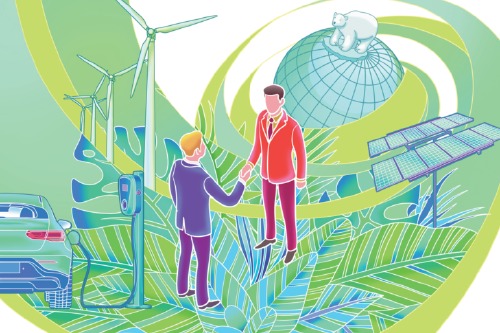
Four decades down the line China has become the world's biggest producer and user of not only wind turbines but also photovoltaic power panels. China's installed capacity of renewable energy exceeded 1.45 billion kilowatts in 2023, accounting for more than 50 percent of the country's total installed power generation capacity, according to data released by the National Energy Administration. More importantly, it accounts for about 40 percent of the world's total.
Behind this remarkable transformation is China's changed attitude toward renewable energy.
Climate change and the threat it poses to the planet have long been a matter of concern for the international community. While agreeing that carbon dioxide emissions must be reduced to mitigate climate change, the developed and developing countries have for years been arguing over the levels of emissions reduction. The developing countries argued that the developed economies should drastically reduce their emissions as well as pay their climate debts for contributing to most of the cumulative historical emissions. They also emphasized that the developing world should not be forced to reduce emissions and thus be deprived of developing their economies. China, of course, was among the latter.
Yet over the past decade or so, China has changed its approach to economic development, putting stress on eco-friendly development, with the top leader saying that "clear waters and green mountains are as valuable as mountains of gold and silver". Given its commitment to sustainable development, China, with some other countries, played a key role in getting the Paris Agreement passed at the UN Climate Change Conference in Paris 2015. And four years ago, China pledged to peak its carbon emissions before 2030 and achieve carbon neutrality before 2060.
These two developments have not only pushed China's renewable energy development onto the fast track but also demonstrated the country's commitment to help reduce global emissions.
Three strategic considerations have prompted China to expedite its pursuit of clean energy. First, the pursuit is in line with China's pledge to help build "a community with a shared future of mankind". China does not believe in zero-sum thinking. Instead, its aim is to build win-win partnerships and achieve common prosperity.
Also, it knows that only when climate change is effectively mitigated can humankind survive. And as the world's second-largest economy, it accepts that it has the obligation of reducing carbon emissions by developing renewable energy.
Second, China takes into consideration environmental protection when drafting its development policy, because increasing renewable energy production can help the country reduce air pollution and check environmental degradation, which have been a major problem associated with economic growth.
In fact, by covering hundreds of square kilometers of deserts in the north and west with photovoltaic panels to generate electricity, China has helped the regeneration of plants in those regions, which incidentally has curbed desertification.
The third strategic consideration is rarely mentioned by observers but is probably high on the decision-makers' agenda — energy security. China has closed an increasing number of coal-powered electricity plants to cut emissions, as well as to reduce the use of fossil fuels.
By developing renewable energy — which already meets one-third of China's consumption requirement — the country can ensure energy security and protect its people from not only the Western sanctions but also the impact of climate change.

The author is former deputy editor-in-chief of China Daily.
kangbing@chinadaily.com.cn