Turkish shadow play has ties to Silk Road







ANKARA — "When we think of the Silk Road, the first thing that pops into people's minds is trade. However, trade isn't limited to goods, it encompasses culture," says Berkant Demir, a young puppeteer at the Intangible Cultural Heritage Museum in the Turkish capital Ankara.
Demir, who is a practitioner of Turkiye's traditional shadow puppetry tradition Karagoz, highlighted how cultural exchange along the Silk Road over the centuries forged strong connections between peoples and nations, notably between the Chinese and the Turkish people.
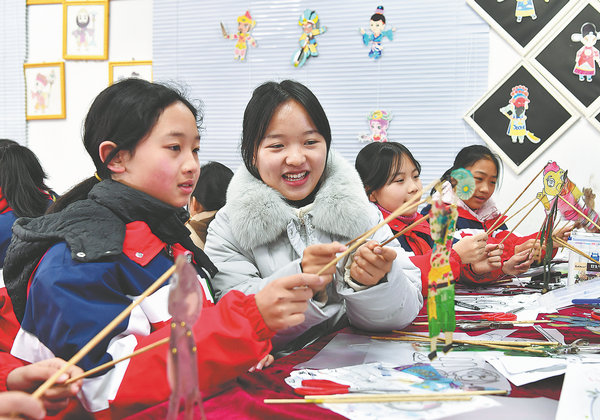
Taking the Turkish art that was recorded by UNESCO on the Representative List of the Intangible Cultural Heritage of Humanity in 2009 as an example, some historians trace the origins of Karagoz back to Central Asia, who drew inspiration from Chinese shadow puppetry, a form of cultural heritage that is well-preserved in China to this day.
"Shadow puppetry exists in most of the countries on the ancient Silk Road," Demir says in a recent interview.
Preserved in Ankara's Intangible Cultural Heritage Museum, the art form stands as a testament to Turkiye's commitment to preserving its folklore, artistic practices, and storytelling traditions.
Demir explains that shadow puppetry is a dramatic form of storytelling, in which silhouettes made of animal leather are projected onto a white screen. Multitasking performers sing the tunes and words of the story, while the lead puppeteer manipulates the movement of the puppets and the light sources behind the screen.
"Karagoz is a slightly more primitive version of television and cinema. There is a light in the background and moving pictures on the screen. … Karagoz was the starting point of cinema," Ibrahim Oztahtali, a scholar from Turkiye's Bursa Uludag University, told Hurriyet Daily News in January.
Karagoz is derived from the name of one of the two leads, a character who is known for being lower class and for having coarse manners. His protagonist is Hacivat, a refined and educated person who engages in lively debates with Karagoz. According to legend, the characters were real individuals, but there is no historical record to prove this is true.
The plays, initially staged by nomadic people in Central Asia in their tents, found its place in Ottoman theater about 700 years ago in Bursa, a city located in northwestern Turkiye that was the seat of the Ottoman Empire in the early 14th century, and where shadow puppetry first rose to popularity in the 16th century, says Oztahtali.
With performances inspired by social events, daily life, political affairs, and romantic tales, Karagoz not only sheds light on the political and social events of the time but also reflects public criticism, says Demir, adding that the tradition's primary objective was to educate people via entertainment.
"Historically, Karagoz performances were not only epic, but also served as an educational tool for people of all classes," he says.
In the past, peak performance season coincided with the Muslim holy month of Ramadan as fasting people needed entertainment until dinnertime. Nowadays, shadow puppetry performances can be enjoyed throughout the year, he says.
Demir attributes the tradition's enduring popularity in modern Turkiye to people's sense of nostalgia.
"As societies progress, there is often a tendency to reconnect with the past," he says.