Villages vitalized by terraces to heaven
Longsheng's spectacular Longji landscapes usher in environmental and cultural tourism boom, Yang Feiyue reports.







Various-sized oxen made of bamboo strips with colorful cloth for the head and tail danced to the accompaniment of gongs and drums. Farmers dressed in distinctive Dong outfits holding plows and whips followed closely in their wake.
The performance took place as part of recent spring celebrations in Guangnan village, Longsheng autonomous county of various ethnic groups in Guilin in the Guangxi Zhuang autonomous region, which is home to many ethnic minorities.
For centuries, the dancing spring oxen have not only been viewed as divine by the villagers, but have also embodied their hopes for better lives in the new year.
Mountains, scarce farmland, and poor transportation once sealed Guangnan off from the outside world and with just a few acres of paddy fields, local residents used to struggle to make ends meet, which is why the cow is the villagers' best helper, says Wang Kaiqi.
"We have a profound respect and love for cattle," the villager in his 70s says.
In the past, residents were impoverished, only able to grow crops like rice and ginger to earn a meager living. Things have significantly changed over the past decade, since the local government encouraged them to expand into new crops and to take advantage of the area's beautiful countryside and ethnic cultures to develop tourism.
Today, oxen are no longer important agricultural tools, and the narrow rural paths they used to plow have turned into wide roads, along which agricultural machinery and all sorts of small cars shuttle back and forth.
Since 2021, Guangnan has been Longsheng's model for rural vitalization and more than 10 million yuan ($1.38 million) has been invested to upgrade roads, river embankments and traditional homes. As a result, the village has attracted visitors from institutes of higher learning across the country on learning tours.
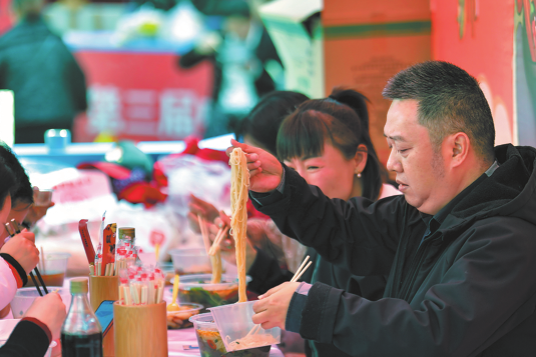
Meng Yongfan, who was one of the first residents to start a homestay and catering business for visitors, now brings in more than 300,000 yuan a year.
A dozen restaurants and homestays have sprung up since, to meet increased demand from travelers from China and abroad, Meng says.
Guangnan is just the tip of the widespread transformation that has taken place across Longsheng, which was recently ranked among the upcoming top 10 rural vitalization models by the Ministry of Culture and Tourism.
In 2023, Longsheng county received 10.11 million visits, an increase of 67.27 percent compared to the previous year, and tourism spending reached 12.6 billion yuan, an increase of 66.35 percent year-on-year, according to county authorities.
About 90 kilometers away to the southeast, residents of Dazhai village earned collective tourism dividends of 7.25 million yuan last year.
This was a big contrast from the 25,000 yuan they earned in 2003, the 147,000 yuan in 2008, and the 1 million in 2013, says Yu Qiongtong, a senior village committee official in Dazhai.
Surrounded by mountains on all sides, there was once only a muddy path leading out of the village. People carried goods on their backs or on mules and lived in stilt houses that were drafty and leaked when it rained. Now, local authorities have managed to turn those basic conditions into attractions.
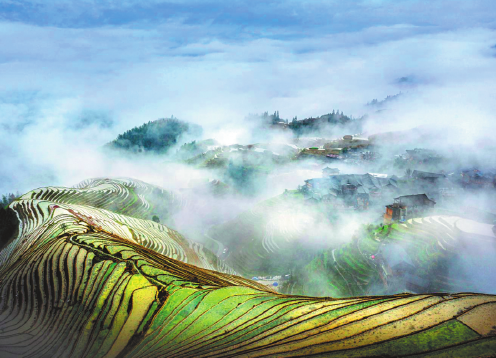
For example, Dazhai boasts around 66 square kilometers of terraced fields that have been cultivated for around 2,300 years. They follow the terrain of the mountains, at heights ranging from 300 to 1,200 meters above sea level. From swiftly flowing river valleys to mist-covered mountains, dense forests and steep cliffs, wherever there is water and soil, terraces have been dug.
Those in Dazhai are important representatives of Longji terracing, a well-known type of terrace that can be found all over the county.
"The highest tier has more than 1,100 levels, winding from the foot of the mountain to the top, creating a magnificent landscape that resembles a staircase to the clouds," Yu says.
The largest terrace is no more than an acre in size, while the smallest only accommodates a handful of rice seedlings.
Longji terraces are based on an environmental practice that focuses on harmony between humans and nature and the dynamic balance of forests and fields.
It is an important model of ancient Chinese water management and agricultural civilization that has been passed down to the present day, Yu says.
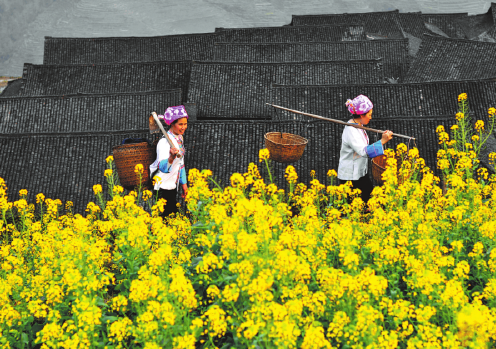
Visitors can appreciate the way the Zhuang and Yao ethnic groups have farmed the terraces and how ancestral farming methods have been preserved.
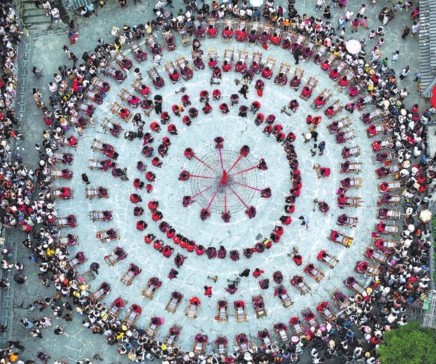
Every year after the Qingming Festival, villagers begin a series of agricultural activities such as planting and harvesting that have given rise to celebrations.
These festivities have become a rich resource for developing tourism, Yu says.
Lu Chulong, a writer based in Guilin, has been focusing on Longji terraces for two years.
"They are not just beautiful landscapes but also carriers of Zhuang and Yao culture," Lu says.
"The stories, history, traditions, and beliefs there are closely related to the land, from ancient villages to magnificent terraces, from hardworking farmers to the culture passed down through generations," Lu adds.
Yu says that today, many other areas with terraced landscapes come to Longsheng for tips on development.
In 2022, the village was named among the Best Tourism Villages by the World Tourism Organization, thanks to its achievements in balancing tourism and economic development, while protecting the environment.
Yu says that more than 200 households in the village run homestays, around 70 percent of which are booked during peak tourist periods, mostly in summer and autumn.
"Next, we aim to introduce more cultural and tourism-related projects suitable to the area, to enrich the experience and further the development of the cultural and tourism sectors," Yu says.
"At the same time, we will continue to strengthen the protection of our culture, terraced landscapes, and traditional architecture, to ensure that terrace culture continues to thrive in our generation."
Local resident Pan Yingfang received more than 40,000 yuan in tourism dividends last year, the most in Dazhai.
Before the road was built in 2003, her family's small rice fields barely helped keep their heads above water.
"We still needed to work outside," Pan says.
Ever since the village developed tourism over a decade ago, she started to receive annual bonuses.
"I also have income from planting the paddies, and life is much better than before," she says.
Being chosen as a rural vitalization model is a manifestation of both social and economic benefits, says Lei Chen, Longsheng Party secretary.
In recent years, the autonomous county has leveraged tourism — especially leisure agriculture and rural tourism — to adjust the agricultural economic structure, increase income for farmers, and enhance livelihoods.
A special annual tourism fund of up to 10 million yuan is available to help integrate tourism with urban and rural construction and preservation of resources, Lei says.
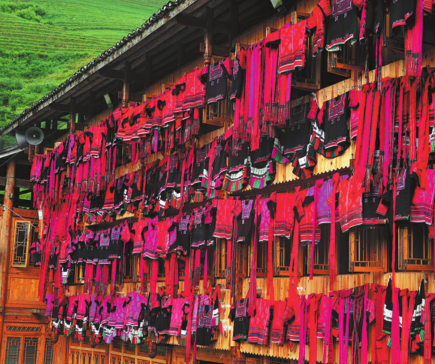
Multiple folk festivals based around ethnic costumes and artifacts, farming culture, revolutionary history and health preservation have been launched.
More effort will be made to showcase Longsheng's well-preserved environment and diverse ethnic culture to the world, with the goal of driving growth in tourist numbers and spending across the county, Lei says.
"Next, Longsheng aims to create a world-class tourism destination and demonstration area for ethnic cultural tourism in Guilin," Lei adds.




Today's Top News
- Xi extends congratulations to 50th founding anniversary of Lao People's Democratic Republic
- Enhancing old-age finance prioritized
- French president to pay three-day state visit
- Strategy defines growth trajectory
- Opportunity to reconnect Europe with China
- Ryukyu's historical tributary ties with China highlighted