THE SOUND OF A COMEBACK
Ancient painting depicting idyllic scene helps inspire the return of a traditional instrument, Chen Nan reports.







When Li Hao went through a book of traditional Chinese paintings, some showing musical instruments, in 2019, he was intrigued by one particular image.
It was a photo of a painting from the Southern Song period (1127-1279) by an unknown artist, titled Zhulin Boruan Tu, or "playing the ruan in the bamboo forest". It features three people clad in long robes in a bamboo forest near a creek, who are playing an instrument, the four-stringed ruan.
"The painting was so vivid and I could imagine the sound of the instrument and how beautiful it would be to hear in nature," says Li.
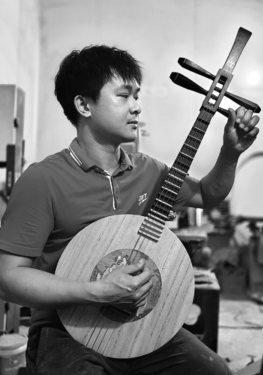
Inspired by the painting, the clerk at a university in Nanning, capital of South China's Guangxi Zhuang autonomous region, had a bold idea: to make a ruan just like the one he'd seen in the painting.
He read a lot of books and did research online, and also taught himself to play the modern version of the instrument.
The ruan is a Chinese plucked string instrument with a long neck and a circular body that is more than 2,000 years old.
After the People's Republic of China was founded in 1949, it was reinvented and given different sizes of sound boxes, enlarging the instrument's family into small, medium, large and bass versions. The zhongruan (medium) and the daruan (large) are mostly seen in Chinese orchestras nowadays.
When Li was a student at the Guangxi Minzu University, he joined the school's Chinese orchestra, playing the pipa (a four-stringed lute) and the guqin (a seven-stringed zither).
"I had many friends who were students at the university's art school. They taught me to play the pipa and the guqin," says Li, who majored in Chinese language and literature. "There were also students in the orchestra playing the ruan, but compared to the pipa and the guqin, the ruan catered relatively to a minority taste."
The 32-year-old started by drawing the ruan when he tried to make his first copy of the instrument.
Born and raised in Nanning, Li says that he has been interested in traditional culture from the time he was a teenager. He recalls vividly that he loved traditional paintings and copying the masterpieces for fun.
However, the ruan of ancient China and those of contemporary times are very different, which required Li to devote a lot of time to research.
"The sound box of the ruan in ancient China was much thinner than today's instruments. Since the instrument can only be seen in museums, I could only do research online to get an idea of how the ancient ruan looked," says Li.
"In ancient China, musical instruments were made of valuable wood and the strings were made of silk. Today's musical instruments are mostly made of wood that is moisture- and mold-proof, making them sustainable," Li adds.
There are more than 10 main steps in making the instrument, from creating the body, to tuning. Of all those steps, the one that challenged Li the most was to find the right sound. He resorted to the internet to look for sounds produced by the ancient ruan, and found out that contemporary ruan sounds more like the guitar, and makes a wide sound range from bright and loud, to deep and low. The ancient ruan, which sounded more like a pipa, produced short and clean sounds.
"It took me about six months to finalize the sounds that I believe to be similar to those the ruan produced in ancient times," he says. "I am still making adjustments."
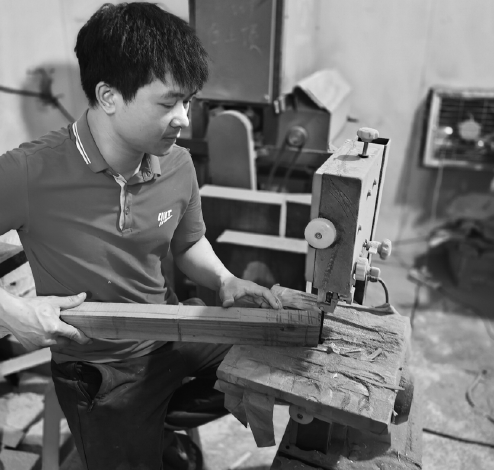
Since 2019, Li has made about 100 instruments, each taking about two weeks to finish. He also makes other traditional Chinese instruments, such as the pipa.
By showcasing his techniques of making instruments and playing them on his social media platforms, he has gained a fan base and attracted buyers.
He also shares his ideas about the ruan, which resonate with fans.
Many admire and applaud Li's devotion to the instrument while others are inspired, expressing their love for traditional Chinese music.
"It's an old musical instrument but very versatile, and can interpret different music styles, like rock," says Li, who showcases the instrument and how to make it on his social media platform.
"I first saw a ruan in the Dunhuang murals and it's amazing to see the instrument come alive," comments one viewer of Li's online streaming programs.
"Though I cannot play the instrument, I want to buy one and put it on my table; it is beautiful," writes another viewer.
One of Li's customers is Zide Guqin Studio, a popular folk music ensemble incorporating traditional instruments.
The ensemble performed on a TV gala by China Central Television in 2022, reimagining a performance by musicians of the Song Dynasty (960-1279). One of the ensemble's members played a ruan made by Li, which resembled an instrument from the Song era.
"Compared to the instruments of the Tang Dynasty (618-907), which usually had bright colors and valuable jewels as decoration, the ruan of the Song era had a very simple look, pure black and decorated with jade," Li says, adding that he has also received orders from abroad.
With the rising number of orders, he plans to quit his job at the university and work full time on his musical instruments.
"My family had no knowledge of music and they had never heard about the ruan before I made one. But they are very supportive and my parents are also starting to enjoy music now," Li says.
Shi Ruipeng contributed to this story.