Global South is being re-imagined, transformed







The phrase Global South has become a buzzword in contemporary international relations. Not a day passes without its mention in one or the other policy document, media commentaries or think tank reports across the globe.
Some see the Global South as a latter-day name for what was once labeled the "Third World", a term said to have been coined in 1952 by French demographer and economist Alfred Sauvy. In this Cold War era theory, the world was divided into the capitalist First World, led by the United States, and the socialist Second World, with its center in Moscow. The "Third World" was an undifferentiated mass of countries remaining outside these two blocs.
In this formulation, a city-state like Singapore and a continent-size nation such as Brazil were both described as "Third World" countries. Furthermore, two major Asian nations did not fit into this neat description: the Sino-Soviet ideological split had taken place way back in the early 1960s, while India was outside the Cold War blocs, following a "nonaligned" foreign policy.
The term "the South" gained currency after the 1981 Brandt Commission report, which aimed to go beyond the East-West dichotomy by examining global problems within a North-South axis. The commission, headed by former West German chancellor and Nobel laureate Willy Brandt, suggested that the "North" and "South" were broadly synonymous with "rich" and "poor", "developed" and "developing "countries. With the end of the Cold War, the "Second World" disappeared from the political lexicon, and "Third World", too, became a redundant concept.
Much has changed since then. The Global South has gained salience, and Western domination of Asia, Africa and Latin America has gradually waned. As the West recedes, groupings such as the BRICS nations have increased their global imprint. China remains an important member of the group, offering alternative geopolitical as well as economic perspectives to counter the Western hegemony embedded in the international financial system through institutions like the International Monetary Fund and the World Bank. The creation in 2014 of the BRICS' New Development Bank as an alternative to the Bretton Woods institutions has sparked the interest of many countries in the Global South. Some have made a case for setting up a "new Bretton Woods" to address the economic fallout from the COVID-19 pandemic and develop an alternative and sustainable post-COVID world economic order.
During the 2023 BRICS Summit in Johannesburg, South Africa, six new countries were admitted: Egypt, the United Arab Emirates, Saudi Arabia, Iran, Ethiopia and Argentina (although Argentina later decided not to join). Indonesia and Turkiye also want to join.
Beyond BRICS, in other forums the Global South is receiving more attention. India used its presidency of the G20 in 2023 to reestablish its credentials as an articulate voice for the Global South. A virtual summit, the "Voice of the Global South", which was held in New Delhi in January last year, was attended by representatives from 125 countries. Providing further impetus to amplifying the voice of the Global South, India ensured that the African Union was given full membership of the G20 at the summit in September last year in New Delhi.
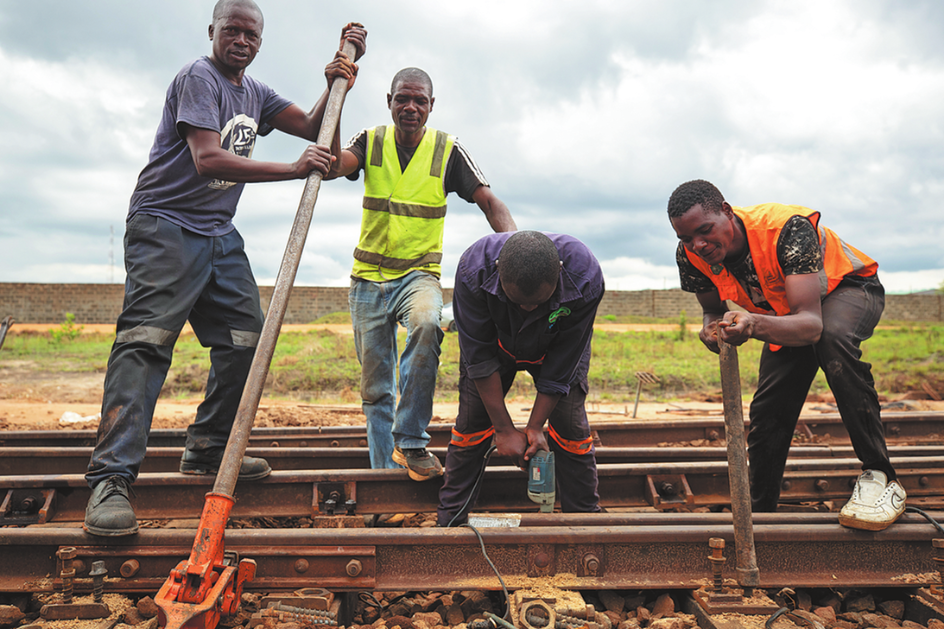
In the past two decades, the intra-South growth in aid, investment and economic cooperation has demonstrated the limitations of the Western developmental model, especially since China has shared its successful poverty-reduction experiences with other parts of the Global South through the Belt and Road Initiative.
As an important aid provider, China has also been instrumental in unleashing the structural transformation underway in many parts of the Global South, partly because of the growing South-South development aid and cooperation. Furthermore, India launched a "Digital India" program in 2015, and the country has witnessed a digital revolution that is now being exported to other parts of the Global South.
Such transformational changes provide optimism to re-imagine the Global South not as a site of what a commentator once described as "coups and earthquakes", but of robust economic progress and the reduction of poverty.
The author is a professor of international communication at Hong Kong Baptist University.