'Containment' efforts by US defy common sense







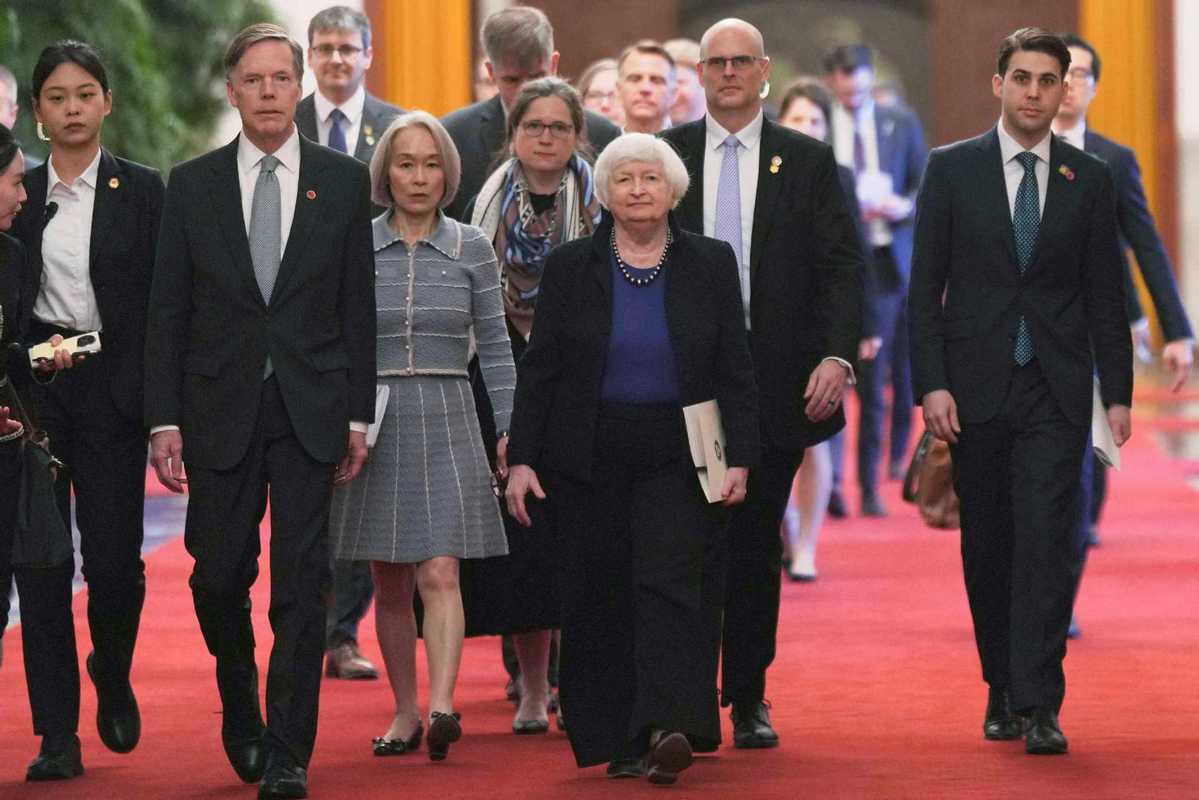
US Treasury Secretary Janet Yellen recently held a series of meetings with leading Chinese officials, during which she wanted her hosts to know that her country had no interest in quashing the strong trade environment in which the US and China operate. Yet almost everything she said gave off vibes that the US does, in fact, want to do just that.
One of her primary claims is that China engages in unfair trade practices that damage US corporations. In effect, she was saying that China needed to be taught a lesson about how to behave on the global stage. Until China changes its actions, Yellen seemed to be saying, it is perfectly acceptable for the US to advocate the "containment" of China's diverse and robust economic engine.
"Containment" is in quotation marks to emphasize that the strategy is fool's gold. Of course, such rhetoric is good for Yellen's boss, with the presidential election less than seven months away. And tough talk affirms to the public at home that the US administration is determined to prevent what it claims are Chinese efforts to "dump products "on the global market.
At one point, Yellen said that "overcapacity isn't a new problem, but it has intensified, and we're seeing emerging risks in new sectors", warning that Washington will not accept new industries being decimated by Chinese imports.
But what if China is not "flooding" markets?
Let's consider China's actions through a different lens. The country is the global leader in producing critical, modern and cutting-edge items such as electric vehicles. Domestically produced EVs already dominate the home market, and they are growing in popularity with Europeans.
Perhaps China is merely providing what consumers want. Meanwhile, the US reaction to China's advantage is to prevent such cars from being sold in the US. In other words, "containment".
As China continues to pull ahead in the green economy, it is suggested that the US is home to more adolescent green manufacturing industries, a polite way of saying that sound policy decisions made years ago by China to invest in the green economy have left the US far behind.
And we know that the US does not want to be considered second best at anything.
Another series of meetings this week needs to be acknowledged. US President Joe Biden is hosting the leaders of Japan and the Philippines to usher in Tokyo's further integration into Washington's security framework and the forming of a trilateral maritime security mechanism involving joint naval patrols in the South China Sea. In other words, the two Asian nations are walking lockstep with the US in seeking the "containment" of China's military, especially in Asian waters.
Let's consider the US' actions from a different perspective. Isn't the problem not that China has been "aggressive", a term often employed by the US to define China's military, but that the US cannot accept that it will not be the sole global power in the 21st century, as it was during much of the 20th century? The US psyche appears fragile: A nation that professes to be strong and mighty cannot accept that another nation has become the same. Therefore, "containment" of that nation must be a primary goal.
Remember that it is the US military that conducts training exercises with allies in the South China Sea and elsewhere. Granted, they take place in international waters, but imagine how the US would feel if China did the same near the states of Washington, Oregon or California.
That being said, let's return to Yellen's trip to China.
One is left to wonder if the US is committed to peace, stability and its own credibility, considering the economic straitjackets, such as wide-ranging tariffs, that it slaps on China, or the military activities that it stages near the Chinese mainland. Washington's refusal to get rid of tariffs and its often-demonstrated determination to deny Chinese products access to the US market are detrimental to the welfare of businesses and people in the US.
China's economy, which grew 5.2 percent last year and which has been pegged to grow by roughly 5 percent this year, continues to be propelled by the country's commitment to furthering reform and opening-up and emphasizing market-oriented and law-based policies. And while the US argues that 5 percent growth is a sign that China's economy has peaked, it applauds its own expected 2.4 percent growth. Biden recently claimed that the US economy is the "world's best". Someone needs to tell him that US and European businesses see China as the world's global economic leader.
Let's consider a final reason why "containment" appears doomed. Foreign investment in China is on the rebound. Taking just one example, global biopharmaceutical giant AstraZeneca recently announced that it would build its latest global strategic center in Shanghai. The company's CEO said that the move will allow for "more in-depth cooperation with local innovative pharmaceutical companies in China, so as to make greater contributions to promoting high-quality development of Shanghai's pharmaceutical industry and better benefit patients around the world".
The US ought to consider the global trend of support for international trade and development that focuses on the principles of win-win cooperation. Is the country ready to make such a commitment?
The author is an associate professor in the Department of Communication and Organizational Leadership at Robert Morris University in Pennsylvania.