Cusp of a new tech revolution
During this period of turbulence and transformation, China should push for the implementation of initiatives to benefit all







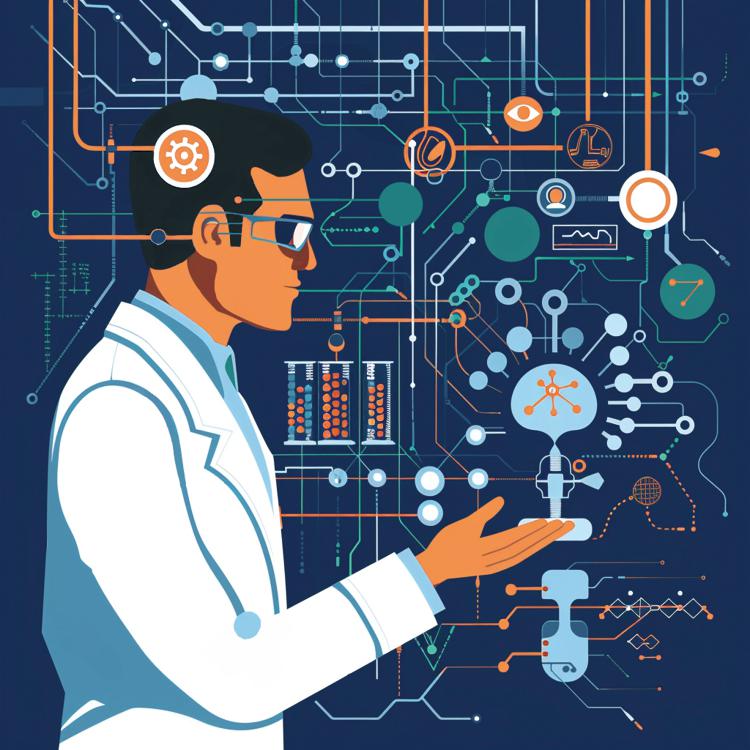
With the rapid development of emerging technologies such as artificial intelligence, quantum technology and biotech, the world stands again at a critical juncture of technological revolution. The new technologies have not only revolutionized the production modes and lifestyles of humanity, but also presented opportunities for transforming the global order. The world has entered a new period of turbulence and transformation. The influence of the new technological revolution is manifested in three aspects.
First, the impact of new technologies on strategic security has prompted some Western countries to politicize technology issues and abuse the concept of security, intensifying the competition between major powers in the technology sector. Advancements in technology have catalyzed a shift in the focus of strategic competition between major powers — from trade to technology. The United States' China-containment strategy has evolved from a trade war into a comprehensive competition in politics, economy, technology, and industry, with "tech-decoupling" becoming the most prominent feature.
Second, the application of new military technologies has tipped the strategic balance between some countries. Featuring military-civilian dual use, advancements in digital, automated, and intelligent military technologies have had profound implications on the global security landscape, which can be seen in the Ukraine crisis and the Palestine-Israeli conflict. Major powers such as the US, the United Kingdom and Russia have proactively scaled up investment in and deployment of new military equipment, which will change the deterrence situation between nations, bring new adjustment to strategic stability mechanisms, and transform the international order.
Third, the escalation in technological competition and the emergence of a new-type arms race between major countries have been compounded by the over-politicization and misuse of the security concept by some Western countries has led to security dilemmas. Consequently, some countries are compelled to engage in crisis management during this period of transformation and turbulence. Against such a backdrop, new mechanisms are urgently needed.
In this shifting international landscape, China is committed to building a more inclusive international order and striving for peace and development. China seeks to constructively improve the current global order by addressing outdated or ineffective elements through enhanced rules and mechanisms.
Currently there is a lack of universally accepted and binding international rules in the field of emerging technologies, and countries are proactively putting forward their own solutions. China, on the one hand, should participate in the formulation of rules for new technologies such as next-generation telecommunications and facial recognition where it takes a lead in the world. On the other hand, it needs to share its experience and insights in new technologies such as generative artificial intelligence, which have high demand for rules, and provide references for drawing up international rules in these fields.
Besides, the new technological revolution has created the demand for building a new global governance architecture, which, however, is still in the making. Out of self-interests and security concerns, some Western countries tend to prioritize competition over cooperation in the fields of technology. But uncertainties involved in the development of emerging technologies have brought about common risks and challenges, and created problems that require concerted efforts to solve, which makes it possible to build a new global governance system. It is important for China to grasp the opportunities in this period to transcend the mentality of competition and build a new technology governance mechanism featuring cooperation, thus pushing for the establishment of a new global order.
Meanwhile, we are witnessing a significant transition in the international order, marked by the phasing out of old structures and the emergence of new ones. This period of turbulence and transformation presents a crucial opportunity for China to share its vision for a cooperative and inclusive future.
At a 2017 speech at the United Nations headquarters in Geneva, Chinese President Xi Jinping elaborated on China's vision of building a community with a shared future for mankind, aiming to create an open, inclusive, clean, and beautiful world of lasting peace, universal security, and shared prosperity.
While retaining the reasonable part of the old international order, China's proposals also aim to reform the old system to accommodate the needs of different social systems and countries at different development stages. From the perspective of international relations, an inclusive international order will make the global system more stable and legitimate, and, from the perspective of the technological revolution, an inclusive international order will be the ultimate solution for problems such as bridging digital gaps, solving algorithm discrimination, and establishing AI ethics.
In short, China should seize the opportunities during this period of turbulence and transformation to push for the implementation of initiatives such as the Belt and Road Initiative, the Global Security Initiative, the Global Development Initiative, and the Global Civilization Initiative with the aim of letting the new technological revolution benefit all countries through technology cooperation, R&D investment, and integration of industrial chains. In this way, the country will help the world cope with common challenges and crises through collaboration and development and jointly establish a more fair and reasonable global order.
Cai Cuihong is a professor at the Center for American Studies at Fudan University. Zhang Luyao is a doctoral student at the School of International Relations and Public Affairs at Fudan University. The authors contributed this article to China Watch, a think tank powered by China Daily. The views do not necessarily reflect those of China Daily.
Contact the editor at editor@chinawatch.cn.