


Exploring the mystique of the 'loong'







April 20 marked the 15th United Nations Chinese Language Day. In celebration of this occasion, a group of international students from Shenyang University of Chemical Technology gathered for a special extracurricular activity to explore the Chinese character for "dragon" — "loong".
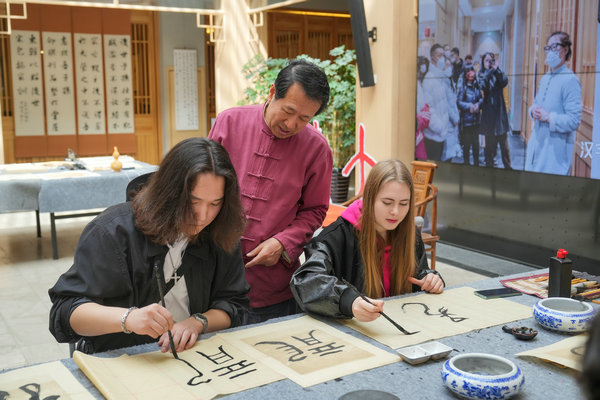
The special lesson took place at a cultural studio in the Laobeishi area of Shenyang, Northeast China's Liaoning province. During the session, Zhang Zhenzhong, an instructor at the studio and a member of the China Calligraphers Association, demonstrated more than 10 forms of the "loong" character, spanning from jiaguwen, the oracle bone inscriptions — China's earliest documented font — to kaishu, the standard calligraphic script commonly used today.
According to Zhang, the character "loong" was selected for this event because this year is the Year of the Dragon, and "loong" is a Chinese national totem. In fact, Chinese people often refer to themselves as descendants of the "loong".
For Phitchapa Prakopjinda, a student from Thailand, the visit to Laobeishi and the studio helped bring to life the Chinese culture that she had previously learned only from textbooks. She pointed out that the special lesson on the character "loong" provided fresh insights into the language.
"I came to realize that the language has undergone a very intricate and exquisite transformation, which I think demonstrates Chinese aesthetics and the inclusive nature of Chinese culture," she said.
Mishell Dorjderem, a Mongolian student, also elaborated on the inclusiveness of Chinese culture, but from a different angle. She was surprised to learn that the mythical creature, the "loong", is a fusion of various animals.
"Mr Zhang taught us that the 'loong' depicted in Chinese legends has the eyes of rabbits, the antlers of deer, and the body of snakes, among other features," she said. "This must be what he means by saying that Chinese is an inclusive language."
Dorjderem also had the opportunity to witness sugar paintings, a traditional Chinese craft where artisans use syrup to create images. She then received a sugar painting featuring the "loong" character. "It was so beautiful that I couldn't bear to eat it," she said.
For Russian student Anna Onuchina, she was only familiar with the simplified Chinese writing of the character "loong" before Zhang displayed the multiple forms of the character.
"I learned in the session that most Chinese characters are hieroglyphs, meaning that they were invented based on how the objects look. I found the 'loong' character in the oracle bone inscriptions full of dynamism — one of them looks like it has a tail shaped like fire, and another has a much larger head," she said.
Zhang emphasized the importance of learning about Chinese characters in mastering the language. "If you truly want to understand the language, you must comprehend the history behind the characters' transformation. They carry over 3,000 years of cultural heritage and transcend time," he said.
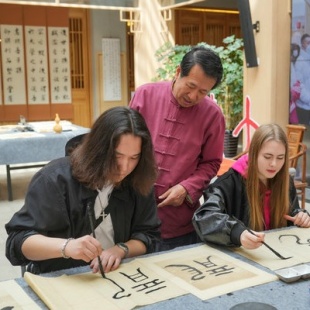
The students also tried writing the character "loong" with a brush, getting a firsthand experience of the beauty of Chinese calligraphy.
Zhang was impressed by the strong interest and active participation shown by the international students from SYUCT. "I was deeply moved by their enthusiasm and amazed by their proficiency in Chinese. The entire session was conducted in Chinese, and they followed along without difficulty," he said.
However, he also stressed that mastering the Chinese language is no simple task, and the students still have a long way to go.
Zhang, who worked as a college professor for years before retiring, views education as a process of "seeding".
"This session merely provided the students with a glimpse into the richness and charm of the Chinese language," he explained. "It's like planting a seed in their hearts. We don't know when or how it will bloom, but hopefully, one day, their interest and understanding of the language will contribute to the preservation of Chinese culture and facilitate cross-cultural communication."