Industrial robot makers gear up for global expansion
With remarkable advances at home, manufacturers look to build on strengths, ambition







At a factory of Sino-Japanese joint venture Dongfeng Honda in Wuhan, Hubei province, over 300 Chinese-made industrial robots weld, shape, fasten and transform raw materials into the contours of a vehicle's body. The process takes a mere 43 seconds, and reduces the exposure of human operators to high temperatures and risks from arc welding.
In China, fostering new quality productive forces has become a key objective under the umbrella of the Industry 4.0 plan, and industrial robots that balance stability and flexibility are crucial to the strategy.
In 2022, China's industrial robot installations accounted for over 50 percent of the global total, with the nation emerging as a powerhouse in the realm of automation. China's manufacturing sector boasts a robot density of 392 units per 10,000 workers, the latest data from the Ministry of Industry and Information Technology showed.
In the past decade, domestically produced robots have found applications in nearly half of the country's key economic sectors. By 2025, China is aiming to double the 2020 density level of industrial robots in the manufacturing sector, the ministry said. The sector's robot density in 2020 was 246 units per 10,000 workers.
Industrial robots now play a crucial role on production lines in industries such as automotive, electronics, food, and pharmaceuticals. By improving production efficiency and precision, industrial robots help enterprises lower costs and elevate their competitiveness, said Song Xiaogang, executive director of the China Robot Industry Alliance.
China's manufacturing sector is characterized by its vast scale and wide variety of categories, yet its level of automation still has room for improvement. This presents significant potential for the expansion of applications for domestically produced industrial robots, which are technologically advanced and cost-effective, Song said.
The industrial robot market in China experienced steady growth in 2023, with sales reaching 316,000 units, representing a year-on-year increase of 4.29 percent, according to a report released by the Gaogong Industry Research Institute.
Domestic strengths
A notable shift in market share between domestic and foreign manufacturers was seen last year. For the first time, domestically produced industrial robots accounted for more than half of the market share at 52.45 percent, according to the report.
Though China has solidified its position as the world's largest industrial robotics market, the country started out by focusing on bridging the gap with established players such as Japan, Germany, and the United States.
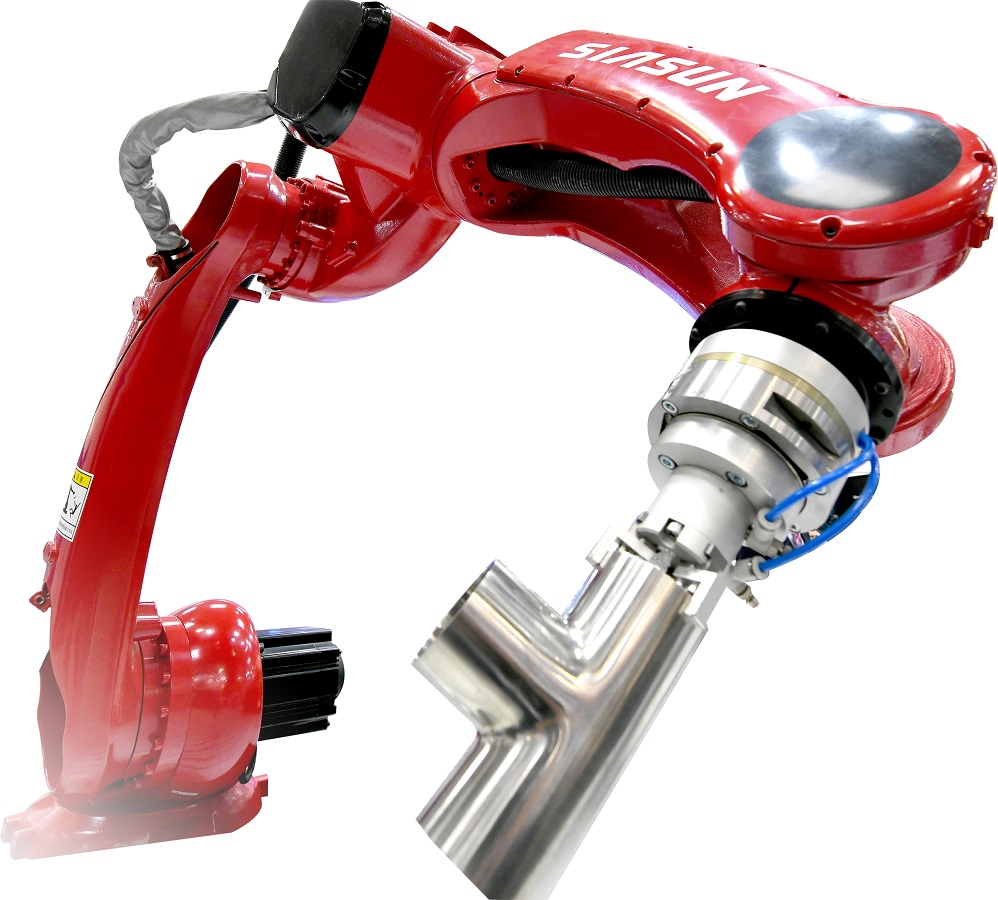
Siasun Robot & Automation Co was one of the first domestic enterprises to delve into research and application of robotics, and broke the long-standing market and technological barriers imposed by foreign products. As early as 2000, their robots were being used in construction machinery and motorcycle manufacturing.
With breakthroughs in multiple core technologies such as force sensors and offline programming, the company's industrial robotics has been widely applied in industries such as electronics, aerospace and engineering machinery. Siasun has also been involved in major national projects like the cross-sea highway project between Shenzhen and Zhongshan in Guangdong province, and the Gezhouba Dam hydropower project on the Yangtze River.
"The advancements have transformed China's industrial robotics landscape, reducing its reliance on imported technologies," said Zhang Jin, president of Siasun, which is located in Shenyang, Liaoning province.
However, despite these advances, international robotics giants such as Fanuc, ABB, Kuka, and Yaskawa, still have a large slice of the domestic market. This is particularly evident in the high-end section of the market, where domestic industrial robots face strong competition.
The global automotive industry, for instance, which accounts for nearly half of the demand for industrial robots, poses significant challenges for Chinese companies seeking to gain a foothold. Established foreign manufacturers currently dominate the industry, making it a daunting task for Chinese companies to carve out a space for themselves, said Yi Mingze, northern regional manager of Zhejiang Qianjiang Robot Co.
Domestic enterprises must prioritize investment in research and development to expand the scope of their core technologies. This approach is essential for reducing reliance on imports, particularly in areas where critical technologies are concerned, said Wang Yaonan, an academician with the Chinese Academy of Engineering.