Feeling pulse of China's tight NEV market from success of newcomer








BEIJING - More and more Chinese car buyers, especially young people, are turning their attention and giving more budget to new energy vehicles (NEVs), which, from my observation, have fancy looks, smart functions, reliable endurance, and cater to the increasingly popular low-carbon lifestyle.
In addition to leading NEV manufacturer BYD and domestic up-rising stars such as Li Auto, NIO and Xpeng, a newcomer born from China's smartphone maker Xiaomi has stirred up a new wave of NEV frenzy.
At the Xiaomi automobile plant in the suburb of Beijing, highly automatic machinery is seen roaring at full steam. Every 76 seconds, a unit of Xiaomi SU7 rolls off the production line. The gigantic modern factory also encompasses display and experience centers as well as area for test drives, including autonomous driving.
On an ordinary weekday, I saw flocks of fanatic customers, mostly young fashion followers, come to experience the car. The delivery counter was even especially moved closer to the door for the convenience of owners who cannot wait to drive the car home.
"I like the color very much, and it is so nice that many design details are special for female drivers," said a Xiaomi fan surnamed Wang who purchased one in the violet color scheme.
Since its official market launch at the end of last month, the NEV newcomer has garnered much attention and popularity. Four minutes after its smash-hit release conference, over 10,000 orders were placed.
Orders are still rising. As of April 24, over 75,000 customers had confirmed their orders. A member of the company's PR team told me that they are sparing no effort to further expand their capacity, because the market performance has exceeded far beyond their expectations.
Seeing from Xiaomi's successful debut in the NEV sector, I feel huge potential of a highly tight market, which is spurred by evolving AI-empowered technologies, improving batteries and, most importantly, rigid consumption demand.
China is already the largest market in the sector, with domestic sales reaching 8.29 million units last year and NEV ownership 20.41 million by the end of 2023. A development roadmap of automobile industry set a goal for the market to achieve a 60-percent penetration rate by 2030 in the country with 486 million car drivers.
The 2024 Beijing International Automotive Exhibition, with 278 types of NEVs on display, offers another window to observe the vitality and undercapacity of this sector. I have browsed floods of short videos about the bustling exhibition on video-sharing and social media platforms these days.
A video clip circulating on the Chinese version of TikTok said the event attracted potential customers from the Republic of Korea and some European countries. A visitor was carefully measuring the size of a car wheel while several vehicle technical staff from Belgium were on all fours to take pictures of an automotive chassis.
Consumers have the final say. Taking Xiaomi SU7 as an example, although it is priced below 300,000 yuan ($42,220), the car is by no means low-end. Price competition is just one form of industrial rivalry; what matters most is the product itself.
China's NEV manufacturers have attached great importance to independent technological progress and have gradually accumulated their competitive edge. Xiaomi founder and CEO Lei Jun said the company spent 19.1 billion yuan on R&D last year and pledged another 24 billion for this year.
As charging facilities steadily improve, more and more NEVs are now racing on the streets across the country, whether in major cities like Beijing and Shanghai or in second- and third-tier cities. Driving NEV is no longer the last choice for Chinese consumers with a limited budget, but a demonstration of personal style.
The visit to Xiaomi's automobile plant also reminded me of the fact that China's vehicle manufacturing has bid farewell to the labor-intensive and energy-consuming traditions.
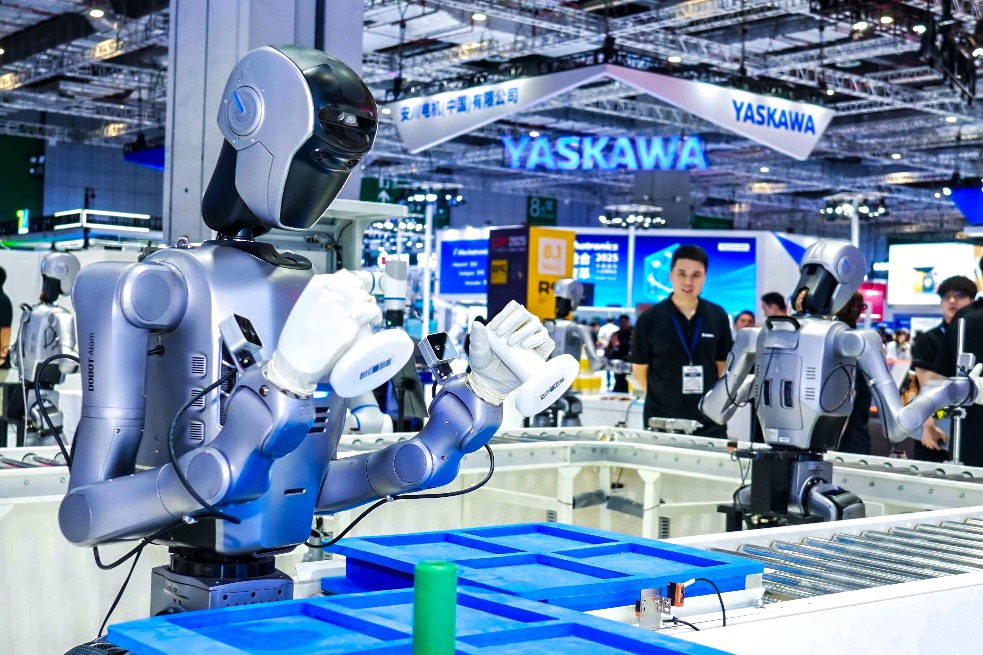
At the assembly workshop, more than 700 robots are operating around the clock. Featuring sustainability and eco-friendliness, the plant is equipped with roofs made of solar panels and renewable production materials, and all its inferior-quality products can be recycled and reused, a PR staff introduced.
As China pursues high-quality development, the burgeoning green industry satisfies the need to cut carbon emission and accomplish carbon peak. I am sure that it will absolutely be a good thing for the world when the carbon neutrality goal is reached in the country with nearly one fifth of the global population.