Young people work to preserve precious past
Institute focuses on protecting ancient Yungang Grottoes for future generations








The Yungang Grottoes in Datong, Shanxi province, listed as a UNESCO World Heritage Site with a history that goes back more than 1,500 years, has attracted a team of young researchers to protect and expand its influence.
As one of the three major grotto sites in China, the grottoes extend about 1 kilometer from east to west, and were all carved out of the mountain.
The 254 extant grottoes consist of 45 major caves and more than 51,000 sculptures from the fifth century, representing some of the oldest carved art in the world.
The Yungang Research Institute, which was known as the Yungang Grottoes Research Institute until 2021, is responsible for protecting, researching, monitoring and exhibiting the Yungang Grottoes, as well as coordinating the development of Yungang studies and the protection of regional grottoes.
At the institute, a group of young researchers are busy restoring the grottoes in an attempt to preserve the precious cultural relics and allow more people to access them.
Through the establishment of archives and a digital technology collection, they conduct comprehensive research of the site and explore methods of protection.
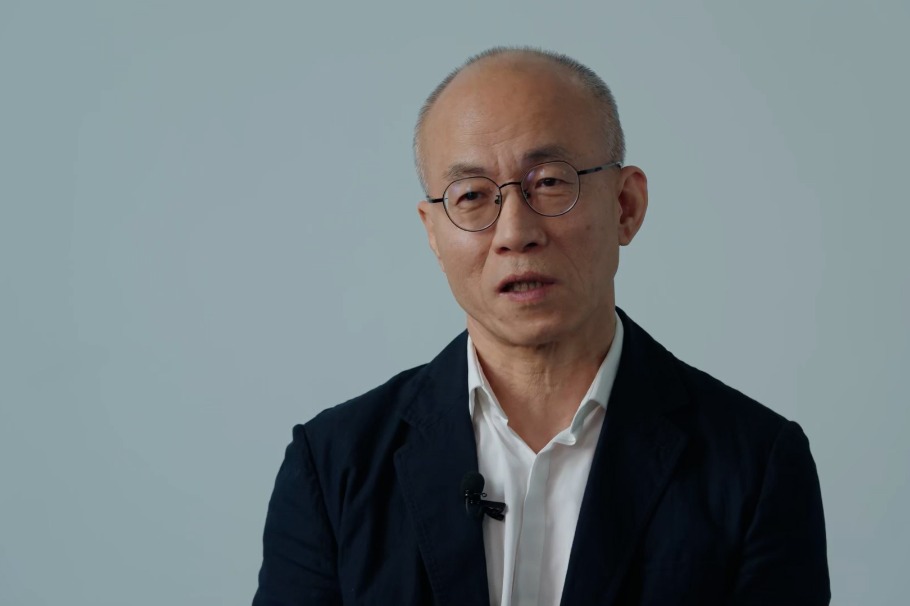
Bent over his desk, Dai Yuxiang carefully used a suction ball to remove white ash from pieces of a mural.
"The suction ball is originally a medical tool used in otolaryngology (the field of ear, nose and throat medical treatment)," Dai said. "During the removal process, it can help me blow away the detached white ash and powder."
Dai, 38, is mainly engaged in the protection and restoration of painted clay murals at the institute. He also gives students lessons on restoration. "My work can be divided into two parts," he said. "We first conduct the restoration on-site. Then, if the mural has been severely damaged, it will be removed and restored indoors."
Sometimes, the restoration work creates pressure for Dai.
In June 2019, Dai participated in the restoration of murals at an ancient tomb from the Northern Wei Dynasty (386-534) in Datong.
"While entering the tomb chamber, we found the murals had suffered extensive detachment and peeling," he said. "Looking at the scattered mural pieces on the ground, we decided to use an archaeological extraction method, systematically extracting the mural layer by layer on the ground in a gridded manner, with each grid corresponding to a box of mural fragments."
Then the team spent nearly seven months restoring the murals to 90 percent of their original appearance.
"After a mural cracks, the edges form a chapped surface, so we used the chapped surface as a guide to piece the fragments together, and factors such as color and lines only serve as auxiliary aids," he said. "Only after gathering the small fragmented pieces into larger ones can the entire mural be reassembled, and then the mural was gradually transferred onto a board."
Although the work is tedious and laborious, Dai has devoted himself to it for over 10 years.
"I often imagine myself as an ancient craftsman from 1,000 years ago, immersed in my work," he said. "I hope I can pass down the skills of mural restoration to my students."
Because of the effects of climate change, the grottoes face irreversible damage year after year.
In recent years, the institute has been promoting advanced digital technologies to allow more people to see the Yungang Grottoes and leave a more complete cultural heritage imprint for future generations.





- Alshaa Badain Jaran Desert promotion event shines in Europe
- Australian scholar finds mission at Yuelu Academy
- CNPC Xinjiang Oilfield celebrates 70th anniversary with milestone
- Chinese vice-premier to visit Uruguay, Brazil and attend Belem Climate Summit as President Xi's special representative
- Chinese defense minister meets US counterpart in Malaysia
- Xi says the world is at new crossroads between unity, hegemonism