Trade barriers in NEV sector criticized
Trade:?Nation treats domestic, foreign carmakers as equals, expert says







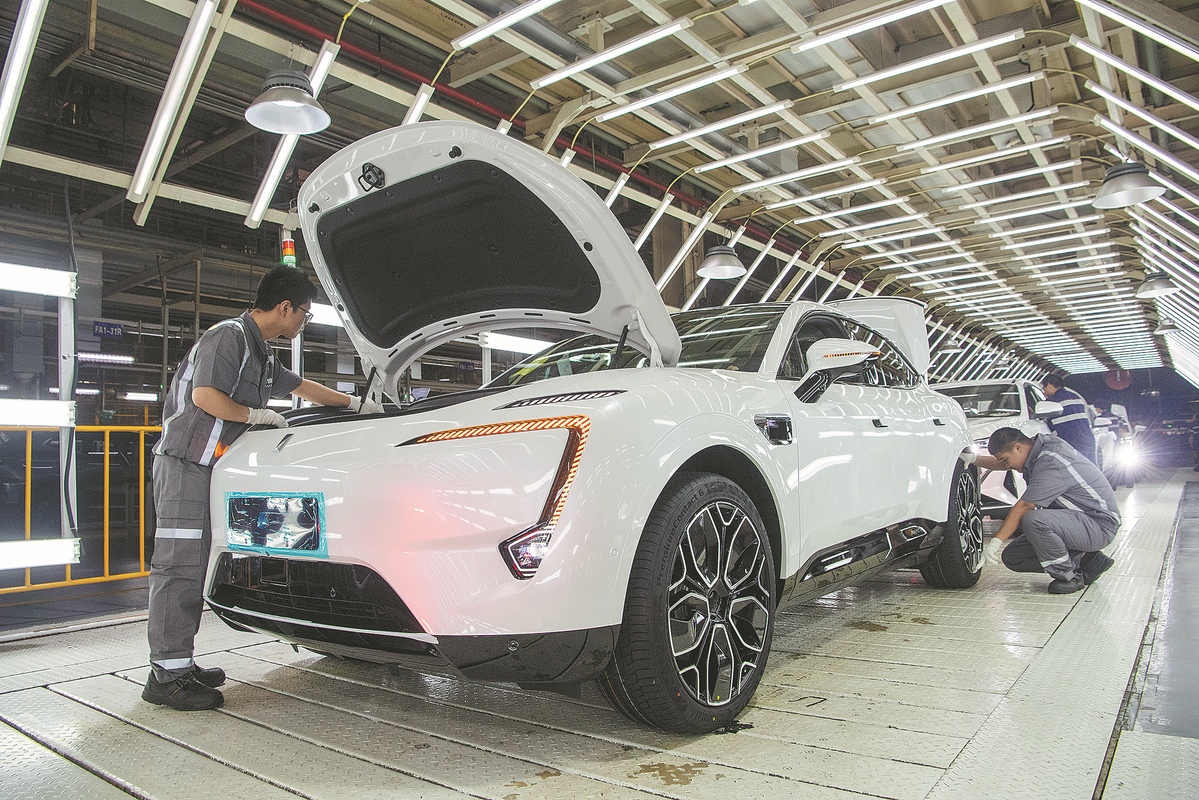
Trade protectionism should never be the main theme of the new energy vehicle sector, an industry so globalized that it requires global vision and openness for its healthy development, said a renowned expert in China's automobile industry.
The United States' ploy to overhype "overcapacity" in China's NEV sector and its national security concerns over Chinese electric vehicles are typical examples of trade protectionism, said Fu Bingfeng, executive vice-president and secretary-general of the China Association of Automobile Manufacturers, in an exclusive interview with China Daily.
"It is palpably irrational to see Chinese NEVs, hailed as a collective creation for the common welfare of humanity, being restricted in the US market," Fu said.
The remarks came amid the news of Washington's possible tariff hike and restrictions on Chinese NEVs.
The Wall Street Journal quoted anonymous sources as saying that the US government is preparing to raise the tariff rate on Chinese EVs from roughly 25 percent to 100 percent.
Last week, Reuters also reported that US Commerce Secretary Gina Raimondo said the country could take "extreme action" and ban or impose restrictions on Chinese connected vehicles after the completion of a national security investigation.
Fu said it is very common to find differences regarding legal frameworks and consumption preferences when an industry enters different markets. "This is what makes dialogue and communication extremely important."
He said that when smart vehicles enter the global market, they should integrate with local laws and consumer habits, and they also require certain levels of redevelopment to better suit local preferences such as privacy protection. "However, these issues cannot be resolved through trade barriers or protectionism."
Fu said the association has noticed that many countries hope that China's automobile supply chain can extend overseas, including to Europe and Southeast Asia, in order to help develop local automotive industries, drive local employment and form new patterns of common growth.
Experts noted that in contrast to the US' hostile attitude toward Chinese NEV makers, including the possibility of banning them without any factual evidence to prove their risks, China has always shown openness toward foreign EV companies.
US carmaker Tesla, along with five Chinese carmakers, cleared a key data security test in China conducted by the association and a national computer network center in April, which proves how communication can help dismiss data security concerns regarding EVs, they said.
Fu emphasized that China treats domestic and foreign carmakers as equals. "Ensuring automotive data security through tests is a new starting point in promoting the healthy development of intelligent vehicles," he added.
Tao Lin, vice-president of Tesla, said the company's rapid growth in China over the past decade cannot be separated from the country's policy support and favorable business environment.
With unmatched advantages and vast prospects, China is a "must-have" market for the US company, Tao said.
China has been the world's largest NEV market for nine consecutive years. Latest data show that in April, the production of NEVs reached 870,000 and sales touched 850,000, up 35.9 percent and 33.5 percent year-on-year, respectively, indicating vigorous growth potential in the domestic market.
On the "overcapacity" issue hyped by some Western politicians and media, Fu called for a more objective and open-minded view.
"A global perspective is a must to understand and support changes and development in a highly globalized industry like automaking, rather than viewing a specific market's production capacity in isolation," he said.
According to the International Energy Agency, annual EV sales are projected to reach 45 million units by 2030, more than four times the demand in 2022.
"Given the development pattern of the automotive industry, maintaining the production capacity utilization rate at a relatively moderate level, typically between 70 percent and 90 percent, is considered a reasonable range," Fu said.
Data from the National Bureau of Statistics show that the capacity utilization rate of China's automobile manufacturing industry stood at 76.9 percent in the fourth quarter of 2023.
Contact the writers at masi@chinadaily.com.cn