Leverage critical minerals for Africa's growth







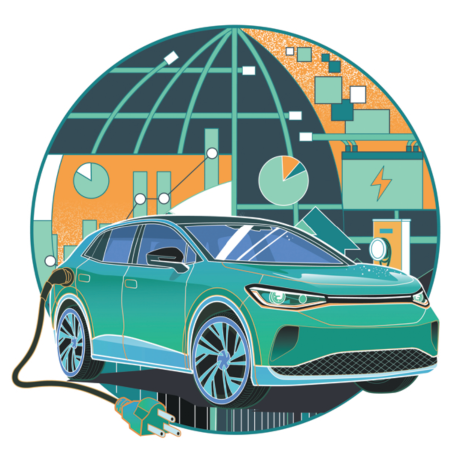
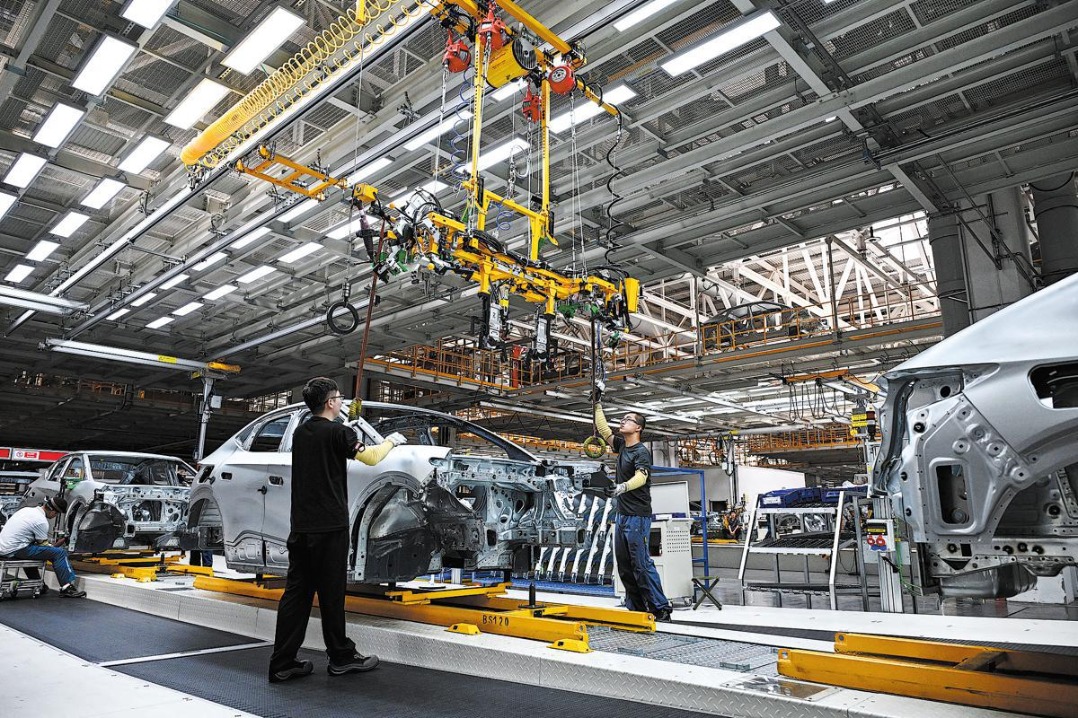
Amid the ongoing historic "Fourth Industrial Revolution", technology conflicts have been intensifying. Recently, US and EU officials have criticized China for overproducing electric vehicles. In mid-May, the US even decided to raise tariffs on Chinese EVs. From such statements and their subsequent rebuttals, it became evident that in just less than a decade of being blamed for polluting the planet as the "world's factory", China has made a great leap, from being overly dependent on fossil fuels to becoming the global leader in green technologies. For example, Chinese-made EVs have become globally competitive in all respects — from design to efficiency to pricing.
At the Beijing automobile show in April and May, another significant event of the month, it was Chinese-made EVs that were trending. Apart from acknowledging the Chinese automakers' unparalleled advancement, some European and US automaker executives said they have lost some of their best designers to Chinese enterprises because of agility, resources and the advancement made in research and development.
One executive said that in China there are battery exchange stations, meaning you do not have to worry about the hours of charging, and even for that, the rapid rollout of charging infrastructure means consumers have fewer troubles to worry about. This discussion reminded me of the concerns by EV owners in Rome who are bitter about the lack of charging infrastructure, compounded by the exorbitant costs of electricity.
The Chinese reply to dumping allegations is simple: China has transitioned into advanced manufacturing which has led to significant breakthroughs in our production capacities using artificial intelligence.
Add to that the scale of the Chinese EV market, and it makes sense that their products are price competitive. It is understandable therefore that in April, the world's leading EV maker, Tesla, decided to reduce prices, taking tech and price competitions to extraordinary levels.
There is a view that more collaboration, instead of rivalry, between China and the US, the two major powers in AI, will benefit the whole of humanity, because many countries can leverage their capabilities and investments to promote sustainable development. Perhaps we will live long enough to write about the realization of this dream.
Tech revolution brings new cooperation opportunities
As a native of Africa, my most profound AI moment was the UN-convened panel in April on the value chains of critical energy transition minerals. This intervention by the UN is as revolutionary as the AI era itself.
First, the advances in technological products referred to above depend on the availability and access to critical minerals. Batteries powering EVs need lithium to store energy, cobalt to improve battery life, nickel to enhance storage and efficiency, and graphite and manganese to improve performance.
Africa has the largest deposits of these minerals. Some are in Canada and China. Solar energy production, which plays a significant role in the just energy transition, relies on materials such as silicon, silver, copper, gallium, indium and tellurium. Without Africa's critical minerals, the world's rapid transition to solar energy will be slowed, if not derailed. Therefore, for the just energy transition to occur, and to win the "Fourth Industrial Revolution" race, Africa's contribution is critical.
There have been widespread reports that in central and west Africa, critical minerals are being exploited along with the communities and countries where they are mined.
The UN intervention is therefore most welcome. For many years now, I have dreamed of the "Kimberly Process 2.0". The Kimberly Process, which the UN played a major role in, was South Africa's contribution to making the global diamond trade more humane. Through it, the world joined forces to eliminate blood diamonds, which spilled blood in Africa while sparkling in capitals of the Global North. This process introduced an accountability system whereby diamonds sold in the open market can be traced back to their origin, significantly reducing conflict and plunder of African resources, thus helping to end wars in countries such as Liberia and Sierra Leone.
Of late, Botswana waged a successful struggle against the diamond monopoly, De Beers, when renegotiating a joint venture deal that compelled the company to add value to the diamonds before exporting them to Europe for further processing. Kimberley, a town in South Africa where diamonds were first mined extensively, gave the name to this initiative.
This new UN initiative should be welcomed, not only because it fulfills many people's dream of implementing the Kimberley Process for all rare earth and critical minerals to minimize conflict, but more so because Africa can use what I would like to refer to as the "Kimberley Process 2.0" to transform their economies. African countries should convert this comparative advantage — they have what others lack — into a competitive advantage by setting strict mining conditions.
These conditions should include beneficiation, investment in bulk infrastructure, skills and technology transfer, as well as environmental protection. Those are basic conditions for industrialization. We cannot mine products to help decarbonize the world while leaving long-lasting environmental, social, political and economic scars in Africa.
There is great potential for mutually beneficial action. Partners such as China can lead the way by joining the Kimberley Process 2.0 and working with Africa to help industrialize the continent's countries while ensuring the just energy transition is shared by entire humankind.
The author is a visiting professor at Fudan University and director-general of the National School of Government of South Africa.
The views don't necessarily reflect those of China Daily.
If you have a specific expertise, or would like to share your thought about our stories, then send us your writings at opinion@chinadaily.com.cn, and comment@chinadaily.com.cn.