The tide of history
Play focusing on family upheaval set for nationwide tour, Cheng Yuezhu reports.







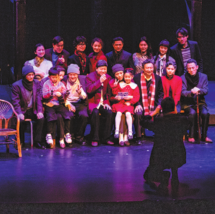
Playwright and theater director Stan Lai is about to take his magnum opus, The Village, a story about migration and love, on a tour around the country, telling the real experiences of a particular group affected by the tides of history.
After the War of Liberation (1946-49), a group of people from across the Chinese mainland relocated to Taiwan, settling in temporarily built villages, with the hope of returning to their hometowns soon, yet ended up spending the next four decades there.
TV producer Wang Wei-chung grew up in such a village, collectively called juancun (military dependents' villages). In 2005, when these cantonments were about to be demolished, Wang contacted Stan Lai, whose father went to Taiwan from Jiangxi province's Huichang.
Together, the two collected and compiled more than 100 real-life experiences of 25 families who had lived in these villages. These stories were then condensed into three fictional families in the play.
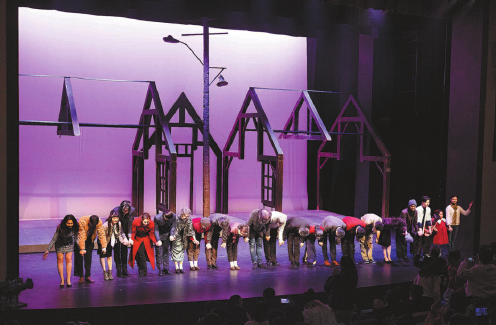
Premiered in Taiwan in 2008, The Village was first performed on the Chinese mainland two years later. As Lai and the cast members recall, despite their uncertainty, the performance in Guangdong province's Guangzhou received a six-minute standing ovation.
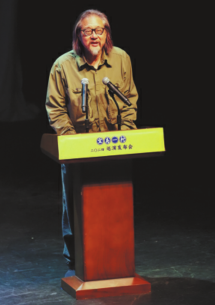
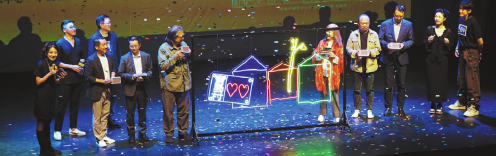
A news conference for the 2024 tour of The Village was held at the Beijing Tianqiao Performing Arts Center on May 20, releasing the tour's schedule and marking the launch of ticket sales.
Starting from Lai's own theater venue Theatre Above in Shanghai on July 19, the play is scheduled to tour six other Chinese cities, including Beijing, Fujian province's Xiamen, Guangdong province's Foshan and Jiangsu province's Suzhou, until the end of August.
"There are no longer military dependents' villages in Taiwan. Actually, there is a single one left, and that is The Village. This story needs to be told. And I believe that all Chinese people should see this story, because it represents a genuine part of history that might be lost if left untold," Lai says.
"These people we have depicted may not have been glamorous, but they have occupied a place in history for just a few decades. Their experiences have woven a unique narrative."
For this tour, the cast features a mix of Taiwan performers, some of whom were from the original cast in 2008, with young performers from Theatre Above, founded by Lai in 2015.
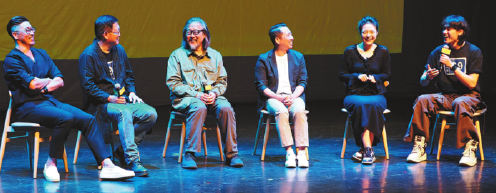
At the conference, cast members shared their stories of participating in the production and their own understanding of the characters and the plot.
Taiwan actors Chu Chung-heng, Feng Yi-kang and Sung Shau-ching, from the original cast, made a pact that they, representing the three families in the play, would never say no to performing. They have remained dedicated members of the play for the past 16 years.
Both Chu and Feng were born and raised in the military dependents' villages. According to Lai, both actors heard of the play's conception in 2008 and volunteered to participate right away.
Feng says that when he first played the role of Uncle Zhu, he put in a lot of effort to contemplate, design and enact the character. At the time, Lai told him the character is someone from the northern part of China. In his experience of growing up in his village, many residents were from Shandong province, so he chose to adopt the Shandong accent for the character.
"I've played this character for 16 years. Now that I've turned 60, I feel that I've become Uncle Zhu. This transformation has been a wonderful experience for me, both as an actor and as a person. I've worked hard to portray a character, and to truly embody him over more than 10 years," Feng says.
Si Wen, a young actress with Theatre Above, has performed many roles in Lai's classic plays. She says that for this tour, the rehearsals have allowed her to work together with and learn from the veteran theater practitioners.
"They have shared with us many true stories that have happened in these villages. I've learned so much, especially as a relatively young performer without those real-life experiences," Si says.
"I've lived at different places around the country, so I try to infuse my own emotions into my acting. From this play, I feel that I'm very fortunate to live in this era, and it has taught me to cherish life and live in the present."





Today's Top News
- Japan tempting fate if it interferes in the situation of Taiwan Strait
- Stable trade ties benefit China, US
- Experts advocate increasing scope of BRI to include soft power sectors
- New engine powers cargo drone expansion
- China to boost green industry cooperation
- Manufacturing PMI rises in November