


Culture Insider: Dragon Boat Festival







The 5th day of the 5th month of the lunar year is an important day for the Chinese people. The day is called Duan Wu Festival, or Dragon Boat Festival, celebrated everywhere in China. This festival dates back to about 2,000 years ago with a number of legends explaining its origin. The best-known story centers on a great patriotic poet named Qu Yuan.
Qu Yuan and Dragon Boat Festival
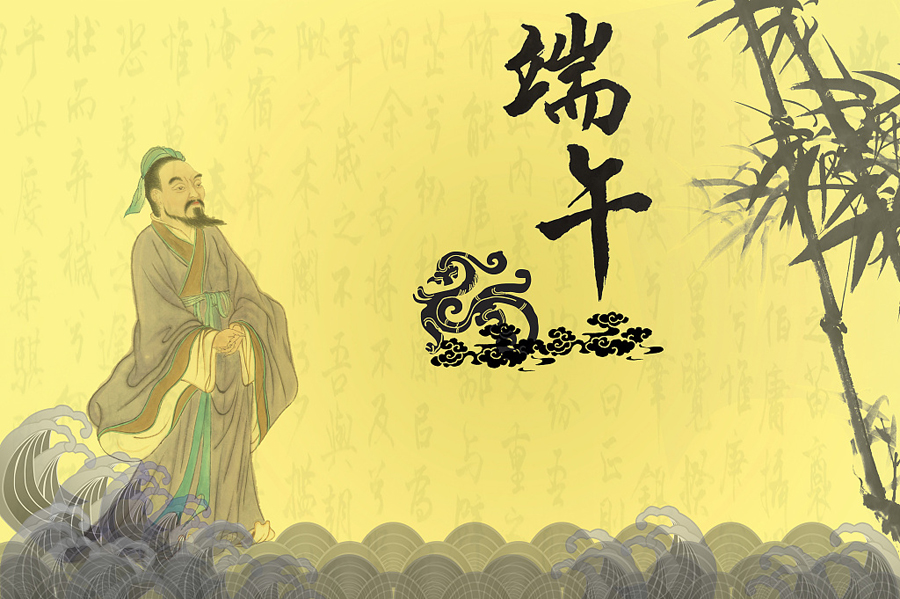
In the Warring States Period (475-221BC), the State of Qin in the west was bent on annexing the other states, including the state of Chu, home of Qu Yuan. Holding the second highest office in the state, Qu Yuan urged that the Chu State should resist Qin and ally with the State of Qi to the east. This was opposed by Zhangyi, a minister of the State of Qin who was trying to disrupt any anti-Qin alliances. He seized upon an incident with a jealous court official in Chu to get rid of Qu Yuan.
Qu Yuan had refused to let Jin Shang, the chief minister in the State of Chu, have a look at a draft of a decree he had been asked to draw up. In anger Jin spread the rumor that Qu Yuan was leaking state secrets. He said that Qu Yuan had boasted that without his aid no decree could be drafted. This made the King of Chu feel that Qu Yuan was belittling him.
When the story reached the ears of Zhang Yi in Qin, he secretly sent a large amount of gold, silver and jewels to Chu to bribe Jin Shang and the king's favorite concubine to form an anti-Qu Yuan clique. The result was that the King of Chu finally banished Qu Yuan from the capital in 313 BC.
The next year, as relations between Qin and Chu worsened, Qu Yuan was called back and named to a high office, but the clique continued its machinations against him.
In 299 BC after several unsuccessful forays against Chu, Qin invited the King of Chu over, ostensibly for talks. Qu Yuan feared this was a trap and urged his king not to go. The latter would not listen and even accused Qu Yuan for interfering.
On the way, the King of Chu was seized by Qin troops. He died in captivity three years later. Chu came under the rule of the king's eldest son, later known as King Qing Xiang. Under him the state administration deteriorated.
Qu Yuan hoped to institute reforms and in poems satirized the corruption, selfishness and disregard for the people on the part of dubious characters who had achieved trusted positions. Neither this nor Qu Yuan's resolve to resist Qin set well with King Qing Xiang, who was in fact married to a daughter of the King of Qin, In 296 BC, Qu Yuan, then in his mid 50s, was banished for the second time. Grieving for the condition of his homeland, for years he wandered about south of the Yangtze River.
During this period he poured out his feelings of grief and concern for his homeland in the allegorical Li Sao, a long autobiographical poem in which he tells of his political ideal and the corruption and mismanagement of the court.
In 280 BC Qin launched an overall invasion of Chu, and captured the Chu capital in 278 BC. The news reached Qu Yuan while he was near the Miluo River in today's northeastern Hunan Province. In frustration at being unable to do anything to save his state, he clasped a big stone to his breast and leaped into the river to end his life.
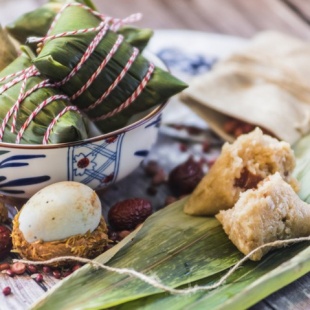
Qu Yuan's sufferings had gained the sympathy of the people of Chu. In memory of him, every year on the fifth day of the fifth month of the lunar calendar, the day he drowned himself, dragon boat races, which are said to represent the search for his body, are held, and the Chinese people eat Zong Zi, little packets of glutinous rice wrapped in bamboo leaves, which was originally thrown into the river to keep the fishes from eating the body of Qu Yuan. In addition, it is said that when hearing the news of Qu Yuan's suicide, some doctors poured realgar wine into the Miluo River to anaesthetize the fishes, hence preventing them from eating Qu Yuan's body.