


Painting across borders








"Ren is a master of his chosen craft, working with pigment and ink on paper. However, the means by which he has chosen to work also gives these materials a great voice in its ultimate form," says Jay Coogan, then-president of the Minneapolis College of Art and Design in Minnesota.
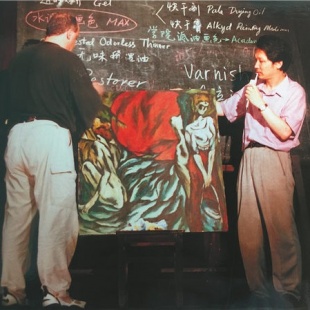
One of the materials Ren adopted was acrylic paint. The mostly water-based, fast-drying paint has been widely used by Western artists since the 1960s, but Chinese artists had no access to it until the late 1990s.
Ren says he felt that needed to change.
"Art exchanges took place in many forms. How could Chinese artists keep abreast of their Western peers without access to the same materials?" he says.
He spent six months in 1997 touring six American acrylics factories, lobbying for free samples. They eventually agreed to make products for Chinese artists.
"The first package of $50,000 worth of acrylic paints was delivered to China, enabling my counterparts there to catch up," Ren says.
Ren continues to explore new ways of amplifying China-US art communications. For more than 30 years, he has arranged bilateral academic exchanges, facilitated visits by scholars and artists, and in recent years, has launched accredited programs taught by internationally renowned scholars and artists.
Ren says that he sees the need to establish a globalized, high-level art education mechanism through which Chinese and Western professors and artists would be able to work together to teach, mentor and supervise students.
"As the world's second-largest economy, China needs to match its economic strength with a culturally abundant art education that communicates smoothly to the West," he adds.
In 2017, he pushed for the creation of an international program at the China Academy of Art. A year later, he started a doctoral program at the Shanghai Academy of Fine Arts and became the head of its faculty.
"I am now like a talent hunter — all American professors, colleagues and stellar artists are on my radar," says Ren, adding that he has visited art schools, museums and galleries around the US to keep abreast of the latest trends.
French artist Charlotte Jeanningros is part of the doctorate program. She chose to attend the Chinese university because she believes that art offers the possibility of transmitting a vision of the world and of countries and cultures, from different angles, and above all, of sharing these visions.
Unlike traditional art programs, the workload at the Shanghai academy for international students is "tedious and daunting", as Ren puts it, because the international program has set a lofty benchmark for the training of professionals.
Jeanningros sees its value differently. "The great asset of this program is the professors. They also come from different backgrounds and all have great experience and a high level of expertise. They are truly fascinating and yet they remain very close to and invested in us. I feel a great familiarity and solidarity from everyone in this program," she tells China Daily.
"When it (exchange) starts, we remain determined and uninterrupted. Inspiringly, there are so many like-minded people in China and America along the road," Ren says.
At a lecture organized by Ren in May, Matt Saunders, a professor at the Art, Film and Visual Studies Department at Harvard University, spoke about the Ivy League school's experiments in art and film pedagogy to hundreds of Chinese art scholars and students.
"I am very happy to share our experiment at Harvard and ready to learn about what's happening in China," he told attendees from Peking University, the Central Academy of Fine Arts and the Sichuan Fine Arts Institute, among others, expounding on American visual and environmental studies.
Jin Jiangbo, deputy dean of the Academy of Fine Art at Shanghai University and host of the seminar, extended an invitation to Saunders to visit the school.
"Anytime you are ready, we are here to welcome you," Jin said.