Renewable energy use on the rise nationwide







China's utilization of renewable energy has either reached or exceeded advanced international levels, reflecting its rapid progress in the field of sustainable energy, according to a recent report.
The adoption of renewable energy in the country has continued its momentum over the past few years, with a utilization rate of 97.6 percent — surpassing 95 percent for six consecutive years since 2018 — said Ye Xiaoning, senior engineer at the new energy department of the State Grid Energy Research Institute.
This is comparable to the levels seen in developed countries such as Germany, Ye said during the release of a report on China's new energy power generation by the institute in Beijing.
China's advancements in renewable energy highlight its determination to reshape its energy landscape, while achieving or exceeding international advanced standards reflects its improving credentials in the global renewable energy arena, he said.
The government has played a key role in this progress through supportive policies and substantial financial investments, Ye said.
According to the report, China's renewable energy generation reached 1,469.1 billion kilowatt-hours last year, a year-on-year increase of 23 percent, accounting for 15.8 percent of the total power generation, an increase of 2.1 percentage points compared to the previous year.
According to the report, the country has entered the high proportion renewable energy stage predicted by global institutions such as the International Energy Agency, with the proportion of renewable energy generation in nine provinces exceeding 20 percent of electricity consumption, especially in the provincial-level regions of Qinghai, Gansu, and the Ningxia Hui autonomous region.
"China's renewable energy sector has now become the primary source of additional power generation, with newly installed capacity doubling year-on-year," Ye said.
The report showed that the cumulative installed capacity of renewable energy nationwide has surpassed 1 billion kilowatts by the end of 2023, accounting for 34 percent of the total installed power generation capacity nationwide, a significant milestone highlighting the country's shift toward sustainable energy.
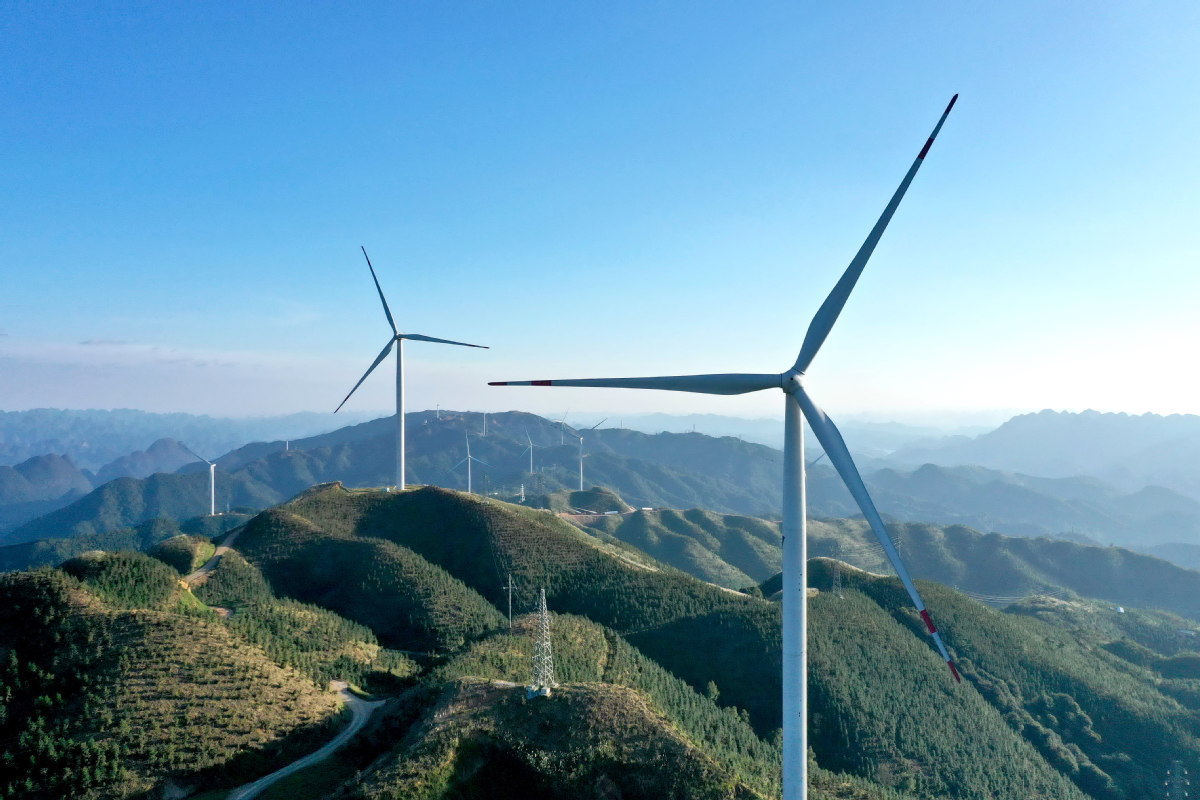
Among these, wind power installations have reached 440 million kW and solar power installations have reached 610 million kW, ranking first in the world for 14 and 9 consecutive years, respectively, accounting for about 43 percent and 42 percent of the global total, it said.
The newly installed capacity of renewable energy rose to 290 million kW last year, 2.4 times that of 2022, accounting for 79 percent of the total new power generation capacity nationwide, and has become the main source of new power generation capacity.
"In 22 provincial-level regions including Hebei and Ningxia Hui autonomous region, the proportion of renewable energy installed capacity exceeds 30 percent, with Qinghai and Gansu having over 60 percent of their installed capacity from renewable energy," said Ye.
The surge in renewable energy capacity also leads to significant investments in solar, wind, and hydropower projects across the country, part of China's broader strategy to peak carbon emissions before 2030 and achieve carbon neutrality before 2060, he added.
Lu Zongxiang, an associate professor with Tsinghua University, said the country must ensure sufficient energy supply as it advances toward its carbon goals.
"Considering the fact that most new energy sources are intermittent and characterized by rapid and unpredictable variations, it is necessary to ensure sufficient power supply in times when the wind doesn't blow and the sun doesn't shine," he said.
Lu said that investment in infrastructure construction, including energy storage facilities as well as grid upgrades and expansion, will be crucial in accelerating China's transition to green and low-carbon energy in the coming years.
According to a plan jointly issued earlier this month by the National Development and Reform Commission and the National Energy Administration, China will increase financing for emission reduction projects at coal-fired power plants.
Construction on some of the projects, which will include green ammonia and the burning of biomass, will start next year, with a goal of reducing emissions by 20 percent for each unit of power generated. China will also leverage carbon capture and storage to lower emissions.
The emission reductions from the upgrades should be 50 percent by 2027, compared with the 2023 levels, it said.
China's progress in this field is expected to positively influence global energy markets and foster further international collaboration in the fight against climate change, Ye said.