Used goods market eyes fresh growth
Green-minded young consumers see virtue, value in secondhand items







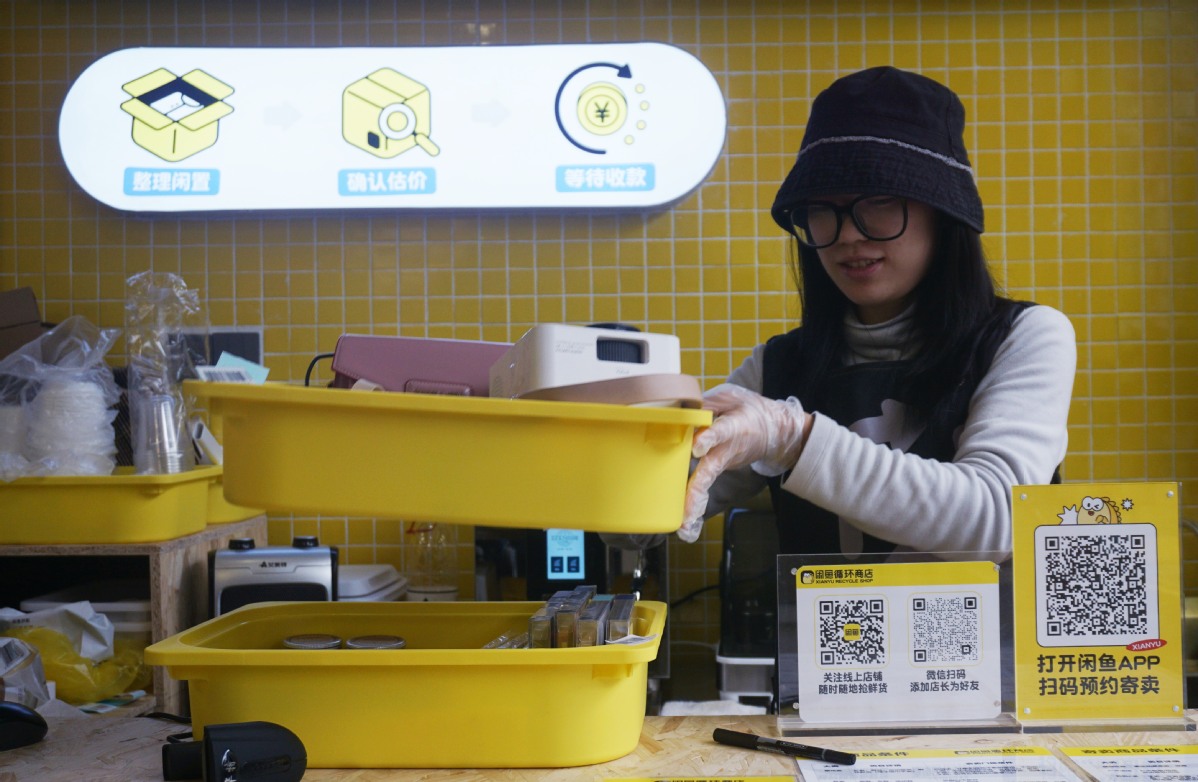
China's secondhand goods trading sector is on the cusp of a new stage of growth as young, internet-savvy shoppers, who are also environmentally conscious, are inclined to use or share such goods and buy the relatively cheaper products online, experts said.
China's latest measures to boost large-scale equipment renewals and trade-in deals for consumer goods, they said, will further stimulate purchasing appetites of consumers, unleash domestic demand potential and consolidate the foundation for a rebound of the economy.
Ding Jian, president of Xianyu, Chinese tech heavyweight Alibaba Group's online trading platform for secondhand goods, said an increasing number of young Chinese consumers are paying more attention to green, sustainable consumption, and regard the purchase of secondhand goods as a thrifty, environmentally friendly way to shop.
Ding said Xianyu will cooperate with the government departments concerned to speed up the establishment of the standards concerning secondhand trading system, and further boost the efficient recycling and utilization of idle items and reduce carbon emissions.
Xianyu, he said, will further leverage digital technologies like artificial intelligence to continuously enrich and innovate the forms of, and mechanisms for, trading in secondhand items. It will also promote the circulation and reuse of idle resources, and bolster trade-in deals for consumer goods.
In late July, China said it will allocate about 300 billion yuan ($42 billion) in ultra-long-term special treasury bonds to support large-scale equipment upgrades and trade-in activities for consumer goods, aiming to further tap into the potential of domestic demand.
According to a notice jointly issued by the National Development and Reform Commission and the Ministry of Finance, about half of the planned bond funds will be used to support trade-in deals for consumer goods.
Ding said the recent trade-in program will encourage consumers to replace old consumer goods with new products that are more environmentally friendly, energy-saving and highly efficient, which will give a strong boost to the circulation of idle goods, adding China's secondhand goods market and the circular economy are expected to usher in new development opportunities.
Ding said Xianyu's daily active users have grown continuously over the past quarters, making him bullish on the prospects of the country's fast-developing secondhand trading sector. Launched in 2014, Xianyu has become one of the largest online trading platforms for used goods in China, with accumulated users reaching over 500 million. On average, more than 4 million such products are posted on the platform every day.
The value of China's used goods market transactions surpassed 1 trillion yuan in 2020, and will reach 3 trillion yuan in 2025, according to a report from the Institute of Energy, Environment and Economy of Tsinghua University.
Hong Yong, an associate research fellow at the Chinese Academy of International Trade and Economic Cooperation's e-commerce research institute, said the recent consumer goods trade-in program is conducive to weeding out consumer goods with high energy consumption and declining performance, further stimulating consumer spending appetites and injecting new momentum into economic growth.
Industry insiders said the trading of underutilized or unwanted goods — an important part of the circular economy — can effectively promote the efficient utilization of recyclable resources in China, help achieve the country's dual-carbon goals and foster green, sustainable development.
Mo Daiqing, a senior analyst at the Internet Economy Institute, a domestic consultancy, said, "The country's secondhand market, which is still nascent, has huge growth potential, and the penetration rate of online recycling and trading platforms is still relatively low."
Mo called for efforts to bolster the standardized and regulated development of the secondhand goods market, carry out third-party identification aimed at some used goods with high value, improve the discarded goods recycling network and enhance the processing and utilization of renewable resources.
The circulation and reuse of secondhand items can greatly reduce carbon emissions, Xianyu said, adding its users collectively helped reduce carbon emissions by 6.59 million metric tons between April 2023 and March 2024.
Li Xiang, head of Xianyu's ESG — environmental, social and governance — practices, said the company expects to serve more than 1 billion users and help drive carbon emission reductions of more than 55 million tons by 2030.