Japan's nuclear plea lacks usual emotive power: China Daily editorial








Seventy-nine years ago on Aug 9, a United States B-29 bomber dropped an atomic bomb on the Japanese city of Nagasaki, killing around 40,000 people in an instant, and another 30,000 from radiation poisoning by the end of the year.
Three days before that, a nuclear weapon was used for the first time, when the US dropped an atomic bomb on the Japanese city of Hiroshima, killing some 70,000 people instantly, and tens of thousands more from radiation poisoning within a year.
Those have been the only times nuclear weapons have been used in war since their development. The deaths and devastation they caused led to the establishment of what was intended to be a strict international regime to prevent the proliferation and use of such lethal weapons of mass destruction.
Despite the obvious impossibility of abolishing nuclear weapons any time soon, a global consensus has been maintained against their proliferation and use.
The annual memorial events in Hiroshima and Nagasaki have thus become fitting occasions for the international community to renew the collective commitment to this regime and a future free of nuclear weapons.
Japan, as the first and only victim of nuclear attacks to date, has taken advantage of the ordeal to remind the rest of the world of the horrors of a nuclear apocalypse. And rightly so.
At Tuesday's commemoration, citing "an imminent risk to human survival", the mayor of Hiroshima described the abolition of nuclear weapons as "a pressing and real issue that we should desperately engage in". Japanese Prime Minister Fumio Kishida vowed to do his utmost in pursuing "realistic and practical measures" to build momentum toward that goal within the international community.
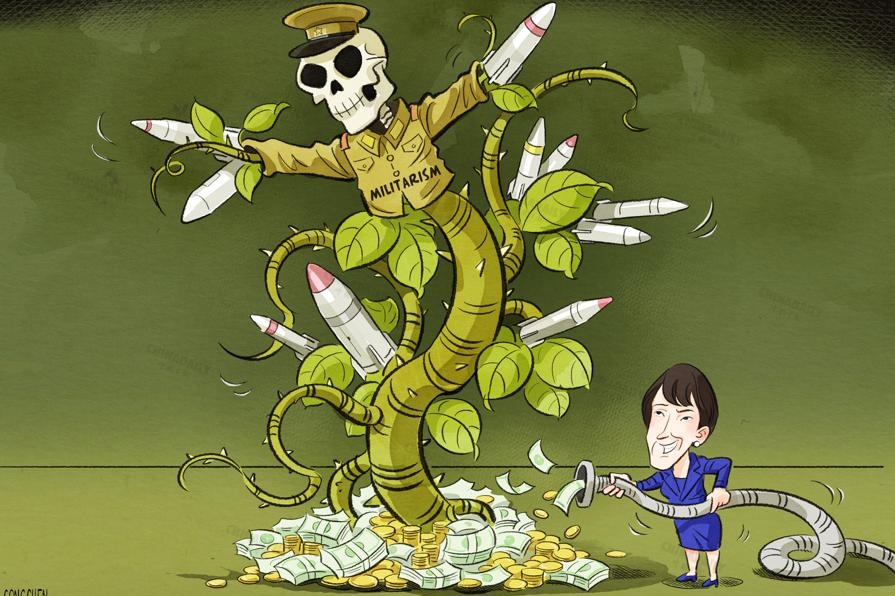
But such rhetoric does not ring with the same emotive power this year as it used to, given Japan's own renewed embracing of nuclear weapons.
While Japan has adopted and upheld the Three Non-Nuclear Principles, under which it has pledged non-possession, non-production and non-introduction of nuclear weapons, it has not forsaken the US' extended nuclear deterrence as an integral part of its security guarantee.
It did a disservice to the commemorations' no-nuclear plea that came just days after Tokyo and Washington reaffirmed the latter's commitment to "extended deterrence", which includes nuclear weapons, for the former's protection.
No wonder the Russian ambassador to Japan said on Monday the US-Japan alliance is posing a nuclear threat to its neighborhood. The Russian diplomat put Kishida's strong support for the so-called extended deterrence as "particularly cynical" given the anniversary of the atomic bombings.
Tokyo cites Russian threats of the use of nuclear weapons in its ongoing conflict with Ukraine as well as the Democratic People's Republic of Korea's development of nuclear weapons to support its need for the US' nuclear security umbrella.
To the general public, particularly people in neighboring countries, however, Japan's calling for the abolition of nuclear weapons appears conspicuously ironic this year given it is discharging nuclear-contaminated water into the ocean in open disregard of nuclear safety. Immediately following the passionate appeals from Hiroshima, Japan started its eighth release of such water from the Fukushima Daiichi Nuclear Power Plant. Reportedly, 7,800 tons of wastewater will be discharged by Aug 25.
A spokesperson for the Chinese Embassy in Tokyo has criticized the Japanese side for being "irresponsible" by ignoring international concerns. Multiple countries, including China, have expressed concerns about the safety of the discharges, the long-term reliability of the purification facilities, and the effectiveness of monitoring arrangements.
It is fully justified for China to urge Japan to cooperate in setting up an independent international monitoring mechanism and allowing the substantive participation of stakeholders.
The discharge of nuclear-contaminated water from the Fukushima nuclear power plant "is by no means a private matter of the Japanese family"; it concerns the global marine environment and the health of all humankind.