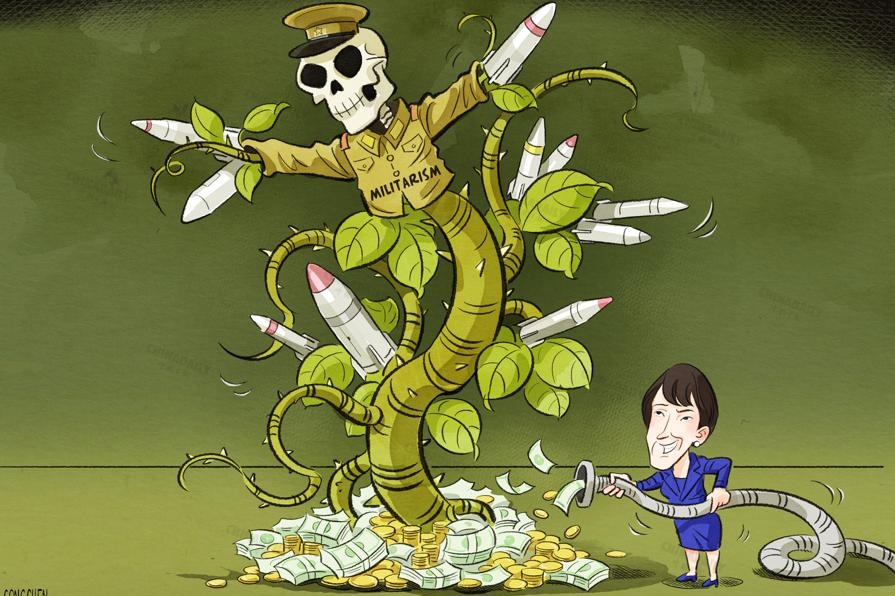
US nuclear strategy change alarming: China Daily editorial







China has traditionally maintained a policy of minimum deterrence regarding its nuclear weapons arsenal. This means its nuclear strategy focuses on having a sufficiently small nuclear force to deter potential adversaries from attacking China with nuclear weapons.
China has also been steadfast in advocating for a world free of nuclear weapons. It has consistently called for nuclear disarmament, nonproliferation, and the prevention of an arms race, urging the nuclear-weapons states to reduce their nuclear arsenals.
It is concerning therefore, that on Tuesday, the White House confirmed media reports that United States President Joe Biden has approved a classified plan to reorient the US' nuclear strategy in a more aggressive way. Spokesperson Sean Savett said that while "the specific text of the guidance is classified, its existence is in no way secret" and that it was "not a response to any single entity, country, nor threat".
In June, however, a senior director of the National Security Council, said the US was preparing to change its strategy from the modernization of existing weapons to expanding its nuclear arsenal. The Nuclear Posture Review released by the administration in 2022 highlighted that the US is fully committed to implementing programs that will begin to field modernized systems later this decade. With the emphasis on a robust experimental approach to the use of emerging technologies and innovative design practices that includes the development of miniaturized nuclear weapons, the US' continued focus on nuclear weapons is alarming.
The change in strategy is being presented by the Biden administration as based on concerns about "possible coordinated nuclear confrontations with Russia, China and North Korea" and the expansion of Chinese nuclear weapons stockpile. Which is a false proposition intended to serve and disguise the latent threat in the US' strategy change. Even by US estimates China's nuclear weapons arsenal remains considerably smaller than that of the US.
Reorienting the US' nuclear posture to target China, which has so far refused to even define bilateral ties as competitive and which adheres to a "no first use" policy on nuclear weapons, does little except bolster and consolidate the aggressive stance the US has adopted toward China. But the move by the current US administration should come as no surprise to anyone who has been following the recent trajectory of global geopolitical developments. There has been a conspicuous change in Washington's perception of China and the bilateral relationship.
Since the US is the only country to have employed nuclear weapons, and since that was against an Asian country, China has grounds for feeling uneasy. And that may be the US' intention, as pushing China into an arms race, as it did with the Soviet Union to the point of collapse, may be part and parcel of the US' strategy. Whatever the rationale, the change to the US strategy is disconcerting to say the least and will certainly have significant implications, since it cannot but have a detrimental effect on global stability and security and affect the strategic calculations of other nuclear-armed states.
It will not only disrupt the relative nuclear equilibrium since the end of the Cold War, but also trigger a new round of readjustments in related countries' nuclear postures as it will inevitably trigger a spiral of increased strategic unease. The US should be playing a key role in global efforts for arms control and nuclear nonproliferation. But the heralded change in its nuclear strategy will adversely influence the international community's perceptions of nuclear weapons and impact efforts to prevent the spread of nuclear weapons to other countries.
After the Donald Trump administration launched its trade war to contain China economically, the US has repositioned China as a strategic rival. Since taking office, the Biden administration has pushed the idea of strategic competition into every conceivable realm of ties. The only way for the world's two largest economies to get rid of such a mutually debilitating vicious circle is to communicate better. But it is also crucial that the international community, not just policymakers, but also experts and the public, voice its objections to the US "normalizing" the possibility of nuclear weapons use to avoid another Oppenheimer moment.