Chinese culture helps advance modernization








China's traditional culture has contributed greatly to the country's modernization. Yet it is not the only factor that has advanced Chinese modernization. The process of modernization has factors such as industrialization and greater equality brought about by socialism, which have been provided by the leadership of the Communist Party of China.
The factors of China's traditional culture that contribute to Chinese modernization include its emphasis on education, the tendency and ability to progress as a community rather than as individuals, and the focus on social harmony. To a large extent, these are derived from Confucianism, the secular ideology most associated with Chinese tradition.
The focus on education was reflected in the examination system, which for centuries had been producing Chinese bureaucrats. The system, however, had many drawbacks. For one, it was closed to women and involved a type of education that required too much rote learning and too little understanding. But it did mean the rulers of China were educated men whose ideology was secular. This was in contrast to countries where those with primary power and influence were hereditary aristocrats or clerics. Thus the focus on education is an enormous contribution to modernization.
It is often said that the Chinese people put emphasis on "community", not individuals. Chinese history is replete with disagreements and conflicts. But compared with other civilizations, China has more examples of people working together, not against one another. A major illustrative example comes from the Han Dynasty (206 BCE-220 CE). After the Han Dynasty collapsed in disorder, China came together again and has mostly stayed unified. In contrast, when Ancient Rome fell in 476, signaling the end of the Western Roman Empire, Europe did not come together again, despite several major attempts at reunification, till the establishment of the European Union.
The Confucian philosophy's emphasis on social harmony also helps focus on living and working together with comparatively little conflict. There are plenty of exceptions, though. I have seen people pushing and shoving in crowds, where good manners might suggest standing back for others. But I have also seen people looking well together in crowded conditions that could lead toward strife in other contexts.
In the 13th century, Marco Polo noted that the Chinese were "friendly toward each other, and persons who inhabit the same street …. appear like one family". Was he a bit uncritical? Maybe, but I believe that in general the Chinese people make the best of crowded conditions and live in harmony.
Yet we know that China is a latecomer to modernization. Its pre-1949 attempts to achieve modernization were mostly dismal failures. Socialism brought equality, which in turn contributed to the country's efforts to advance Chinese modernization. For example, the 1950s saw China implementing a hitherto unknown concept of gender equality, including providing education for girls along with boys. Over the decades women have contributed more and more to the formal economy. In fact, giving play to women's capabilities, skills and high education levels is one of the main reasons why the process of Chinese modernization has been so successful.
In fact, modernization was the central theme of the third plenary session of the 11th CPC Central Committee held in December 1978. The plenum paved the way for "four modernizations", those of industry, agriculture, science and technology and national defense. China's progress since then has been phenomenal.
Some Americans claim credit for China's modernization. They say the visit of then US president Richard Nixon to China in 1972 foreshadowed essential assistance to China, and exaggerate the United States' contribution to China's modernization. The real reasons helping the country advance Chinese modernization are its advanced traditional culture, the hard work of the Chinese people and the effective leadership of the Party. No doubt, the West helped in certain fields, but it is certainly not the main reason for China's success. What we see now is the US' efforts to check China's development.
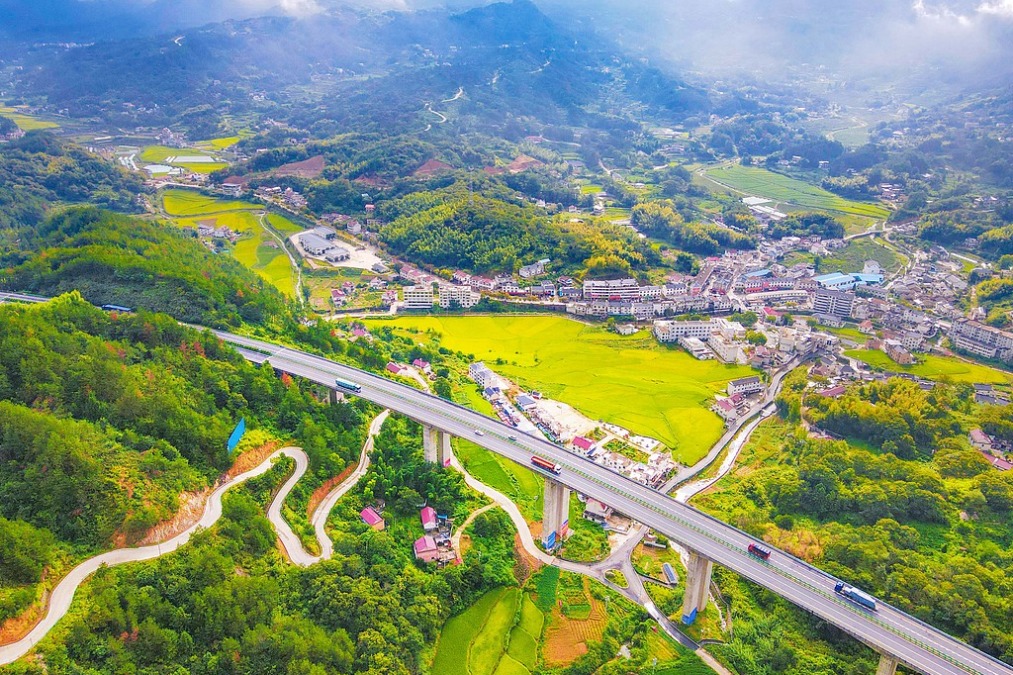
As someone who has been visiting and teaching in China since 1964, I have witnessed the enormous strides the country has taken toward achieving modernization. More than six decades ago, infrastructure in China was terrible. But now China has developed the largest and best high-speed train network in the world. Trains are punctual and comfortable, run smoothly, and are extremely fast.
Poor and backward in the 1960s, China now dominates world trade, and its economy has grown rapidly since the modernization policy was introduced. Measured in PPP (purchasing power parity) terms, China is now the world's largest economy. In terms of standard of living, it has improved to an almost unbelievable extent. The World Bank estimates China's GDP per capita was only $164 in 1962. By the end of 2023, it had increased to $12,174.
As for the science and technology sector, Cambridge scholar Joseph Needham has praised China's brilliant scientific tradition in his monumental work, Science and Civilisation in China. The scientific revolution took place in Europe, paving the way to modernization. In the 21st century, the tide has turned, and China is catching up. It has overtaken the US in many crucial areas of technology.
China's modern and contemporary culture has helped advance Chinese modernization. But China's traditional culture has also helped advance modernization in multiple ways, an important one being the emphasis on education.
The author is a Sinologist and an emeritus professor at Griffith University in Australia. The views don't necessarily reflect those of China Daily.
If you have a specific expertise, or would like to share your thought about our stories, then send us your writings at opinion@chinadaily.com.cn, and comment@chinadaily.com.cn.