Xinjiang orders local govts to support sanctioned businesses
Two-year-old US law targets entities allegedly responsible for 'forced labor'







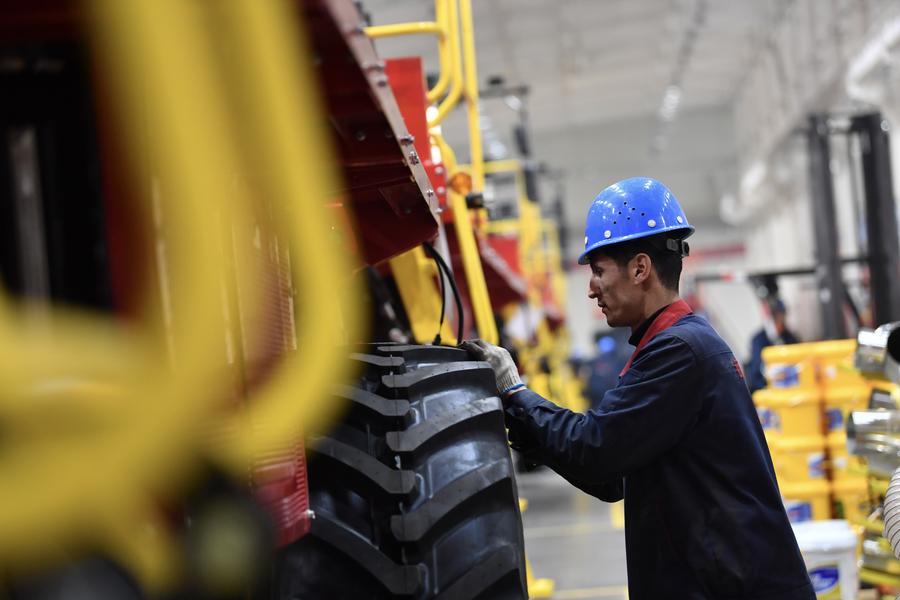
The Xinjiang Uygur autonomous region has told local governments to provide stronger support to enterprises hit by United States' sanctions for their alleged use of "forced labor".
A resolution passed last month by the Standing Committee of the Xinjiang People's Congress, which was made public on Monday, outlines measures aimed at countering US sanctions and supporting companies in Xinjiang that have been subjected to them. It directs all levels of government in the region to establish organizations or leadership bodies focused on opposing US sanctions and addressing challenges faced by enterprises affected by them.
Under the new regulations, which are now in effect, local governments must enhance support for businesses subjected to US sanctions by helping them expand their domestic and international markets. That includes efforts to improve brand recognition, promote technological innovation and provide assistance in overcoming operational difficulties.
The resolution also calls for increased efforts to inform the international community about the socioeconomic achievements of Xinjiang, aiming to present a more comprehensive picture of the region's development. Additionally, it emphasizes the need for legislative bodies at various levels to strengthen their legislative and supervisory roles to create a business-friendly environment governed by the rule of law.
Judicial efforts in accordance with international laws and regulations are to be bolstered to assist enterprises in seeking compensation from the US government and related trading partners for losses resulting from sanctions.
The US sanctions are part of the Uygur Forced Labor Prevention Act, which was signed into law by US President Joe Biden in December 2021 and took effect in June 2022. The law targets entities allegedly responsible for "forced labor "in Xinjiang, with a focus on producers of cotton, tomatoes and the polysilicon used in solar panel manufacturing.
The Xinjiang legislature has strongly condemned the US law, arguing that it infringes upon the rights of Xinjiang enterprises to operate and develop, and severely affects the economic interests and social rights of various ethnic groups in the region.
"The ban on goods allegedly involving 'forced labor' from Xinjiang entering the US market has seriously infringed upon the production and operation rights as well as the development interests of Xinjiang enterprises," the legislature said. "It has also severely violated the rights to survival and development of the various ethnic groups in Xinjiang, bringing significant harm to the sentiments of the people in the region."
The legislature emphasized that the resolution is aimed at protecting the legitimate rights of sanctioned companies and the employment rights of people from all ethnic groups in Xinjiang. It is also seeking to highlight what it sees as the US government's efforts to undermine regional development and stability.
Labeling the resolution as a crucial step in enhancing China's legal framework related to foreign affairs, the Xinjiang legislature said, "The legal document is essential for addressing risk challenges and advancing the urgent needs for high-quality economic and social growth in Xinjiang."
The Chinese government has consistently rejected allegations that "forced labor" exists in Xinjiang, asserting that they are fabricated by anti-China forces and contrary to the facts. It has also indicated that further support will be provided to regional enterprises to foster their development.
In May, Chen Weijun, the autonomous region's executive vice-chairman, announced plans to further open Xinjiang to global markets, proposing the creation of a "golden corridor" between Asia and Europe, with a focus on collaboration with Central Asian countries in the new energy, medical care and agricultural sectors.



- Cheng Li-wun assumes leadership of Kuomintang
- Captivating landscape forms in Yunnan
- Global taekwondo athletes thrill Wuxi with electrifying matches
- Expedition team sets sail on journey to Antarctica
- Grand ancient wedding ceremony held in Fuzhou
- China achieves 1st thorium-to-uranium fuel conversion in molten salt reactor