Over 100 Neolithic jade relics unearthed







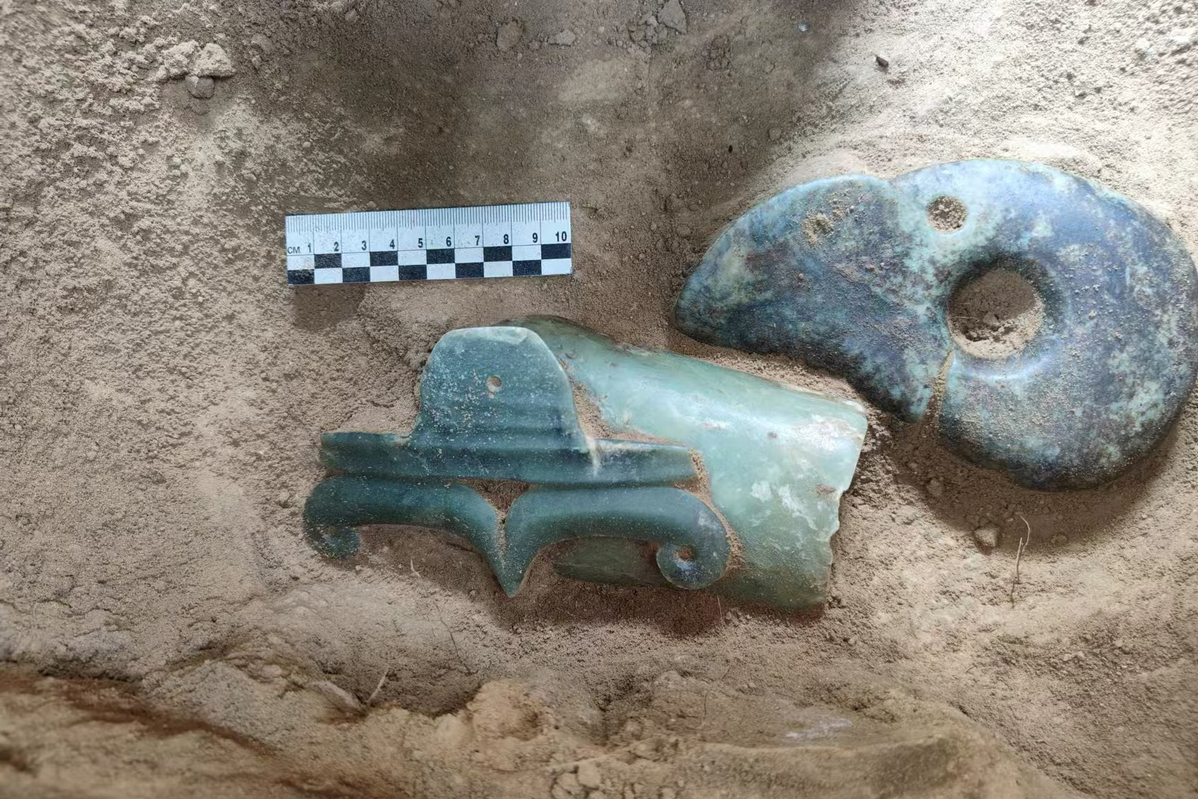
Three jade dragons of different colors and sizes, and each around 5,000 years old, were among the more than 100 jade relics of the Hongshan Culture recently unearthed in North China's Inner Mongolia autonomous region.
The jade artifacts, found at the Yuanbaoshan archaeological site in Aohan Banner in the city of Chifeng during a four-month excavation work that began in May, include a palm-size, emerald green dragon that is the largest of its kind unearthed in northern China.
The biggest jade dragon among these artifacts is 15.8 centimeters long, 9.5 cm wide and 3 cm thick. It is slightly longer than the one previously unearthed about 150 kilometers away at the Niuheliang archaeological site in Chaoyang, Liaoning province.
The chubby, pig-headed dragons are iconic figures of the Hongshan Culture, which was an important part of the Neolithic period and encompassed present-day Inner Mongolia as well as Liaoning and Hebei provinces.
Dating back 5,000 to 6,500 years, Hongshan Culture sites help form a relatively comprehensive picture regarding the origins of Chinese civilization.
Dang Yu, research librarian at the Inner Mongolia Institute of Cultural Relics and Archaeology, said the jade artifacts unearthed at Yuan-baoshan since May cover the majority of Hongshan Culture jade ware, including loops, discs and axes, as well as birds and insects such as cicadas and silkworms.
One jade headgear resembles another belonging to the Lingjiatan Culture, dating back 5,300 to 5,800 years in present-day Anhui province, indicating long-distance exchanges between the two cultures, she said.
Dang made the remarks on Sunday when addressing a seminar held in Chifeng to commemorate the 70th anniversary of the naming of the Hongshan Culture.
The relics of the Hongshan Culture have attracted the attention of Chinese and foreign scholars since the beginning of the 20th century. At that time, they focused mainly on sites in a hilly area in suburban Chifeng called Hongshan, which means "red mountains".
In 1954, archaeologist and historian Yin Da (1906-83) took the advice of archaeologist Liang Siyong (1904-54) and officially named this Neolithic culture after the area in his book on the Neolithic period in China.
So far, more than 1,100 Hongshan Culture sites have been discovered, mostly in the West Liaohe River basin in southeastern Inner Mongolia and western Liaoning.
Archaeological and research efforts spanning a century have unraveled some mysteries of the Hongshan Culture, represented by its sacrificial system. A well-laid ritual complex unearthed at the Niuhe-liang site, comprising an altar, a temple for a goddess and rubble mound tombs, as well as social stratification marked by the use of exquisite jade in sacrifice, showcased the system.
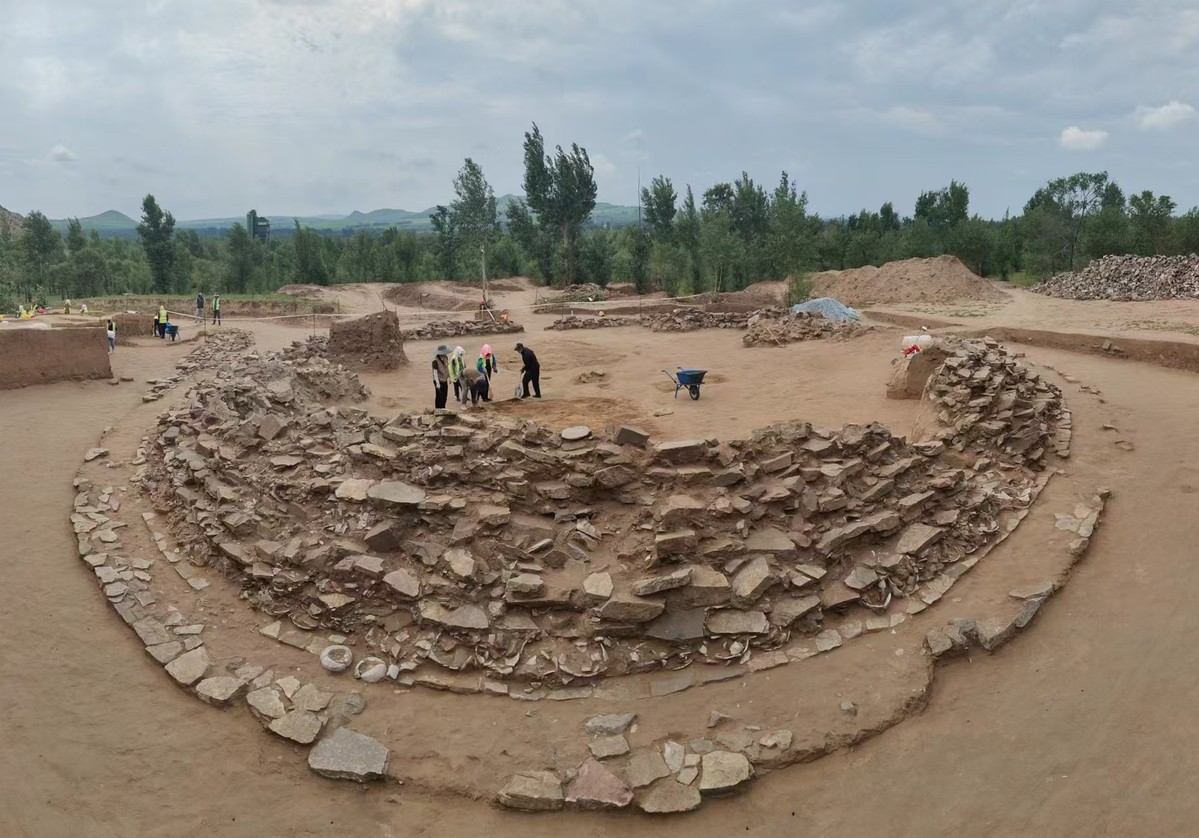
At the Yuanbaoshan site, which is around 5,000 to 5,100 years old, some of the unearthed jade relics were found inside and underneath the walls of a round rubble mound tomb, 23.5 meters in diameter, which is the largest discovered in Inner Mongolia to date.
Dang, from the Inner Mongolia Institute of Cultural Relics and Archaeology, said they are conducting further paleoenvironmental studies, laboratory tests and other research methods to learn more about the topography of the area, date the relics and trace the sequence of construction.
Jia Xiaobing, a researcher at the Chinese Academy of Social Sciences' Institute of Archaeology, said the layout of the round rubble mound tomb at Yuanbaoshan and the tomb's surroundings show similarities with tombs found at Niuheliang, dating back 5,000 to 5,500 years.
"Such consistency in an expanded area proves that a shared belief system existed among the Hongshan ancestors," he said.
Jia is currently leading a program aimed at bringing together his Beijing-based institute and universities and archaeological institutions of Inner Mongolia, Liaoning and Hebei, in order to strengthen archaeological and research efforts on the Hongshan Culture.