


Wall restoration based on tradition and experience







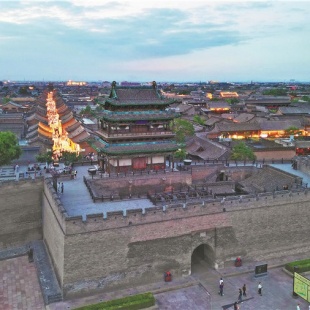
One of the most outstanding treasures of the best-preserved ancient walled city in China — Pingyao Ancient City in Pingyao county, North China's Shanxi province — is the wall itself.
Shao Shuai, 41, still remembers an afternoon in 2012 shortly after he joined a company specializing in restoring ancient architecture in the county.
It was about 4 pm. A heavy rain had washed soil from the wall onto the road. Shao and his colleagues were busy shoveling the soil and cleaning the road.
The wall, first built about 2,800 years ago, was rebuilt and expanded in 1370 using the old-fashioned method of rammed earth inside and gray bricks on the outside. Over the following 500 years in the Ming (1368-1644) and Qing (1644-1911) dynasties, the wall had been repaired 26 times, historical records show. Now standing 12 meters tall, it is 6.4 kilometers in perimeter and, on average, five meters wide.
At Point No 77, Shao and his colleagues found more soil had washed away. Without enough experience, they did not notice much difference in the wall, so they removed the soil and moved on. Walking about 60 meters away, they heard a loud noise — the wall had collapsed. About 120 metric tons of soil had slid, leaving a 16-meter-long gap in the wall.
Since then, the county bureau of cultural relics organized teams to inspect the walls each year to find potential dangers and restore the wall one section after another. Shao is one of the restorers.
In October 2021, heavy rain hit Pingyao again, causing the wall to collapse in 61 places.
"The rain lasted too long — nonstop for three days and nights — and the rammed soil inside drew too much water. The proportion of water reached 20 to 25 percent," he says.
"Experts from the National Cultural Heritage Administration decided after examination that it was caused by a natural disaster," Shao says.
"But the parts we restored over the past decade, mostly on the east side of the wall, stayed in good condition, surviving the flood," he adds.
Already an experienced restorer of the city wall, Shao said in a previous interview that the restoration was very challenging because it was hard to tell the situation inside the wall judging from its surface.
To reinforce the wall and restore its original shape and structure, Shao and his team adopted traditional techniques passed down from the Song Dynasty (960-1279).
In addition, applying stricter standards for the rammed earth's ingredients and processing method, they further consolidated the top of the wall to reduce permeability.
At Shao's supervision, by November 2022, the restoration project was completed. After carefully examining the project, Wang Guohe, 75, who led Shao into the world of restoring ancient architecture, said: "The preservation of the city wall is in good hands. The repair and maintenance following the disaster were well executed."
Born and raised in the ancient city, Shao used to play on the wall, capturing insects when he was little. His father is a craftsman who adorns traditional architecture with painted patterns, and crafts paper dolls that depict scenes from Chinese operas, which is a national-level intangible cultural heritage.
In 2006, Shao graduated from Sichuan Normal University with a bachelor's degree in environment design. After working in Guangzhou, Guangdong province, as an interior designer for several years, he returned to Pingyao. In 2012, he joined the company founded by Wang.
Apart from the wall, Shao has also restored other ancient buildings, such as the Fire God Temple and the Guandi Temple in the ancient city, which commemorates the late Eastern Han Dynasty (25-220) general Guan Yu. Now he is working on another ancient Guandi Temple in one of Pingyao's remote villages.
As a project manager, he organizes bricklayers and carpenters and instructs and supervises their work.
"Before each project, I need to do a lot of research and read many books to continuously improve my knowledge and understanding of ancient architecture," Shao says.
"After so many years of learning and practicing, I am not a novice anymore but a person who can communicate with ancient architecture when I stand before them, reading the information left by their builders decades or centuries ago," he says.
?