FTZ reforms deepen China-ASEAN economic, trade ties







NANNING - In a bustling fruit processing facility in South China's Guangxi Zhuang autonomous region, the air is sweet with the luscious aroma of mangoes. Workers diligently manage a state-of-the-art, fully automated production line, preparing to send the delectable products to eager markets across Southeast Asia.
In recent years, with the deepening of economic cooperation and the trade exchange of agricultural products between China and the Association of Southeast Asian Nations (ASEAN), the complementary advantages of agricultural products trade between Guangxi and ASEAN have become more prominent. The geographical advantages of land and sea links with ASEAN have also injected vitality into the continuous expansion of Guangxi's fruit exports.
According to data from the Nanning Customs, in 2023, Guangxi imported 16.71 billion yuan ($2.4 billion) of ASEAN agricultural products, a year-on-year increase of 43.1 percent. At the same time, Guangxi's special fruits, such as orah mandarins and sweet tangerines, have also been well received in the ASEAN market.
The thriving fruit trade has also spurred related companies to invest and establish their operations in Guangxi.
Guangxi Junyi Agricultural Science and Technology Co Ltd, a mango-processing company established in 2020 in the Chongzuo area in the China (Guangxi) Pilot Free Trade Zone (FTZ), is the region's first border-based fruit processing enterprise with an annual main business turnover of at least 20 million yuan.
"The pilot FTZ's policies, including tax incentives, streamlined trade procedures and financial innovations, have not only laid fertile ground for growth but also provided substantial cost benefits to businesses," said Shen Wuyang, the company's deputy general manager.
Guangxi, often described as China's gateway to ASEAN, has risen to the forefront of China's trade and cooperation with ASEAN in recent years, thanks to the establishment of the pilot FTZ.
In 2019, the pilot FTZ was established to promote China's opening up to ASEAN and to pilot new mechanisms in China-ASEAN cooperation. Since its inception, the pilot FTZ has proven to be a powerhouse, taking up a 37.7 percent share of Guangxi's total foreign investment and a notable 38.6 percent share of the region's foreign trade volume.
The pilot FTZ comprises the Nanning area in the region's capital city, the Qinzhou Port area along the coast and the Chongzuo area bordering Vietnam.
The Chongzuo area is home to Youyiguan Port, or Friendship Pass, one of China's busiest land ports for the trade of fruit.
Thanks to the development of economic and trade relations between China and ASEAN, Youyiguan Port's cargo clearance efficiency has doubled.
"Our cargo predominantly goes to Southeast Asia, with Vietnam taking up 80 percent of our shipments and the remainder being distributed to places like Malaysia and Thailand," noted Wang Shuqing, operations supervisor of a supply chain management company in Guangxi.
The zone's Nanning area focuses on the development of modern finance, the digital economy and modern services. It is pioneering innovation in cross-border finance and renminbi businesses, especially those working with ASEAN nations.
"Previously, cross-border transactions between Guangxi and Indonesian companies involved an intermediate step of converting RMB to US dollars before changing it to Indonesian rupiah. Now, we can achieve direct settlements," said Bai Lili, deputy general manager of a China CITIC Bank branch located in the Nanning area of the pilot FTZ.
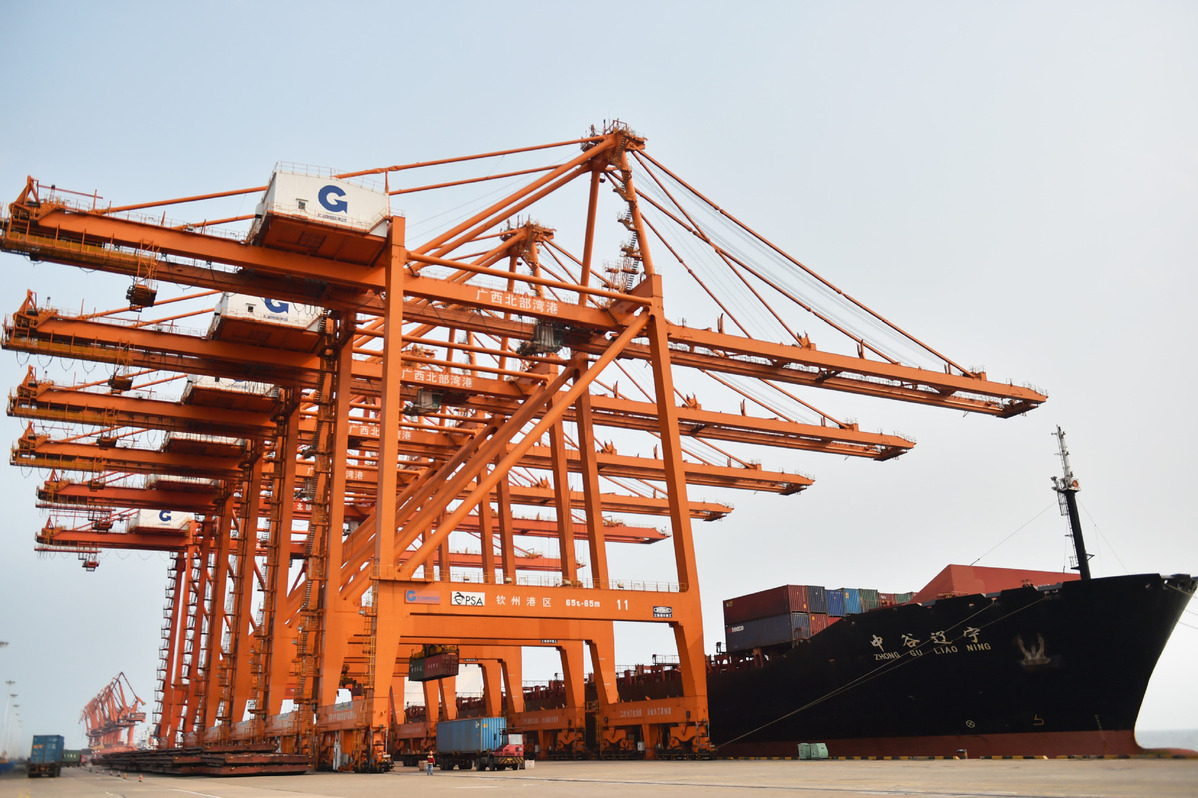
As the pilot FTZ's only coastal area, Qinzhou Port Area is establishing itself as a high-level gateway port that facilitates the transportation of cargo between China and ASEAN.
According to Ye Jun, an official with the administrative committee of Qinzhou Port Area, the industrial focus of the area is on petrochemical projects, with quite a number of petrochemical enterprises having already set foot in raw material and preliminary processing in ASEAN countries.
So far, more than 38,000 new enterprises have been established in Qinzhou Port Area, including 355 foreign-funded companies. Among the over 150 industrial projects operational or under construction, the area has attracted investments exceeding 300 billion yuan and is home to four enterprises with annual outputs of over 10 billion yuan.