Battle of brains
Peking University's team of three sophomore students shines on the global stage by solving complex programming problems, demonstrating exceptional teamwork and preparation.







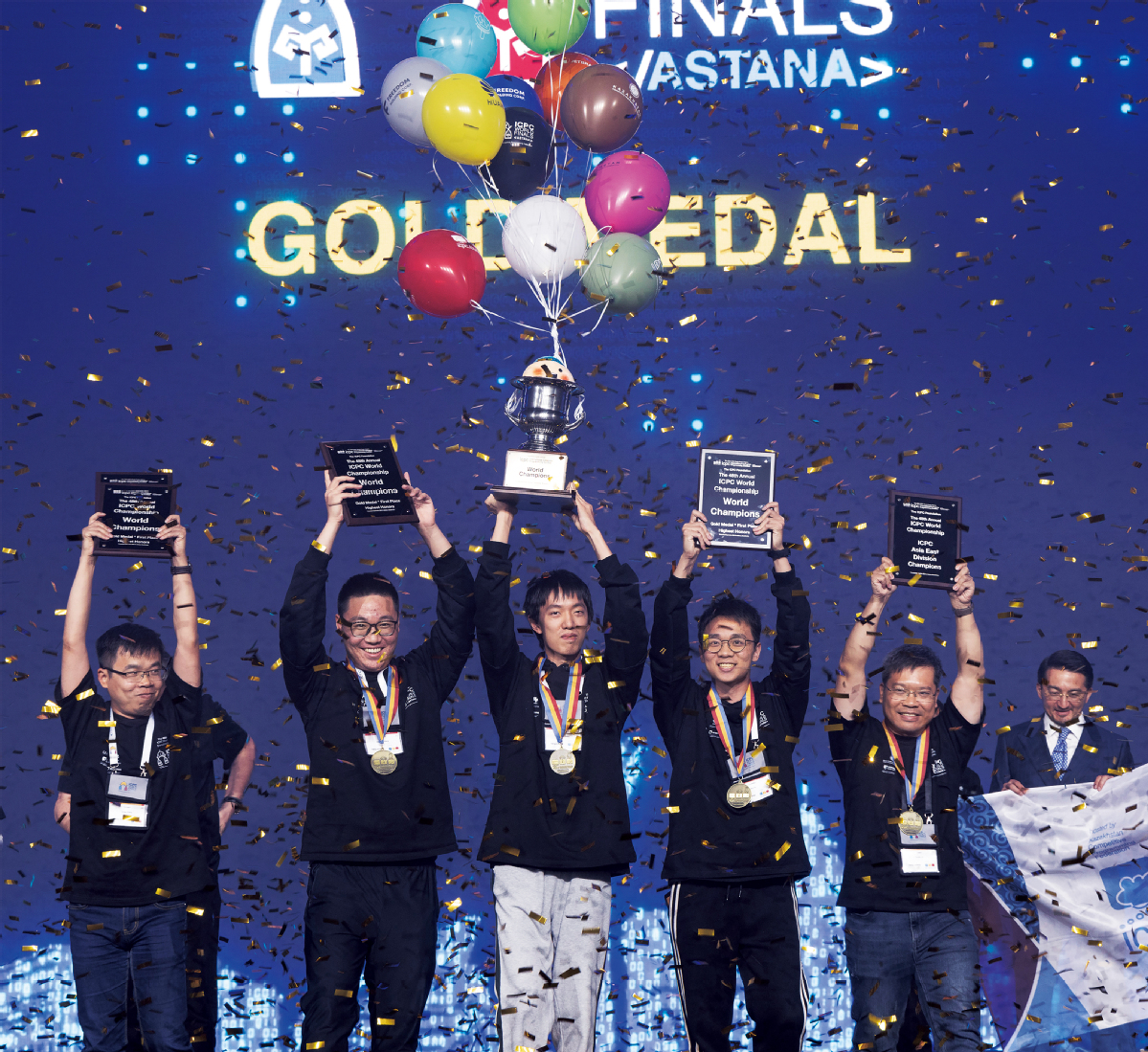
The ICPC International Collegiate Programming Contest is often referred to as the Olympics of computer programming. In this year's ICPC World Finals, held in Astana, Kazakhstan from Sept 15 to 20, the Peking University team, consisting of three sophomores from the School of Electronics Engineering and Computer Science, emerged as the champions.
Wang Weicheng, Wang Xiangwen, and Xu Anyi distinguished themselves among over 400 competitors representing 141 of the world's top student programming teams, winning this intense "battle of the brains", as described by the competition's official website.
In the final round, each team was tasked with solving 12 problems within five hours, using programming languages such as C/C++, Java, or Python3. The team that solved the most problems correctly in the shortest amount of time was declared the winner.
The problems primarily featured advanced algorithms, challenging competitors to utilize their logic, knowledge, strategy, and mental endurance.
"Each problem tests different aspects, from computational geometry and data structures to dynamic programming," Xu explained. "Most of the problems are quite challenging, which helps differentiate among participants." In fact, one problem was so difficult that no team managed to solve it.
The Peking University team successfully completed nine problems, becoming one of the four gold medal teams with the highest accuracy.
When the team learned they had won the championship, they were "very excited and happy", according to Wang Xiangwen.
"We were led to the center of the stage to receive our medals, and then a huge trophy was brought out as gold confetti began to rain down," he recalled. "Cameras were broadcasting live, and people were taking pictures. I felt so nervous that I wasn't sure what expression to make, so I simply held the trophy high."
"But I believe this result is a reward for all the hard work we've put in over the past few months," he added.
The team's training primarily involved mock exams, using past problems from previous competitions to simulate the official format within a five-hour limit. Each team member also worked individually to strengthen their weak areas.
They started holding weekly mock contests last semester. During the summer break, free from the pressure of other coursework, they intensified their training, practicing almost every day in August. They also participated in three training camps: one hosted by Tsinghua University, another by Huawei, and an international camp primarily for European university students, which they joined remotely.
For Xu, frequent training never becomes tedious. He has found programming enjoyable ever since he began learning it in sixth grade. "Writing code is like writing an essay; it allows me to express what's on my mind. The sense of accomplishment I get from solving problems also brings me joy," he said.
In addition to strong individual skills, effective teamwork was key to their success, as the team members noted.
Their strategy involved tackling the easier problems individually at first, then collaborating in pairs or as a group to solve the more complex challenges.
Interestingly, all three members attended the same high school — Hangzhou No 2 High School of Zhejiang Province — where they had known each other and participated together in the school's computer competition training courses. This shared background fostered a deep understanding among them and strengthened their sense of camaraderie.
"We know each other's strengths very well. When a problem arises, we can immediately assign it to the right person," said Wang Xiangwen.
In terms of team roles, the captain, Wang Weicheng, was responsible for making team decisions and prioritizing problems. His proficiency in English also made him the key communicator, ensuring that the team fully understood the problem statements. He also specialized in handling geometry-related problems. Wang Xiangwen excelled at writing code quickly and accurately, taking on most of the coding tasks. Xu was versatile and could tackle a wide range of problems, stepping in wherever needed.

Wang Weicheng observed that while some teams may have members with strong individual skills, their lack of regular training leads to less cohesive teamwork, preventing them from achieving better results in competitions.
In contrast, Peking University teams have consistently excelled in the ICPC over the past four years, securing two championships and two runner-up titles, thanks to their well-developed training system.
The university organizes internal selection contests where students can freely form teams, and the winners, if willing, go on to represent the school in global competitions.
"In collegiate programming contests, Russia and the United States have traditionally been powerhouses. However, several Chinese university teams have demonstrated impressive performances in international competitions over the past two years. Teams from South Korea, Japan, and Singapore are also on an upward trajectory," he noted.
Wang Xiangwen believes that participating in competitions requires a deep understanding of algorithms. However, his next goal is to broaden his knowledge and skills beyond just algorithms. Next semester, he and his classmates will join three research groups to explore areas such as theoretical computing, artificial intelligence, deep learning, and reinforcement learning.
"I think the best way to apply what you learn is through research. Although I haven't decided on a specific direction yet, I hope to explore many areas in the future," he said. "In today's world, new developments in information technology are constantly emerging. To make a mark in this field, you need to quickly adapt to new environments and embrace lifelong learning."
guiqian@i21st.cn


Today's Top News
- China's consumer prices creep up in October
- Fresh opportunities seen in China
- Xi meets IOC chief and its honorary president
- National Games an embodiment of China's strength, unity and progress
- Xi declares 15th National Games open
- Xi attends opening ceremony of 15th National Games