Global cooperation key to climate success
International Renewable Energy Agency chief: More efforts needed to address environmental issues, reach carbon goals







"IRENA places great importance on its cooperation with China and hopes that by further leveraging the role of China-IRENA cooperation office as a bridge and hub, both sides can reap more practical outcomes in areas such as policy dialogue, technical discussions and capacity building."
"China is currently at the forefront of renewable energy deployment worldwide … It is noteworthy that approximately 40 percent of global solar capacity is located in China. Moreover, a significant portion of renewable energy jobs can be found within the country," La Camera said.
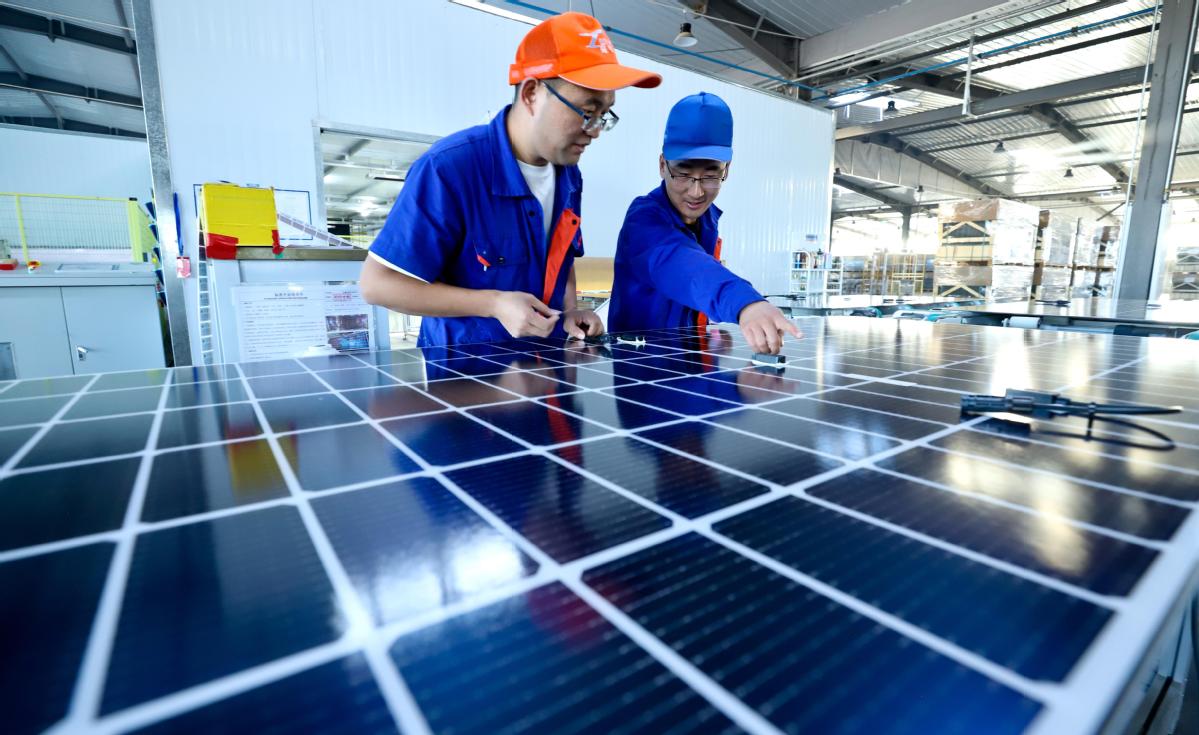
As of end-September, installed capacity of renewable energy power generating units in China reached 1.73 billion kW, a year-on-year increase of 25 percent, accounting for approximately 54.7 percent of the total installed capacity in China, latest data from the NEA showed.
This includes hydropower installations of 430 million kW, wind power installations of 480 million kW, solar power installations of 770 million kW, and biomass power installations of 46 million kW.
Meanwhile, renewable energy consumption has been steadily increasing. In the first three quarters, power generated from renewable energy sources reached 2.51 trillion kilowatt-hours, a 20.9 percent year-on-year increase, representing about 35.5 percent of total electricity.
Combined electricity generated from wind and solar power reached 1.349 trillion kWh, a 26.3 percent increase year-on-year, nearly matching the electricity consumption of the tertiary sector (1.395 trillion kWh) during the same period and surpassing electricity consumption for urban and rural residents (1.172 trillion kWh).
China is also stepping up efforts to promote the development of electric vehicles and charging infrastructure, and actively participating in global trade despite ongoing conflicts, La Camera said.
"We see that there is an incredible progress in transport — the electric vehicles, if you go into the street, you see so many green plates, which means that there are many electric vehicles … China's technology advancement also allows for battery recharging in a very short time."
"We have seen that there is interest in hydropower, in power storage, and in hydrogen (in China). So these are all areas where the country is progressing fast. Furthermore, the country's commitment to achieving 1.2 terawatts of renewable capacity six years ahead of schedule exemplifies its dedication to environmental stewardship, providing reference to other countries that need to accelerate its renewable deployment," he said.
"China may achieve carbon neutrality well in advance of the target year of 2060," he added.
The rapid expansion of renewable energy sources has driven the need for energy storage facilities, as such intermittent energy sources cannot be managed and dispatched like traditional fossil fuels. According to the NEA, innovative energy storage systems, distinct from traditional methods like pumped storage hydropower, have served as vital "super power banks" for renewable energy, significantly bolstering power supply during peak demand.
By the end of September, China had 58.52 million kW of operational innovative energy storage facilities, marking an 86 percent increase from the end of 2023. Particularly in East China, there has been notable growth in these installations, with over 9 million kW added this year. Between January and August, the total charge and discharge capacity of innovative energy storage systems nationwide reached around 26 billion kWh.
"The country may still face challenges, as in all other countries. When putting so much renewable energy capacity into the system, we need a grid system that is interconnected, flexible, moving from one direction to another, and balancing," La Camera said.
An upgrade of the grid system is necessary to efficiently transmit and balance electron flow generated from intermittent renewable sources, he added.
To tackle these challenges, China is accelerating investments in ultrahigh-voltage direct current transmission projects, with related grid construction making solid progress. At the same time, China has introduced a new type of power system, with the primary goal of maximizing the integration of new energy sources, utilizing smart grid, and encouraging electricity generator-grid-power load-power storage integration.
"Building a diversified, clean and stable energy supply system is an important path for developing countries to enhance their energy security capabilities," Zhang of the NEA said. "We are willing to work with other countries around the world to develop more ambitious green energy development plans based on each country's endowments and development needs."