


A goddess reborn
Global Gen Z explores the legacy of an ancient Chinese goddess and her enduring influence as a spiritual bond fostering international exchange, Gui Qian reports.








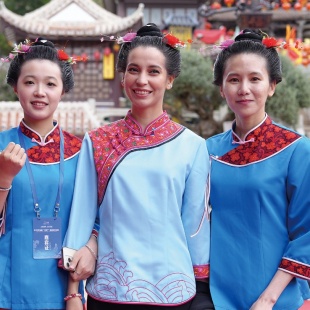
Wearing her hair in a bun resembling a ship's sail and dressed in a blue top symbolizing the sea, Nikita Li Van Heerden from South Africa immersed herself in the Mazu atmosphere of Meizhou Island in Putian, East China's Fujian province.
According to legend, the original Meizhou hair bun was designed by Mazu herself, the revered goddess of the sea.
Van Heerden, 22, took part in the 2024 Global Gen Z Dialogue on Meizhou Island, co-organized by China Daily and the Putian Municipal People's Government on Nov 18.
The event, part of the ninth Global Mazu Culture Forum, with the theme "Philanthropy, Peace, and Mutual Appreciation of Civilizations", highlighted Mazu culture's influence on Putian's development and its role as a spiritual bond in fostering cross-regional and international exchanges.
More than 30 young people from over 20 countries and regions — including Australia, France, Kazakhstan, Russia, South Korea, and the United States — joined the dialogue.
They visited the Meizhou Mazu Ancestral Temple, the world's oldest Mazu temple, dating back to 987 AD. They also enjoyed Mazu-themed performances, experienced traditional clothing and hairstyles, and discussed innovative ways to promote Mazu culture.
Van Heerden said she hopes to spread Mazu stories and spirit by sharing her experience on Meizhou Island with her social media followers.
In her speech at the opening ceremony of the dialogue, Lin Shaowen, deputy mayor of the Putian Municipal People's Government, encouraged young people to explore the rich connotations and values of Mazu culture, to boldly and creatively promote its modern expression, and to strengthen exchanges and mutual learning to enhance cultural diversity and inclusiveness.
Global cultural influence
In fact, Mazu's cultural impact extends far beyond Fujian. According to the Putian government, there are tens of thousands of Mazu temples worldwide, spanning about 50 countries and regions, with an estimated 300 million worshippers. In 2009, Mazu beliefs and customs were inscribed on the UNESCO Representative List of the Intangible Cultural Heritage of Humanity.
Tuen Li Huey, a young Chinese Australian, is keenly aware of the global reach of Mazu traditions. Having grown up in Australia, the US, and Malaysia — each with its own Mazu temples — she feels a strong connection to this heritage.
At the event, Tuen performed a song titled My Mazu Goddess, singing with heartfelt emotion: "On this side of the sea, on that side of the island, in every village and town, big and small, there is a temple in our hearts. I devoutly offer incense, feeling your compassion and kindness."
Zheng Yaling, from Taiwan, China, said she was deeply moved by how Mazu culture connects people on both sides of the Taiwan Strait.
Since childhood, she has participated in festivities celebrating Mazu's birthday. Upon arriving at Meizhou Island, she saw Mazu statues, posters, and cultural products everywhere and observed the people's devout faith in Mazu.
"This feels almost like a homecoming," Zheng said. "Mazu is a spiritual bond between people in the Chinese mainland and Taiwan, connecting our hearts. She represents love and protection, and her spirit knows no bounds."
Marjina Gokova, from Turkmenistan, is pursuing her master's degree in Hangzhou, Zhejiang province. When she arrived in Putian, she found the local culture distinct from that of China's inland cities — more integrated and diverse, even bearing similarities to Southeast Asian characteristics.
After visiting the Mazu Origin Museum, she discovered the reason. Over 1,000 years ago, Fujian was a key hub of the ancient Maritime Silk Road, where cultures from various regions converged. Mazu, deeply rooted in China's maritime culture, has become known as the goddess of peace at sea.
In the 21st century, Mazu's spirit of "establishing virtue, doing good, and great love" remains relevant and aligns with the Silk Road spirit of "peace and cooperation, openness and inclusiveness, mutual learning and mutual benefit", as embodied in the Belt and Road Initiative.
"This is fresh information and a great experience for me, allowing me to see a new side of Chinese culture," said Gokova.
Mazu also impressed foreign Gen Zers with her international significance.
Tom-Louis Flohrer, 25, from Germany, was amazed to learn that in modern times, Mazu has her own ID card and can even buy tickets for trains and flights when people invite her statue to other places for worship.
Another part of Mazu's story that resonates with Flohrer is her role as a guide during the global climate crisis. He noticed that a large beer factory in Putian uses solar panels to generate power, adhering to the principles of low-carbon production.
"Mazu's deep connection to the sea reveals a profound respect for the natural world. Her story reminds us that our destinies are intertwined with the rhythms of nature — a lesson that feels ever more urgent today," he said.
Flohrer was also struck by how Mazu culture has withstood the test of time.
"What allows certain customs to endure while others fade? I believe it is because they carry within them values that speak to the human spirit," he said.
Contact the writer at guiqian@i21st.cn