Subnational work key to Sino-US climate cooperation







Top advocates of China-US collaboration on climate change have published an article urging provinces and cities in the two countries to expand their teamwork.
The article, published on Monday in the science journal Nature, is co-authored by China's former special climate envoy Xie Zhenhua, former California governor Jerry Brown, and scholars Fan Dai and Peng Gong from Hong Kong and Yi Wang from Beijing. It is titled "How provinces and cities can sustain US-China climate cooperation".
Citing the fruitful cooperation between China and the United States at the subnational level, the authors address in the article how subnational governments and non-state actors can play a "crucial part in supporting dialogue and collaboration" after US President-elect Donald Trump takes office on Jan 20.
Trump has indicated that federal policy on climate and environmental issues might shift drastically, the authors wrote, adding that Trump's proposed hefty tariff on imports from China "will have a pronounced impact on the US-China relationship, which is already fractious".
Nevertheless, "it is important to recognize that both countries share common vulnerabilities, including weather-related disruption caused by climate change, and have reasons to act jointly in some areas", they wrote, calling for "sustained engagement between the world's two largest economies".
On joint initiatives between California and Chinese agencies and provinces on clean energy and climate action, the authors highlighted areas in which "expanding subnational collaboration can be effective and lay out steps to advance the US-China partnership on climate change".
For example, they said, the two sides can exchange decarbonization technologies, improve power grids and markets, and expand climate financing.
Collaboration between California and China has grown over the past decade. In 2017, when Brown was governor, he met with Chinese President Xi Jinping and signed a series of climate- and energy-focused agreements between California and several of China's national agencies and provincial governments.
Those efforts strengthened earlier ties and built on California's first memorandum of understanding on climate change with China's National Development and Reform Commission and Guangdong and Jiangsu provinces, according to the article. The memorandum was signed in 2013.
In 2021, Xie, then China's climate envoy, and US climate envoy John Kerry supported dialogue and cooperation on climate change, paving the way for a meeting in November last year between President Xi and his US counterpart Joe Biden in San Francisco.
The two nations then released a joint statement on enhancing cooperation to address climate issues, identifying areas for deeper bilateral collaboration, including exchanging know-how on the transition from coal to green energy, and the reduction of methane emissions and waste through more efficient use of resources.
Working groups were set up to exchange ideas in each of those areas. The groups' discussions culminated in a high-level bilateral meeting at the California-China Climate Institute in Berkeley, California, in May. Participants included the governors of California and Guangdong province and officials from five cities and four provinces of China.
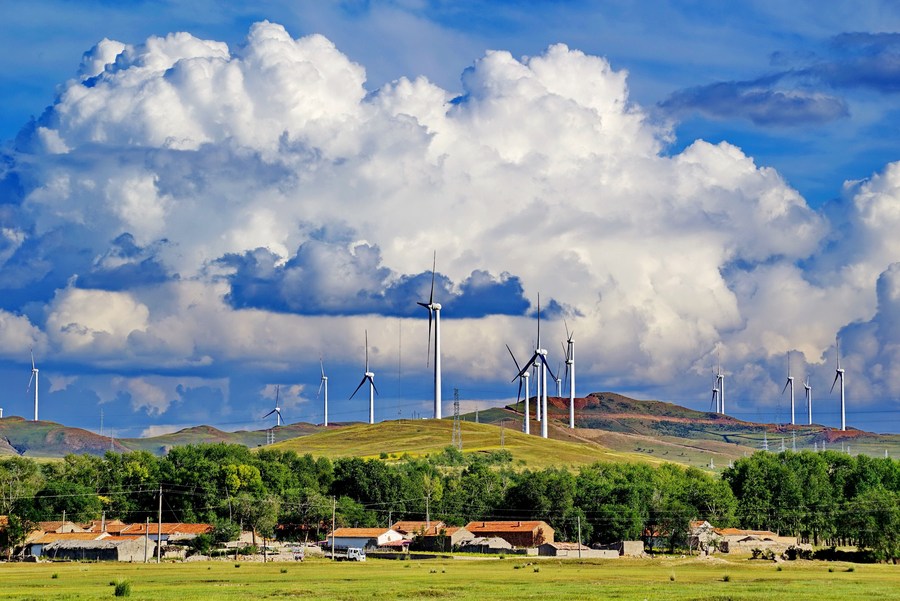
As California looks to rapidly initiate offshore wind projects, it has turned to Chinese wind turbine manufacturers.
China, meanwhile, has modeled its new green-building regulations after California's Title 24 standards — a set of building codes that ensure energy efficiency.
"By sharing expertise, the United States and China can help one another to address their challenges," the authors wrote.
On future cooperation, they recommended several steps to enrich the climate-centered partnership.
The first is to support subnational cooperation. Both national and local governments need to empower regional initiatives, provide policy frameworks, and fund joint projects, even in challenging diplomatic periods, they wrote.
Second, broader participation is recommended, and more players are needed to aid meaningful climate-related exchanges, the article said.
The third suggestion is to prioritize what works. California's agreements with Beijing, Shanghai and several Chinese provinces offer a model for advancing multilateral efforts. The authors wrote that, as climate change is a global issue, subnational cooperation must eventually find its way back to the global stage.
No matter how formidable the obstacles are, collaboration remains the most viable path forward, they wrote.