Doing the 'write' thing
Courage, talent and determination help award-winning author to overcome challenges







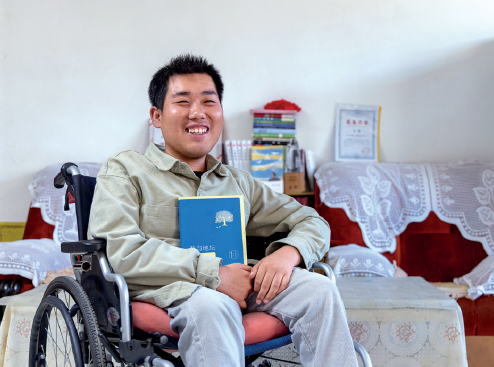
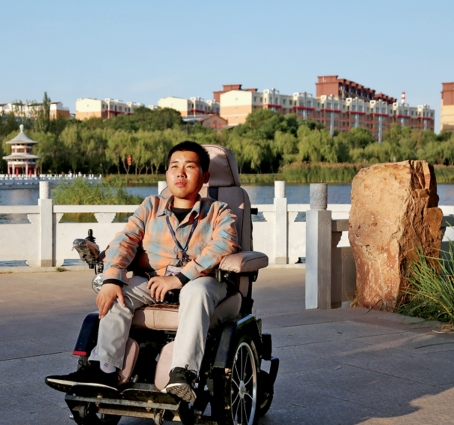
"When I was 8, a doctor predicted that I wouldn't live past 20. But now I'm here, at 29, happy with my life," says Ma Jun, the youngest laureate of this year's Junma Awards for Ethnic Literature in the prose category. Ma is not only talented but determined and has overcome many obstacles in his life.
Ma, who uses a wheelchair, was born in 1995 in the Ningxia Hui autonomous region. His winning piece is his debut prose collection, Qing Bai Shijie (The Green and White Stone Steps), which he wrote under the pen name Liu Kexing. The book is divided into five parts, depicting his life experiences: growing up, daily life, love and aspirations, emotions and reflections.
The opening chapter, also titled Qing Bai Shijie, delves into Ma's childhood memories. At birth, his parents noticed something unusual — his limbs were weak, and he couldn't move or stand without help. His health condition isolated him from other children. While his peers ran and played, Ma could only sit on the stone steps, watching in frustration and sadness. This vivid memory has stayed with him, and it became the title of his first officially published prose piece and the entire book.
The title also holds symbolic meaning. In Chinese, qing bai suggests purity and innocence. Throughout his life, Ma faced hurtful bias. Some people cruelly suggested his lack of mobility was "divine punishment" for supposed wrongdoings. Through his writing, Ma hopes to counter such prejudice, showing that he is no different from anyone else.
Ma's writing journey began in 2016, the year he passed his college entrance exams but chose not to enroll in university. His family's financial circumstances and his health conditions forced him to make a difficult decision: If he went to college, his younger brother would have to drop out of school. For years, Ma's parents carried him on their backs to school, braving wind and rain. They ran a shop to earn a living. If Ma went to college, one of them must accompany him. With limited resources, they couldn't manage both sons' education. Ma made the selfless decision to stay home, sacrificing his own opportunity to give his brother a chance to continue studying. "My brother was too little, fluffy and cute. I couldn't bear to see him upset," Ma recalls.
Although his decision was rooted in love and sacrifice, it plunged Ma into despair. He longed to experience university life and prove he could achieve success despite his condition. Instead, he found himself confined to bed, overwhelmed by feelings of hopelessness, even contemplating, in the darkest hours, taking his life.
The turning point came when a friend gave him a book, Shi Tiesheng's best-seller Wo Yu Ditan (I and the Temple of Earth). Shi, a renowned writer who also uses a wheelchair, had transformed his struggles into profound literature.
At first, Ma had no interest in the book — he had lost passion for everything. But one word caught his eye: "wheelchair". He thought this writer might have encountered the same situation as him, so he decided to open the book. As he read, Ma felt a spark of light illuminating his world. Shi's vivid observations and unwavering hope inspired Ma deeply. He was struck by the realization that someone with similar struggles could find meaning and joy in life.
Shi inspired Ma, who had found a path for the rest of his life: literature. He started to think about following Shi's spirit: He could gather the courage to do something meaningful, like writing, instead of staying in bed letting life pass him by.
He embarked on a three-year odyssey of writing the book by recording his own life, pouring his heart and soul into the words.
However, when the book was finished, Ma faced yet another seemingly daunting obstacle: publishing. Without fame or financial resources, he couldn't afford the costs of self-publishing. Just as despair began to creep in again, he learned of an opportunity. In January 2023, the China Writers Association launched the "Stars of Literature by Chinese Ethnic Writers" project, seeking submissions from ethnic writers. Meeting the criteria, Ma submitted his collection of prose, though with little hope of success.
In June 2023, Ma received unexpected good news: His book was one of 10 selected for publication through the project, allowing him to bypass the financial barrier. This achievement marked a significant milestone in his literary journey.
Then, the Junma Awards for Ethnic Literature, one of China's four major national literary prizes held every four years, began the selection process this year. Encouraged by his recent success and qualification for the selection, Ma enrolled, again without high expectations.
The moment he received notification of winning the award, Ma was sitting under a willow, reading a book, resting. Overcome with joy, he let out a loud scream, startling his family. When they learned of Ma's win, everyone laughed with excitement and congratulated him.
Traveling to Nanning, the provincial capital of the Guangxi Zhuang autonomous region, for the Junma Awards gala in November marked a unique experience for Ma, who had previously only left his hometown for medical consultations. For most of his life, his condition had remained undiagnosed. His parents tirelessly sought answers, consulting numerous doctors, but none could identify the cause. It wasn't until Ma came across information online about spinal muscular atrophy that he finally found clarity at the age of 27.
SMA is a genetic condition that causes worsening muscle weakness. Fortunately, since 2021, a crucial medication for SMA has been included in China's national medical insurance program, making treatment affordable. Ma now undergoes lumbar punctures and intraspinal injections every four months, which help manage the disease.
Fighting against the illness for many years, Ma never defines himself as a man to be pitied. "I don't think my experiences are tragic. Nowadays, many people face mental health challenges, especially young people. Sometimes they just feel lost and underachieved, and trapped in anxiety. This kind of situation is becoming normal, and we could also say this is trauma for these people. Everyone in this world suffers from something. For me, it's physical; for some others, it's emotional. We're all fighting our own battles," he says.
Ma has firmly established his own daily routine. He breaks one day into three separate parts and will follow them for the rest of his life, he vows.
In the morning, he exercises to wake his body up and get it functioning.
Afternoon is the best time to read, and he will embark on his own journey of words.
Shi has given him the courage to write, and there are many good writers for him to explore, he says.
When night falls, he will sit at the desk and throw himself into the creation of words. Ma is currently working on a novel. Having shared his own story in Qing Bai Shijie, he now seeks to create fictional narratives that explore other people's lives.
Ma writes this line in the profile for his personal social media account: "Be a faithful writer." It is now his life motto. Writing is not just a profession for Ma — it's a lifeline, a way to connect with the world and leave behind a legacy of courage, sincerity and hope.
Tu Jiayi contributed to this story.
China Daily