Sowing seeds of change







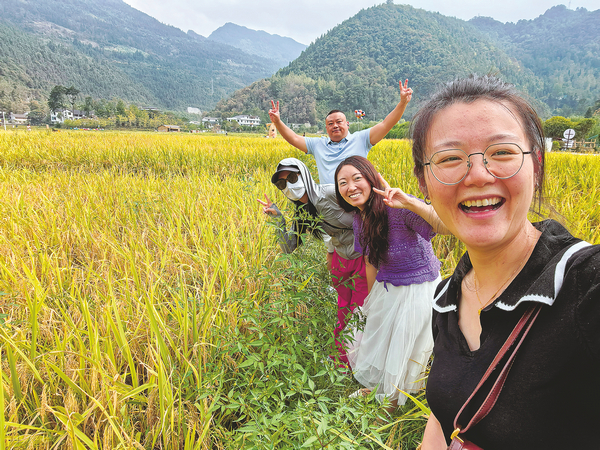
"Our time studying away from home wasn't about escaping our impoverished hometowns but about gaining the skills and knowledge to one day help lift them out of poverty," said Fu Shuqin, a co-founder of Xishanshui, a company specializing in cultivating and selling Gexian rice, which, despite its name, is actually a rare and nutritious blue-green algae.
Fu and her partners, all college graduates originally from Enshi Tujia and Miao autonomous prefecture in Hubei province, embarked on this journey after Fu discovered Gexian rice at a local restaurant in 2022.
She learned that Gexian rice, known as "gold in the water", contains 17 types of amino acids and up to 52 percent protein — twice that of fish. The current global annual yield of wild Gexian rice is less than 3,000 kilograms, with 95 percent of it coming from her hometown of Hefeng county. However, despite its nutritional value and scarcity, local farmers struggled to sell it at a fair price.
Cultivating prosperity
After extensive research and discussions, Fu and her partners decided to build an entire industry chain from scratch — a project far beyond their budget. To seek funding, they turned to venture capital, impressing investors with a meticulously prepared project dossier and a hundred-page PowerPoint presentation. Their efforts paid off, securing substantial financial backing.
"We are committed to building modern agriculture and place great importance on standardized production and technological innovation," said Fu.
To achieve this goal, they first set a quality standard for Gexian rice. According to Fu, wild Gexian rice is graded into five categories based on evaluations of its color, aroma, taste, and condition. To strictly regulate production standards, they use sensory, physicochemical, and microbiological indicators, rather than relying solely on visual and olfactory assessments, as many farmers do.
"We have developed a dedicated production line, carefully controlling the process to ensure each step is scientific, safe, and hygienic," said Fu.
However, since the industry is still in its early stages, Fu's team relies mainly on nature's offerings for harvesting.
To change this, Xishanshui has been working to build a standardized industrial base, collaborating with university experts to research and refine breeding technologies as a first step toward industrialization.
"We are actively developing artificial cultivation techniques to enhance the yield of Gexian rice, aiming to increase harvests and improve local incomes," said Fu.
The first batch of Gexian rice was harvested in July. As their production process stabilizes, they have begun exploring ways to promote their products, such as creating short videos, writing articles, and participating in exhibitions.
"My partners often say that we're not afraid of hard work; we're only afraid of not working hard enough and regretting it later," Fu shared.
Fu and her team are not only building their own business but also supporting their fellow villagers by creating a local e-commerce platform that anyone can join free of charge.
In Fu's view, they've made significant strides in industrializing Gexian rice, moving from zero to one. While there is still a long way to go before reaching 100, she remains confident and determined.
"Rural areas need young people, but young people also need the rich, vibrant land of the countryside to flourish," she said.
Contact the writers at liukun@chinadaily.com.cn