


Ceramic culture fires up touring American artisan







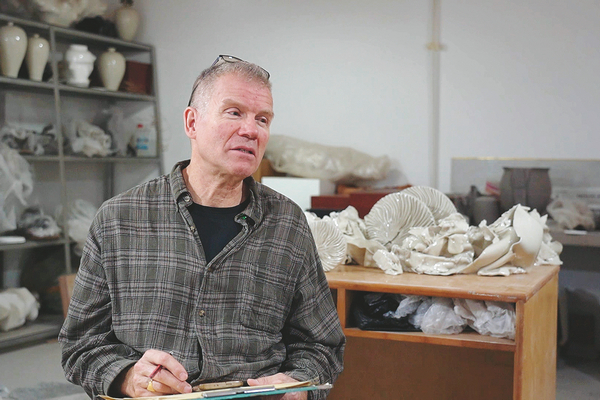
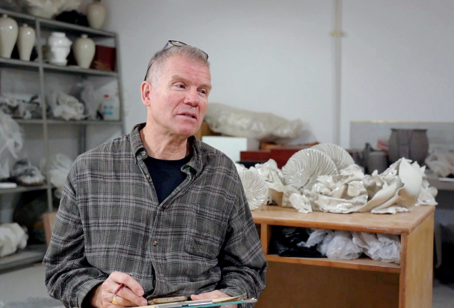
SHIJIAZHUANG — Enchanted by the beauty of white Chinese porcelain, Marc Leuthold has spent the past two months creating contemporary artworks using the local clay and firing methods of Quyang, a county in Hebei province, with over a thousand years of ceramic-making history.
Leuthold, an elected lifetime member of the International Academy of Ceramics and a retired professor from the State University of New York, has been invited to around 20 Chinese cities to exhibit, lecture and exchange ideas. He also worked full-time at an art institute in Shanghai from 2018 to 2023.
"When I came to China for the first time in 2007, I saw how everything was booming. There were opportunities everywhere and people wanted me to do all sorts of exciting things. If I had been younger, I'm sure I would have stayed," recalls the 62-year-old.
Upon his arrival in Quyang this September, the American ceramist felt thrilled.
The county is home to the Ding kiln, one of the five most famous ancient ceramic kilns that flourished in the Song Dynasty (960-1279). Quality white ceramics produced by the Ding kiln enjoyed fame for being "white as jade, thin as paper and sounding like a bell".
"My first experience with Ding porcelain was as a child. My father collected a very beautiful Ding bowl and I never will forget it," he says. "Ding ware is the most refined and elegant of the Song Dynasty ceramic cultures."
Since ancient times, Chinese artisans have been using turntables to shape and polish wet clay — hoping to produce delicate ceramic ware like vases, bottles and bowls.
Although made of Ding clay and featuring the same ivory-white glaze, Leuthold's creations are unique among rows of works because their shapes are completely different from traditional Ding porcelain items.
"The artistry in his works inspires us a lot," says Pang Yonghui, a Chinese arts and crafts master and representative inheritor of the Ding porcelain firing technique, an intangible cultural heritage.
According to Pang, Leuthold's way of handling wet clay is much bolder. Leuthold takes a lump of clay, throws it on the ground until it becomes a sheet about 5 mm thick and then uses a utility knife to draw the base before printing patterns and forming a symbolic shape such as a mountain, river or sun through folding, tearing and laminating.
"By inviting foreign ceramists with multicultural backgrounds to express themselves through traditional Ding clay and firing methods, we hope to embrace the ancient art with modern aesthetics," Pang adds.
So far, Pang's company has invited nearly 50 artists from Japan, the Republic of Korea, the United States, Canada and other countries to create art in Quyang.
"One thing I admire about China is that there's a balance," notes Leuthold, pointing out that both contemporary and traditional cultures are supported and considered essential.
As Leuthold says, "art and culture have the potential to create a bridge of understanding which may help people from different cultures work together", with his cultural journey to Quyang benefiting both China and the US.
The local porcelain industry has drawn new inspiration from this Western way of thinking and doing things. Leuthold, meanwhile, has continuously innovated with the help of traditional Chinese culture.
Leuthold plans to stay in Quyang until mid-December. However, his exploration of ancient Chinese porcelain culture will not stop wherever he is.
In February, he is scheduled to travel to Longquan in East China's Zhejiang province, where another famous ancient kiln produces green-glazed porcelain.
"I've studied that ceramic culture a lot. Their materials and glazes are different, so I can make something completely different. That's interesting to me," says Leuthold.
Xinhua