China's role highlighted in green transition of shipping







The global shipping industry still faces significant challenges in decarbonization, where China can play a critical role, said industry experts and company executives.
Decarbonizing the global shipping industry is challenging, while China's role in this transformation is vital, said Juha Pankakoski, executive vice-president for global functions at Siemens Energy, during a recent conference in Danzhou, Hainan province.
"As a leader in alternative fuel production, a major investor in clean technologies, and a strategic hub for international shipping, China is well-positioned to drive the global decarbonization of shipping," Pankakoski said. "With the right policies, incentives, and technological advancements, we can achieve a sustainable and resilient shipping industry."
Zhao Zuozhi, chief technology officer for Hub China at Siemens Energy, said reducing carbon emissions in shipping should focus on improving the energy efficiency of existing vessels and exploring alternative fuels. These strategies are crucial for achieving both short-term and long-term emission reduction targets.
The large number of vessels in operation globally makes efficiency improvements a key pathway for emissions reductions, Zhao said.
According to the International Maritime Organization, 92.6 percent of the world's operating fleet still relies on traditional fuels such as marine diesel, gasoline and heavy fuel oil.
Through innovation and operational optimization, shipping companies could significantly reduce fuel consumption and carbon emissions. By 2030, efficiency improvements could cut traditional fuel use in operating ships by 16 percent, it said.
In China, green fuels are becoming a core driver of energy transition.
In August, the National Energy Administration clarified that green liquid fuels, such as biodiesel and sustainable aviation fuel, are recognized as renewable energy. Green ammonia and green methanol were also categorized by the NEA as green liquid fuels.
According to market research firm Verified Market Reports, the global green fuel market was valued at $70.2 billion in 2023 and is projected to reach $175.1 billion by 2030, with a compound annual growth rate of 12.66 percent.
The IMO predicts that by 2050, the share of traditional fossil fuels in the shipping industry will decline to 15 percent, while green methanol's use will rise to 42 percent. Demand for green methanol in shipping is expected to reach 190 million tons by mid-century, it said.
Amid the backdrop, multinational companies working in energy and logistics are keen to deepen collaboration with China to drive positive change in energy-intensive sectors.
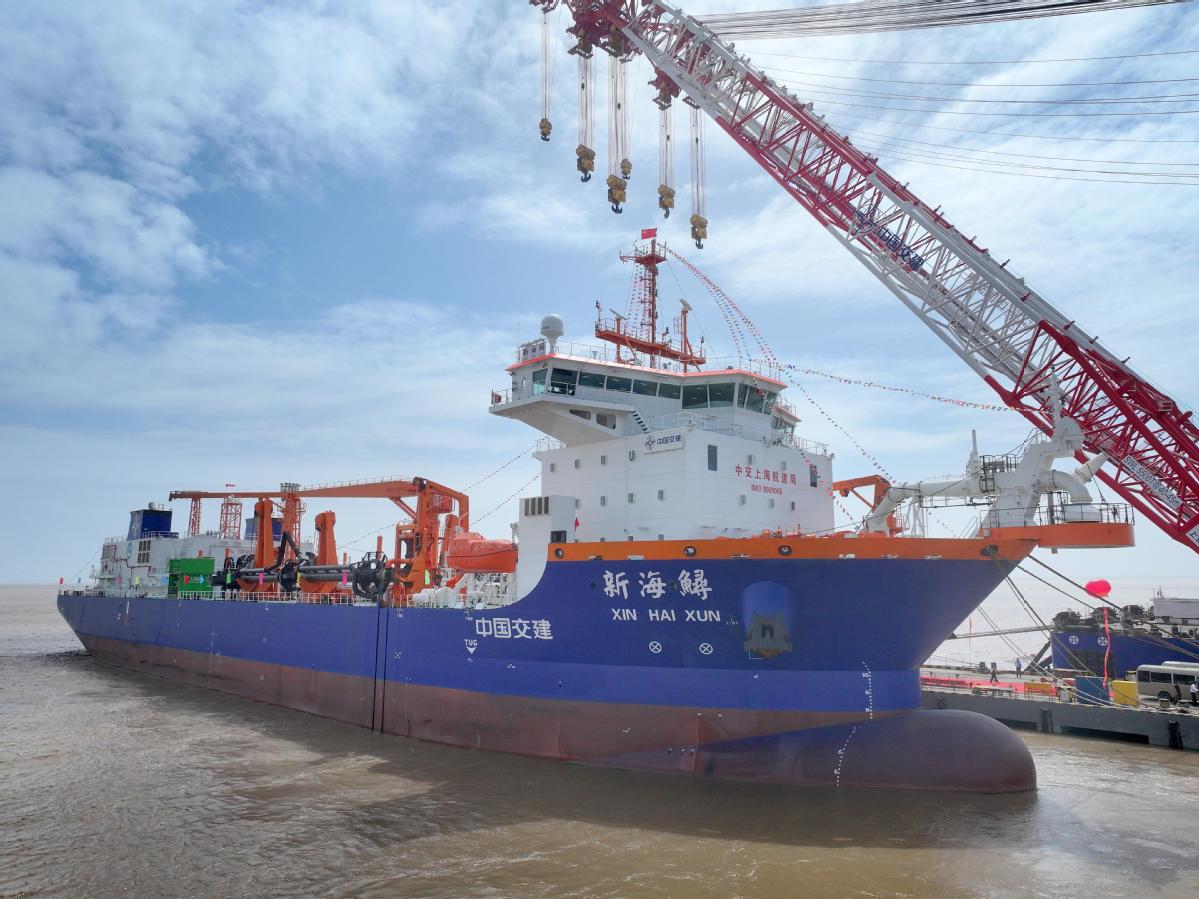
Siemens Energy is actively contributing to China's shipping decarbonization efforts by leveraging advanced energy solutions and technological innovations. Last year, China's largest clean energy ro-ro vessel was officially put into operation, for which Siemens Energy provided torque-assisted propulsion system and shaft-mounted generator systems.
Sophia Zou, partner of global consultancy Bain & Company, said more efforts are expected to explore other low-carbon fuels that are both technically and economically feasible, such as sustainable aviation fuel and green methanol, for maritime shipping.
Citing the challenges in promoting green development, Zhao of Siemens Energy said:"These include the challenges of advancing sustainable fuels, such as green hydrogen, ammonia, and methanol, which call for collaboration across the industry to integrate into shipbuilding and operations," he said.
"Establishing aligned global emission reduction frameworks and innovating solutions for retrofitting existing fleets require collective efforts and partnership."
To address these challenges, the International Clean Energy Innovation Alliance, an international, nonprofit organization supported by Hainan province and initiated by Siemens Energy and CHN Energy Investment Group, was launched during the conference.
The future of China's shipping decarbonization will depend on technological breakthroughs, policy coordination and international collaboration. Scaling up sustainable fuel production, reducing costs and accelerating the development of global fuel infrastructure networks are seen as critical steps, Zhao said.
zhengxin@chinadaily.com.cn