CHN Energy reports record year for renewable capacity







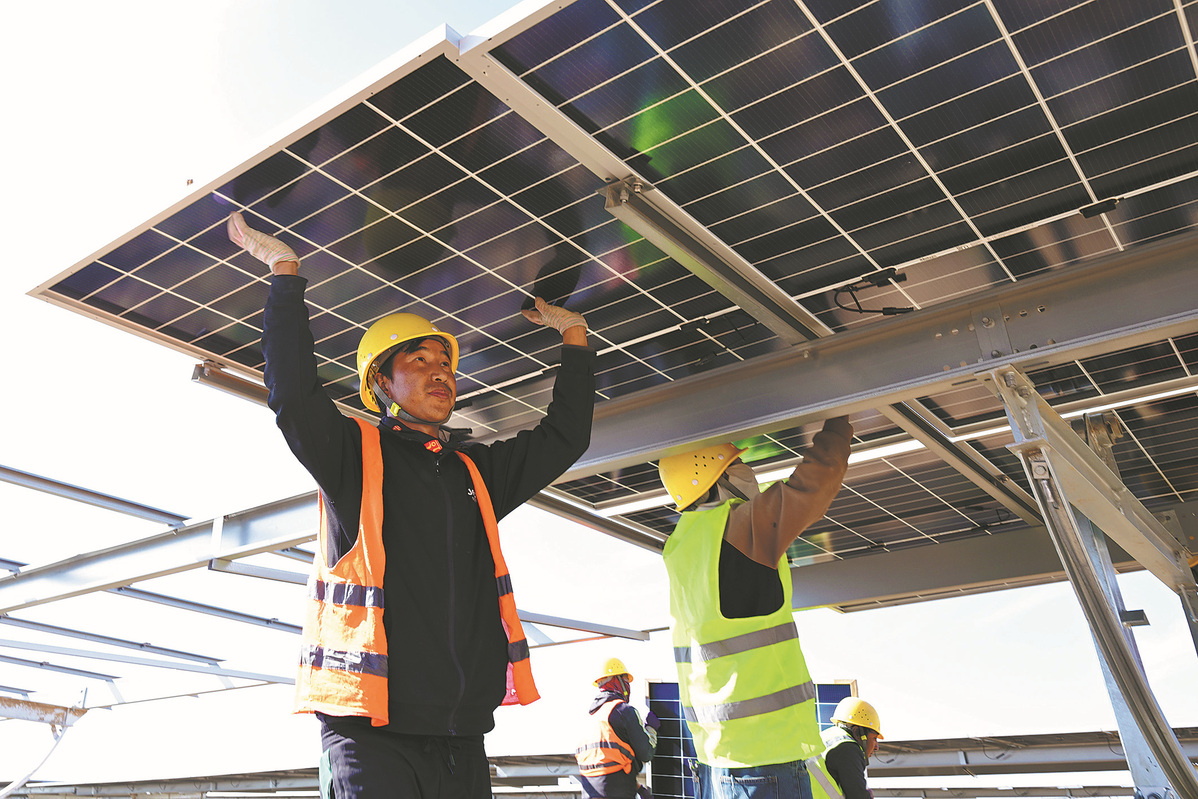
CHN Energy Investment Group is on track to step up investment in renewable energy and clean utilization of coal this year, after the group's renewable energy installed capacity hit a record high in 2024.
Last year, the company's newly installed and operational capacity of renewable energy surpassed 30 million kilowatts for the first time in history, company spokesman Huang Qing said during a news conference in Beijing on Thursday.
Renewable energy now accounts for over 40 percent of the company's total installed capacity, with the overall scale doubling compared to the end of the 13th Five-Year (2016-20) Plan, and achieving the 14th Five-Year (2021-25) Plan target one year ahead of schedule, said Huang.
In the field of new energy, the group has started the construction of 31.18 million kilowatts of capacity, with 27.73 million kilowatts already in operation, setting a record, he said.
Hydropower installed capacity has exceeded 20 million kilowatts, while the construction of conventional hydropower projects is ongoing with a total capacity of 8.24 million kilowatts, ranking first in the country.
The company, the world's largest power producer and the top wind power developer in terms of installed capacity, has vowed to actively expand investment in renewable energy in 2025, continuing to strengthen efforts in acquiring and developing offshore wind, desert and large-scale wind-solar energy base resources to further accelerate the company's green and low-carbon transformation.
Analysts noted that State-owned enterprises have long been central to large-scale development, and their growing investments in renewable energy reflect a strong alignment with national objectives for sustainable growth and energy security.
SOEs are key drivers in large-scale energy infrastructure projects and their shift is seen as essential for China to achieve its carbon neutrality target by 2060, said Wang Lining, director of the oil market department of the Economics and Technology Research Institute under China National Petroleum Corp.
This green shift is not only a response to domestic environmental challenges but also a key factor in China's broader economic resilience and leadership in the global energy transition, he said.
The company recently launched China's largest single-unit coal subsidence photovoltaic (PV) base, with a capacity of 3 GW, in Otog Front Banner in the Inner Mongolia autonomous region.
With a total investment of around 12 billion yuan ($1.64 billion), the solar power station is expected to produce 5.7 billion kWh, generating significant environmental and economic benefits.
The company has also been stepping up efforts in coal technology to boost the sector's development in recent years. It has launched an integrated spectral coal quality rapid detection technology last year, which significantly enhances the precision of coal quality detection while reducing transaction costs.
Leveraging the interdisciplinary integration of artificial intelligence, spectroscopy and chemical analysis to accurately detect moisture, ash and sulfur content in coal, the technology allows for full-scale, real-time, automatic detection across the coal supply and demand chain.
According to figures released by the National Bureau of Statistics on Friday, China's industrial raw coal production in 2024 reached 4.76 billion metric tons, up 1.3 percent year-on-year. Coal imports totaled 540 million tons, rising 14.4 percent compared to the previous year, it said.
In 2024, electricity generation by large-scale industrial enterprises totaled 9,418.1 billion kilowatt-hours, an increase of 4.6 percent year-on-year. In December, the growth rates of nuclear and solar power generation accelerated, while thermal power output shifted from growth to decline, it said.
In December, thermal power generation fell 2.6 percent year-on-year, compared with a 1.4 percent increase in November. Hydropower rose 5.5 percent, reversing a 1.9 percent decline in November. Nuclear power grew 11.4 percent, accelerating by 8.3 percentage points from November, while wind power increased 6.6 percent, compared to a 3.3 percent decline in November. Solar power generation surged 28.5 percent in December, up 18.2 percentage points from November, it said.