Reshaping education's core meaning







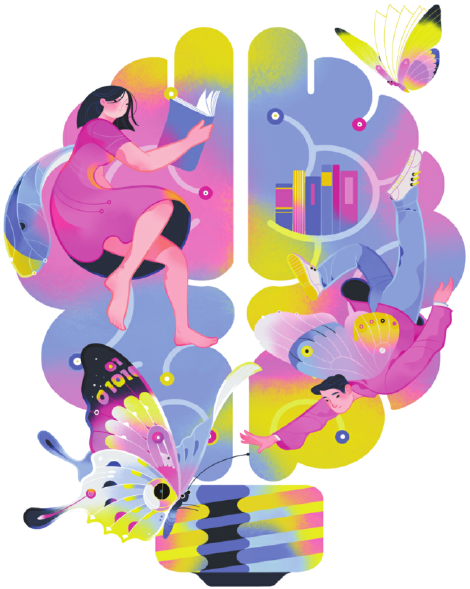
Tesla and xAI founder Elon Musk has added a worrying dimension to the growth of artificial intelligence by claiming recently that AI models have already run out of human-created data, and turned to AI-generated information to teach themselves. In other words, AI has mastered all human knowledge and started to teach itself, making human involvement in knowledge generation and dissemination unnecessary.
This conjures the vision of a "mirror maze", where the infinite reflections of possibilities hide the challenges, including the weakening of education value and marginalization of the human role.
As AI, as Musk says, gradually takes over the function of knowledge transfer, the essence of education will undergo a change, necessitating the development of new educational values and creating new roles for humans. Education in operations research thinking, as a form of liberal arts, should be used as the "wisdom key" to unravel this maze, helping humans to reshape the core meaning of education and guide society toward a new future of coexistence and mutual prosperity with AI.
The 2024 Nobel Prize in Physics was awarded to two scientists who laid the foundation for machine learning, while the 2024 Chemistry Prize recognized those using AI to predict protein structure and computational protein design. This means basic disciplines such as physics and chemistry could lose their significance in the future because of AI's supercomputing power. As AI gradually takes over the generation and application of knowledge, aspects like self-improvement along with some traditional disciplines may either disappear or will be replaced.
The underlying logic of AI is the science of thinking. AI's knowledge capability could far exceed those of humans, creating the need for education to enhance human thinking ability in order to coexist with AI while maintaining control over it. Operations research (OR) thinking, as a core competency, embodies balanced ideas of coordination and optimization, focusing on finding relatively stable and optimal solutions in complex systems. This thinking helps humans to investigate and make strategic choices in an AI-driven ecosystem, forming an indispensable cornerstone of intelligent societies.
AI and operations research are like twin entities, entangled in a quantum-like relationship. AI's large models are rooted in the theoretical framework of operations research, which, empowered by AI, breaks through traditional methods, facilitating innovation in both theory and practice. The deep integration of the two drives technological progress and societal transformation, forming a parallel ecosystem.
The core of education has shifted from knowledge transmission to shaping a new civilization. Education in operations research thinking plays a key role in promoting collaboration between AI technology and human values, helping humans to find their place in the "AI-OR" symbiotic ecosystem, and ensuring long-term stable development and mutual prosperity.
Daron Acemoglu, the 2024 Nobel Prize winner of Economics, has warned that if technology serves only a few, it will worsen social inequality. Operations research thinking's generalized education aims to develop systematic decision-making, forward-looking planning and critical thinking skills, enabling individuals to coordinate the allocation of resources and optimize strategies, and ensuring advanced technologies are not monopolized by a minority.
That's why operations research thinking is essential for preventing AI abuse. As super-intelligent robots take over most cognitive tasks, humans must become "value enablers" and "system designers". This thinking emphasizes systematics, cooperation and balance, offering a framework for managing complex systems and ensuring humans maintain their irreplaceable role in design, optimization and ethical oversight, while mitigating risks like "technological misuse" and "algorithmic bias".
As AI replaces human labor, the ethics of technology use will become central, helping humans to learn foundational skills such as modeling, optimization and systems analysis, while using operations research thinking to evaluate global challenges such as climate change.
In the final analysis, education in operations research thinking can help reshape humans' role in future society, by enabling individuals to improve their problem-solving and decision-optimization skills, and ensuring humans retain control of societal functions, reshape their value and contribute to a new, value-driven social structure.
As such, education in operations research thinking should focus on three core areas: curriculum innovation, technological empowerment and industry-education collaboration. The goal is to create a global education paradigm that fosters inclusive, innovative thinking and ethical responsibility among people across the world, while helping reshape the global education system.
Moreover, by leveraging generative AI, course content should focus on how to address major global issues, and use data-driven case studies and interdisciplinary problem-solving mechanisms to teach students the skills to tackle complex challenges.
The aim of technological empowerment is to deepen the integration of education and technology, and ensure AI and virtual reality create immersive learning environments, where students can experience the entire process from modeling to optimization.
The collaboration between industry and education fosters a two-way connection between education and social needs, so universities and enterprises should work together to develop industry-oriented educational resources based on generative AI and big data.
Besides, the "Outline of the National Plan for Education Modernization" has set a goal, the goal of China becoming a knowledge-driven country by 2035.
A country's strength relies not only on technology and systems but also on the direction it takes, the rules it makes, as well as operations research thinking, with the latter providing a governance framework for managing complex systems, balancing interests and integrating technology with ethics.
As a key driver of technological equality and sustainable prosperity, operations research thinking also helps to prevent the risk of "technological backlash" and supports the establishment of new social ecosystem and a highly educated society.
The author is a distinguished professor at Sichuan University, and a member of the National Committee of the Chinese People's Political Consultative Conference.
The views don't necessarily reflect those of China Daily.
If you have a specific expertise, or would like to share your thought about our stories, then send us your writings at opinion@chinadaily.com.cn, and comment@chinadaily.com.cn.