Drones reducing costs while boosting efficiency
Nation's UAV market is forecast to surpass 600 billion yuan by 2029







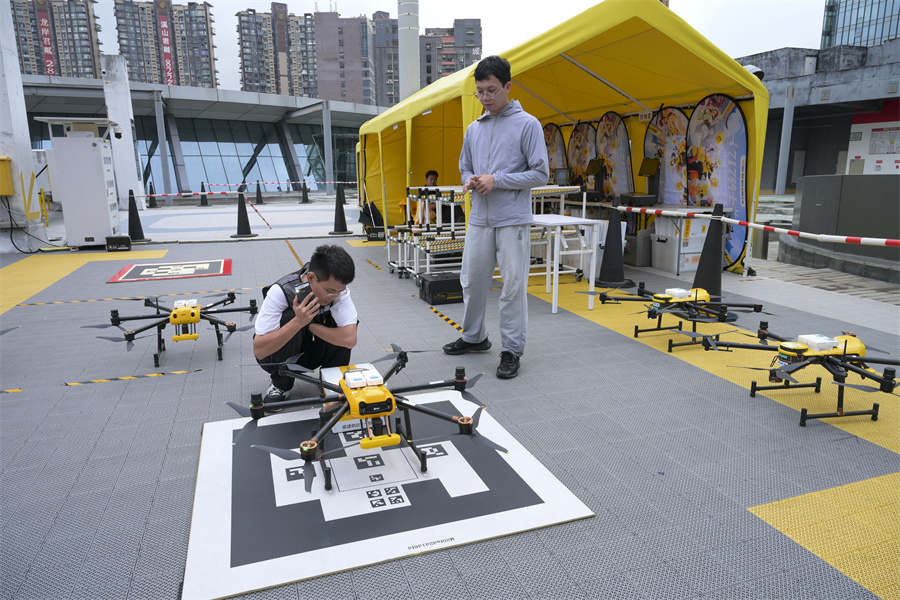
BEIJING — In China's ambitious bid to reclaim its vast, arid landscapes, drones have emerged as powerful tools, flying over the Kubuqi Desert each spring, autumn and winter to spread seeds, reinforce windbreaks and rejuvenate fragile ecosystems.
Li Ting, a millennial with a decade of experience in desertification control, has witnessed firsthand how unmanned aerial vehicles are transforming both the landscape and the approach to combating desertification.
"It has not only reduced the reliance on manual labor, but also significantly lowered operational costs and boosted efficiency. Drones allow workers to carry out their tasks regardless of weather conditions, as long as extreme weather does not occur," Li said.
Li's experiences mirror the broader drone revolution sweeping across various sectors in China, from agriculture to infrastructure, where such devices are delivering game-changing solutions to boost efficiency and productivity.
Drones that are made in China combine affordability, quality and continuous technological advancements, driving their innovative adoption in new areas.
Deploying drones to fight desertification, for instance, is a new application scenario where China has taken the lead, according to Li, who has traveled to countries like the United States and Singapore to learn about drone applications.
In the early years, desert reclamation efforts were labor-intensive, with workers scattering plant seeds by hand across the vast, arid expanses of the desert. This method was slow, inefficient and costly, with limited coverage and uneven distribution of seeds, Li recalled.
He explained that it took three to five people to manually sow seeds on a few dozen mu (1 mu is equal to about 0.07 hectares) per day, at a daily labor cost of around 500 yuan ($69), whereas a single drone can cover 300 mu daily at just 6 yuan per mu, making the process three to four times more efficient than manual labor. "Drones significantly reduce costs and boost productivity, enabling large-scale desert reclamation projects on an unprecedented scale."
Li Lingling, general manager of E-Hawk, a drone manufacturer based in Central China's Hubei province, echoed this sentiment, noting that China boasts a higher UAV adoption rate than many advanced economies, thanks to its robust, well-developed industrial supply chain, which has significantly lowered production and research and development costs for Chinese drones. "Drones made in the United States are often more than three times as expensive as their Chinese counterparts."
"China's UAV market has experienced explosive growth in recent years, but before that, companies like ours had been laying the groundwork in the sector for over 10 years," Li said, noting that her company began developing drones in 2014, with a focus on the mid-sized drone market.
China's drone market is forecast to experience continuous growth from 2024 to 2029, surpassing 600 billion yuan by 2029, with a compound annual growth rate of 25.6 percent during this period, according to a report released by Zero Power Intelligence Group, an industry research company in China.
The expanding fleet of drones is now set to take on tasks once deemed too costly or dangerous for human workers, such as high-altitude work.
Li Lingling cited the installation of her company's gleaming metal sign as an example. The sign, made up of eight character blocks weighing several hundred kilograms, would have cost around 10,000 yuan to install with a professional rigging team. However, by deploying a self-developed heavy-lift drone, the company completed the installation at nearly zero cost.
- Tesla's Shanghai energy-storage battery Megafactory to enter operation next week
- Changsha's Tongguan Kiln puts on Chinese New Year extravaganza
- Let's go to factories -- Factory tours emerging as new Spring Festival travel trend
- Chinese expertise helps restore damaged monument in Nepal
- China sees travel surge as Spring Festival holiday concludes