Sea sentinels
Marine mammals call Southeast Asia's waters home







Editor's note: In this weekly feature China Daily gives voice to Asia and its people. The stories presented come mainly from the Asia News Network (ANN), of which China Daily is among its 20 leading titles.
Many people living in Southeast Asia often think they have to visit Australia, the United States or Japan to see whales, but such marine mammals can also be found in the waters in the region.
Marine mammals have been sighted across Southeast Asia, one of the world's marine biodiversity hot spots with more than 3,000 species of fish and 600 types of corals.
Marcus Chua, who studies mammals at the Lee Kong Chian Natural History Museum at the National University of Singapore, or NUS, said the presence of marine mammals shows that local habitats are able to support a population of large predators, or, in the case of the dugong, large herbivores.
Louisa Ponnampalam, the co-founder of Malaysian marine mammal research and conservation group MareCet, added: "The significance of losing (marine mammals) would mean that their habitats can no longer support them."
"We should be really concerned about our own future should we ever lose them, because it means the sea around us is no longer healthy, and we humans rely so much on the sea for so many things, whether we realize it or not," Ponnampalam said.
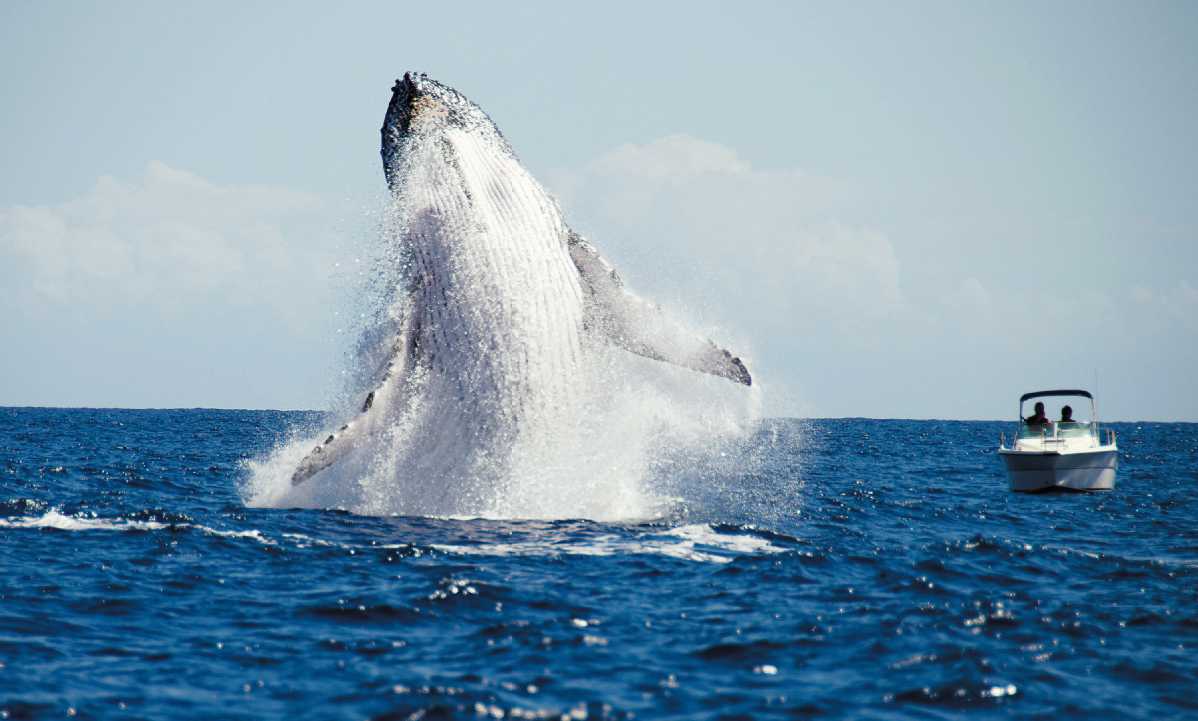
Found off the coasts of the Philippines and Thailand between October and January in search of warmer waters for mating and reproduction, humpback whales can grow up to 18.3 meters in length and weigh up to 36,280 kilograms, or the approximate mass of three to five buses.
Once hunted to the brink of extinction, their numbers have gradually recovered, thanks to conservation efforts.
Another marine mammal species, sperm whales, categorized as being vulnerable to extinction, can grow up to 18 meters, with the largest brain of any animal. A whale's brain is five times the size of a human brain, weighing up to 9 kg, six times heavier than a human's.
Though generally spotted off Malaysia, Indonesia, Brunei and Cambodia between April and July for feeding, mating and molting (the process of whales to exfoliate their skin), the carcass of a sperm whale was beached along Jurong Island in Singapore in 2015.
Nicknamed "Jubi Lee", it was found with its spine broken in several places, likely from a ship strike. Its skeleton now hangs in the Lee Kong Chian Natural History Museum.
Additionally, an increase in sightings of Bryde's whales in Southeast Asia were reported lately, with three spotted in Thai waters in November. Also found off Indonesia and Brunei, they are among the few whale species that prefer warmer waters above 15 C. Hence, they are also known as tropical whales.
In 1994, the carcass of a false killer whale surfaced on the coast along Tuas in Singapore, and was mistaken for a shark by two men who discovered it while hunting for crabs. Its species was later correctly identified by Underwater World Singapore.
Irrawaddy dolphins can be found in estuaries and the coastal waters of Vietnam, Indonesia, Brunei, Cambodia, Laos and Myanmar. Growing and weighing up to 2.7 meters and 130 kg, they feed on bony fish and fish eggs. These endangered dolphins herd fish into their hunting area by squirting streams of water that reach up to 1.5 meters.
The only porpoise to lack a dorsal fin, the Indo-Pacific finless porpoise can be spotted in estuaries and shallow coastal waters around Singapore, Malaysia and Thailand.
Despite resembling whales, dolphins and porpoises, dugongs are believed to be more closely related to elephants. These herbivores are typically sighted in estuaries and shallow coastal waters around Singapore, Malaysia, Indonesia, Cambodia, Vietnam and the Philippines.
Dugongs are commonly known as "sea cows", due to their herbivorous diet, with adult dugongs consuming up to 30 kg of seagrass daily, said Sirius Ng, a PhD student studying marine mammals at the NUS.
As they are found in only areas rich in seagrass, it indicates that the area of water is still able to support the existence of the meadows, which in turn supports these species' ability to continue existing in an area, said Ponnampalam.
According to Ng, studies have shown the germination of seagrass seeds speeds up once it has passed through the dugong's digestive system, and they are later deposited onto the seabed when it defecates.