


Yinxu's young museum a big draw for the nation








Since opening to the public on Feb 26 last year, the Yinxu Museum in Anyang, Henan province, China's first comprehensive archaeology museum dedicated to the Shang Dynasty (c. 16th century-11th century BC), has embraced the enthusiasm with which it has been greeted, and has become a new calling card for the city.
Receiving over 1.8 million visits in 2024, its popularity made a huge splash in China's museum circle last year.
A series of activities marking this anniversary was held in Anyang between Tuesday and Thursday, including lectures, seminars and performances related to Shang civilization.
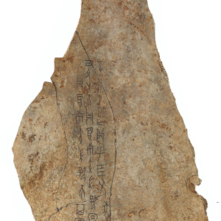
To celebrate the occasion, a new exhibition, The Show of King's Return: The Inscribed Oracle Bone Collections of Tianjin Museum Back to the Great Settlement Shang, kicked off on Wednesday, with a display of 36 inscribed oracle bones that were discovered at the Yinxu Ruins in the late 19th century.
Directly related to Wu Ding, a Shang Dynasty king, this was the first time these bones, now part of the Tianjin Museum collection, returned to the place from where they were unearthed.
Oracle bone inscriptions, used for fortune-telling and recording, compose the earliest-known established writing system in China. In 2017, the inscriptions were listed in the UNESCO Memory of the World Register program.
"Oracle bone inscriptions can now be found in more than 200 institutes around the world. In my heart, they are living and want to return to their origins in Anyang. I believe even a brief stay here will bring them comfort. Although this wish seemed difficult to fulfill, it has finally come true," says Song Zhenhao, an oracle bone expert at the Chinese Academy of Social Sciences.
Named after the nearby Yinxu Ruins, a UNESCO World Heritage Site, the museum is a display of the highest civilizational achievements of China during the Bronze Age through more than 4,000 artifacts, including bronze, pottery and jade vessels, and oracle bone inscriptions, according to Shi Jinsong, deputy director of the Institute of Archaeology with the CASS, and also acting director of the museum.
Shi says that Yinxu occupies an important place in the birth and development of archaeology in China.
First excavated in 1928, it is the country's longest studied ancient capital city as excavations continue to this day. It is also a cradle for its most famous archaeologists, many of whom left footprints at the site during their careers.
"At the museum, we can see the beginning and development of archaeology in China, the evolution of ideas, methods and techniques. We can also see the exploration and achievements of Chinese archaeologists," Shi says.
Archaeologist Wang Wei highlights the performance over the past year. "Undoubtedly, this is a good museum, as it provides understandable content to even middle school students and arouses their interest not merely through text, but well-designed displays," Wang says.
"The artifacts leave a lasting impression on visitors since they are introduced in the most straightforward and effective manner. I believe it has taken a leading position among China's museums."
He Yuling, head of the Anyang workstation affiliated to the Institute of Archaeology with the CASS, says Yinxu Museum may just have celebrated its first birthday, but the Yinxu Ruins date back some 3,000 years.
Consequently, the young institution still has a long way to go to fully illustrate the history and culture it contains.
"The museum has an inexhaustible vitality as we are constantly introducing artifacts and archaeological achievements fresh from the site," He says.
Contact the writers at wangru1@chinadaily.com.cn