


Simple mausoleum in Henan belies importance of warrior occupant







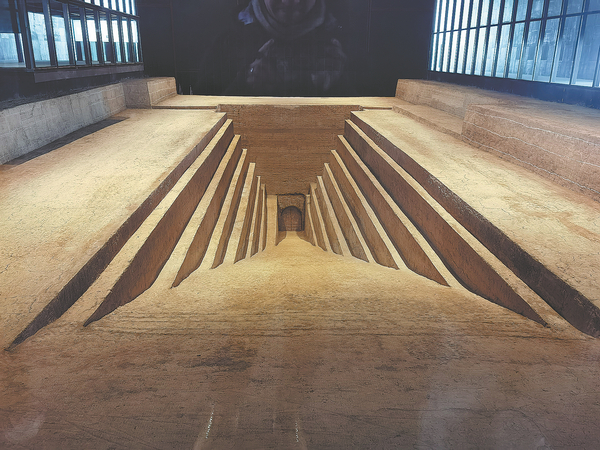
The mausoleum in suburban Anyang, Henan province, seemed not to match the fame of its occupant, the late Eastern Han Dynasty (25-220) warlord and poet Cao Cao.
Standing in front of the Cao Cao Mausoleum Museum, I saw a grand building in black and red, noble colors during Cao's time. The museum, which opened in 2023 and is about a 40-minute drive from downtown Anyang, is built on the site of the mausoleum.
I couldn't help feeling that without the presence of such a building, the mausoleum would have gone unnoticed in the farmland around. No wonder it had disappeared from history for 1,800 years.
Western Jin Dynasty (265-316) historian Chen Shou once said of Cao that he was "an extraordinary man and a great talent". In the turbulent era at the end of the Eastern Han Dynasty, he unified northern China and paved the way for his son to found the Wei Dynasty (220-265), one of the three dynasties that coexisted during the Three Kingdoms (220-280) period. Although Cao could not have the last laugh as he died in 220 without seeing the unification of China, he wrote a remarkable page in Chinese history and spawned a number of legends. His writing, especially his poems, also earned him a name in literature.
Before his death, Cao requested a simple burial. He didn't want a large mound above his chamber, stone tablets to mark his mausoleum, or precious gold or silver funerary objects to accompany him in the afterlife.
This goes with his reputation of being frugal, but even so, his decision was unusual, because at the time, people of high social status tended to be buried with many precious funerary objects, which they believed they would continue to enjoy in the afterlife. Cao bucked tradition, and his final words said he chose to be buried like this because the country was not yet stable.
According to legend, Cao had plundered tombs to support his army, and so some say that he knew any precious object would be stolen. That sounds like a reasonable explanation, but even so, his wish for his tomb not to be disturbed failed despite the lack of precious artifacts.
In the replica of the burial chamber at the museum, I saw the two big holes through which plunderers entered the burial chamber. One has been inferred as a form of political revenge during the Western Jin era.
When archaeologists finally opened the mausoleum in 2008, they found only a skull and some bone fragments. DNA testing shows they belonged to a male who died in his 60s, probably Cao, whose facial bones were badly damaged. Two female remains were more or less intact, and probably those of consorts.
It took researchers years to combine scattered evidence, including descriptions in documents, unearthed objects, and comparative DNA analysis of Cao's descendants, to identify the site as his mausoleum, which was historically referred to as Gaoling.