Intl brands adjust strategies to catch up
Global automakers look to make up lost ground in competitive Chinese market







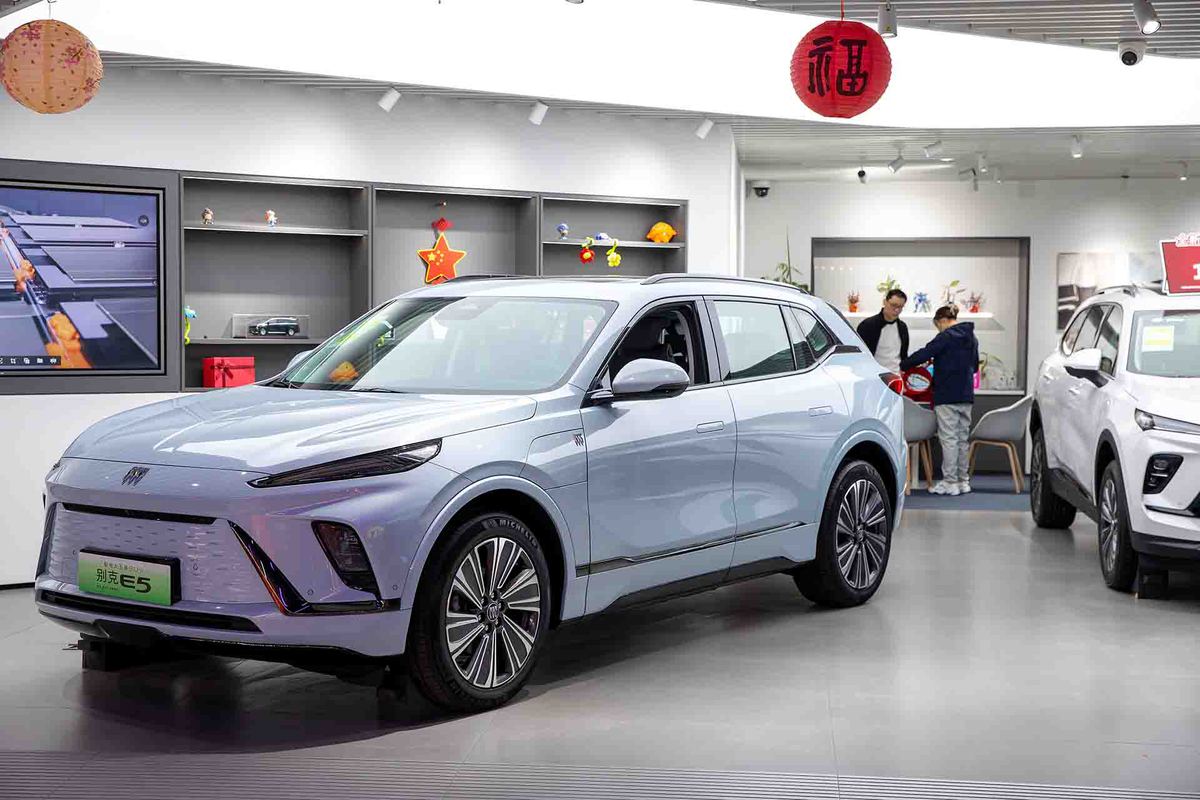
Foreign carmakers are adjusting their operational strategies in China as they seek to prevent losing further ground to local vehicle companies amid intense competition in the world's largest vehicle market.
According to data from the China Association of Automobile Manufacturers, Chinese-brand passenger car sales reached 2.13 million units in January, 68.4 percent of the market share — an 8 percentage-point increase year-on-year.
Facing this trend, global automakers such as Volkswagen and Toyota are adjusting their strategies, seeking to regain competitiveness in the market through marketing reforms and localized research and development.
Late last month, Sino-US joint venture SAIC GM started a "fixed-price" sales strategy for its Buick marque, in an effort to boost its appeal amid intense competition in the Chinese vehicle market.
The transparent, non-negotiable pricing approach, inspired by direct-sales strategies used by new energy vehicle makers, will be rolled out gradually across its entire product lineup.
Xue Haitao, deputy general manager of SAIC GM, emphasized that as the industry's shift to electrification accelerates and competition intensifies, traditional car manufacturers must innovate and adapt their marketing strategies.
"The 'fixed-price' model aims to reduce consumer uncertainty when purchasing a vehicle. It is not merely about competing on price but ensuring that customers receive genuinely fair and transparent treatment," Xue said.
These flexible marketing approaches are expected to enhance its competitiveness in the country's heated smart NEV market.
Chinese brands have attracted a large number of consumers with intelligent cockpits, optimized software systems and faster product iterations.
Emerging Chinese electric vehicle brands such as Li Auto and Aito are gaining traction in the high-end market, as some traditional premium car buyers are shifting toward domestic NEVs.
"Electrification and intelligent technology are the defining trends of China's automotive industry," said Zhang Xiang, a fellow at the Research Center of Automobile Industry Innovation of the North China University of Technology.
"Market demand is accelerating the transition of automakers, which is essential for achieving sustainable development and enhancing competitiveness," said Zhang.
In 2024, Chinese-brand passenger car sales reached 17.97 million units, marking a 23.1 percent year-on-year increase and accounting for 65.2 percent of total passenger vehicle sales — an increase of 9.2 percentage points from the previous year, according to the CAAM.
As their market share declines, international brands are accelerating localized R&D efforts and advancing electrification and intelligent technology upgrades to woo back Chinese customers.
In 2024, Volkswagen announced a partnership with domestic EV startup Xpeng to jointly develop intelligent EV models for the Chinese market.
FAW-Volkswagen revealed plans in February to incorporate AI models such as DeepSeek to further explore applications of intelligent technology.
Meanwhile, BMW plans to launch over 10 NEV models in 2025 while optimizing its in-car software to better suit local user preferences.
Japanese automakers are also accelerating their NEV transition. GAC Honda plans to launch three all-new EV models and has introduced upgraded intelligent features in its latest electric P7 SUV.
Nissan aims to roll out eight new NEV models in China by 2026, while the electric sedan bZ3 jointly developed by Toyota and BYD has been on the market for two years.
International carmakers' urgent need to adjust their business in China is also due to their falling profits as a result of their sales slumps.
According to Chinese news outlet The Paper, Mercedes-Benz experienced a 6.7 percent decline in sales in China in 2024, with its revenue dropping 8.5 percent year-on-year in the country, and this trend is expected to persist into 2025.
Mercedes-Benz China initiated layoffs in February, reducing its workforce by approximately 15 percent, according to local news reports.
Despite facing significant challenges, international automakers said they will not retreat from the Chinese market.
Volkswagen projects China's annual car sales to reach 28 million units by 2030, with the automaker aiming to capture a 15 percent market share — higher than its current level.
wangyuchen@chinadaily.com.cn