Private firms encouraged to further invest in nation's EV charging service







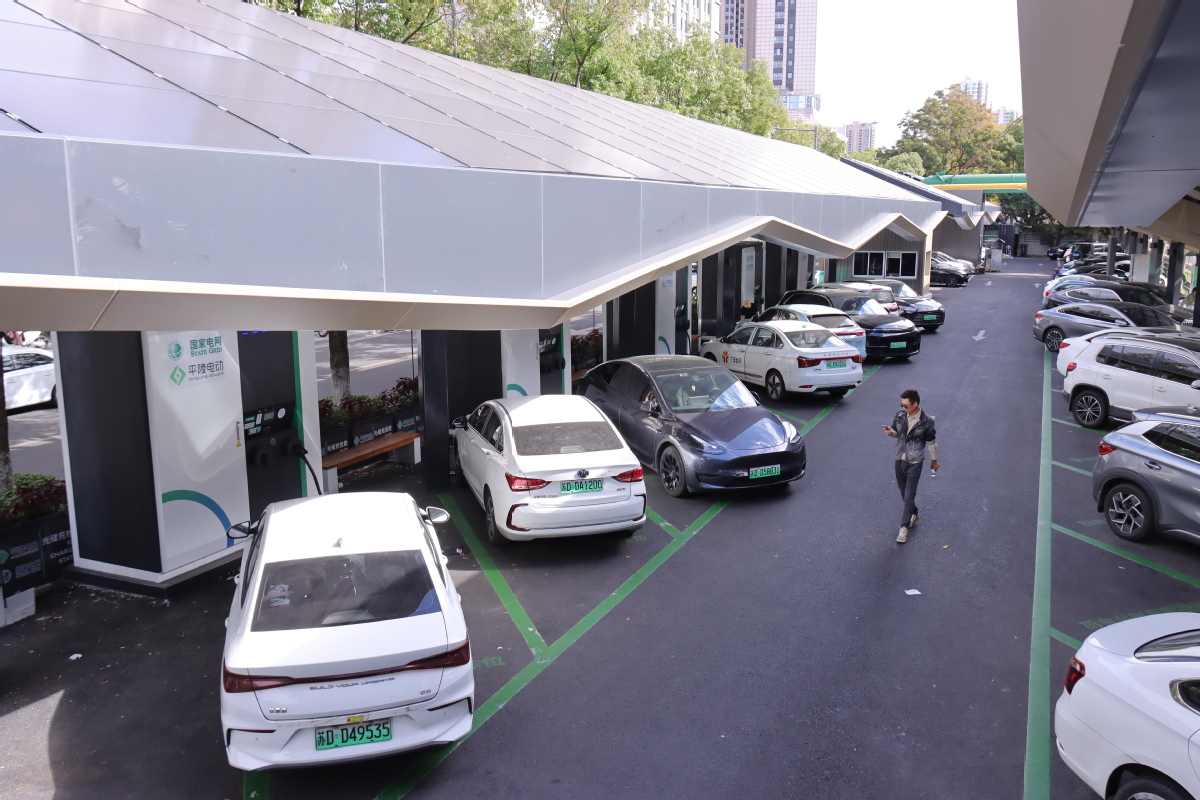
China's private sector has been playing a key role in expanding the country's public electric vehicle charging network, with private enterprises accounting for a significant share of the fast-growing market, according to the nation's top energy authority.
The National Energy Administration is encouraging private enterprises to participate in the battery services sector to meet the growing demand for EV charging, reducing the need for government funding and enabling a more market-driven approach.
As of early this year, there were more than 10,000 charging operators across the country, with private companies accounting for over 80 percent of large-scale operators — those managing more than 10,000 charging facilities — contributing to a more reliable and advanced charging network, the administration said.
China's central leadership has vowed to continue promoting private sector involvement in major energy projects this year, including nuclear power, oil and gas exploration, energy storage, smart grids and other general power infrastructure construction, to deliver more efficient and smooth operation of the market.
The private sector has been serving as a key engine driving China's economic development in recent years, which has further spurred technological innovation and increased efficiency, enhancing the Chinese economy's overall competitiveness and sustainability.
According to the administration, China's four largest charging operators, including Teld New Energy Co and Star Charge, are all private companies and collectively hold more than 50 percent of the market.
The rapid growth of the private sector's participation in the construction of a public EV charging network comes as China expands its EV charging infrastructure to support the world's largest electric vehicle market.
According to the National Development and Reform Commission, China boasts the world's largest new energy vehicle consumption market, and Chinese NEVs account for more than half of the world's total.
By the end of 2024, the country's total number of charging facilities had reached 12.82 million, up 49 percent year-on-year, according to data from the National Energy Administration.
The total charging volume by the end of last year exceeded 110 billion kilowatt-hours, marking a 38 percent year-on-year increase. Meanwhile, China has also installed 35,000 charging stations along its highway service areas, covering 98 percent of the network, the administration said.
Data released by the China Electricity Council shows that the battery charging and swapping sector — one of the fastest-growing industries in terms of electricity demand — registered an annual growth rate of 62.1 percent since the start of the 14th Five-Year Plan period (2021-25).
Last year, the electricity consumed by battery charging and swapping services witnessed an impressive jump of 50.9 percent, with total usage reaching 81.1 billion kWh, the council said.
Industry experts said the push to expand charging infrastructure aligns with China's broader efforts to accelerate its transition to NEVs and reduce reliance on fossil fuels.
Lin Boqiang, head of Xiamen University's China Institute for Studies in Energy Policy, said the central government has rolled out policies to encourage investment in the sector, including financial incentives and land-use support for the construction of charging stations.
A diverse mix of public and private players fosters competition, which can pull down costs, improve user experience and promote long-term sustainability of the charging network, he said.
Data shows that the number of NEVs on the road in China has continued to increase at a faster pace, reaching 31.4 million by the end of last year, a 260-fold surge over the past decade, thanks to the country's technological progress and its improvement of charging infrastructure.
Lin said that as China's energy sector is increasingly driven by market forces, it is expected that private companies will receive greater encouragement to invest in energy development, utilization and infrastructure projects.
zhengxin@chinadaily.com.cn