Mastering mahjong: a game of strategy
Top players from across China prove that mahjong is more than just a game — it's a test of strategy, skill, and endurance.







Mahjong has long been a beloved pastime across China, but few realize it's also a sophisticated intellectual sport.
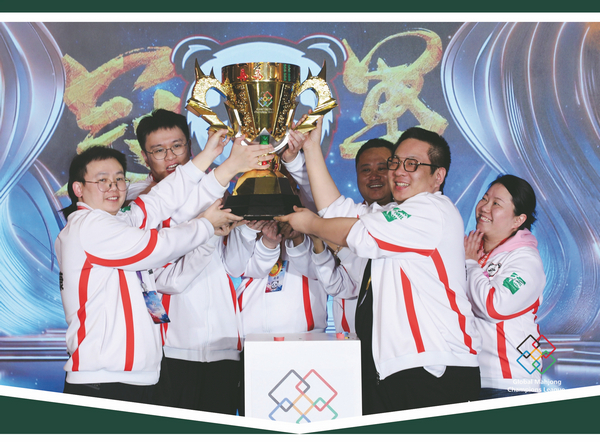
From March 1 to 4, the Global Mahjong Champions League 2024 China Finals were held in Hangzhou, Zhejiang, featuring 16 top teams from across the country and nearly 200 professional mahjong players.
After 10 hours and 64 intense games on the final day, the Sichuan Panda Club emerged as the champion.
During the four-day event, the team fielded eight players, with Wang Yu, 29, from Chongqing, and Ge Rui, 32, from Deyang, Sichuan, serving as core members. Both Wang and Ge played almost continuously throughout the competition.
"It shows that mahjong is indeed a sport that tests not only mental but also physical strength," explained Wu Taikang, the captain of the Sichuan Panda Club and one of the participants.
The members of the Panda team all have full-time jobs in diverse fields such as education, technology, investment, acting, and directing.
They usually play mahjong once a week to keep their skills sharp. However, to prepare for this competition, they engaged in intensive training sessions, practicing and analyzing live match videos, sometimes until 3 am.
According to Wang, there is a key difference between casual and competitive mahjong. In recreational play, the focus is on perfecting each hand. Competitive mahjong, however, relies on a strict point system and follows a duplicate rule, with four players at each table from two different teams. This reduces the influence of luck and requires participants to concentrate on strategy, teamwork, and card-counting skills, including logic, memory, and mathematical abilities.
Dispelling misconceptions
The Panda team's average age is around 30, and its members boast impressive educational backgrounds, earning them the nickname "academic team".
Wang and Ge both graduated with bachelor's and master's degrees from Peking University, while Wu graduated from the prestigious Harbin Institute of Technology in Heilongjiang and later obtained an MBA from Tsinghua University.
However, Ge stated that he doesn't want people to misunderstand that "only smart people can play mahjong".
"A good sense of the game can solve over 95 percent of the problems," he explained. "When I was a kid, I quickly picked up the rules just by watching my parents play. Anyone with strong analytical skills can play well."
Wang agreed. "My mom plays mahjong much better than I do," she laughed, highlighting the importance of practice and experience in mastering the game.
Despite the team's success, competitive mahjong still faces a major challenge: prejudice.
"When people talk about mahjong, many still associate it with idleness or even gambling. But competitive mahjong is entirely free of gambling," Wu explained. "We advocate for healthy mahjong playing and encourage people to take the game seriously."
The club's motto is: Enjoy the fun of mahjong, convey the competitive spirit. According to Wu, true "competitive spirit" is about not giving up, embracing challenges, analyzing problems, and finding solutions.
"This is the spirit we aim to share with the world through mahjong — a spirit that young people should embody," he said.
Changing the image of mahjong is a long-term effort that requires dedication from those involved in competitive play.
As Wu noted, public perception may gradually shift from skepticism to neutrality, and eventually to appreciation — recognizing mahjong as a "national treasure" that showcases the depth of Chinese culture.
"When I play mahjong, I feel connected to the wisdom of our ancestors who created and developed this game. The element of uncertainty and randomness reflects the natural order and objective laws of the world," Wu elaborated. "Mahjong trains people to handle complex situations in life and work."
Although mahjong originated in China, it has gained global recognition.
In 2017, the World Mind Sports Games officially designated mahjong as a competitive sport. Hollywood star Julia Roberts is also a mahjong fan and once described the essence of the game in an interview:" (Mahjong is about) creating order out of chaos based on the random drawing of tiles."
Wu first participated in a global mahjong competition in 2016, with teams from Asia, Europe, and the Americas. According to him, many countries, such as Canada, Russia, and Singapore, host regular local competitions. In Japan, there are even professional mahjong players who can make a living from it full-time.
Immense potential
In China, the development of competitive mahjong has made significant progress in recent years. A club-based operating system has been established, along with a structured athlete development program.
Currently, mahjong players are ranked from amateur first level to professional ninth level. The Panda team's recent championship victory will elevate Wang and Wu to professional fifth level, while Ge will become a top-ranked player in China, certified by the Mahjong International League.
The rise of livestreaming and short video platforms has also accelerated the sport's expansion.
For example, the 2024 China Finals live broadcast reached more than 300 million viewers. Over the past three years, more than 5.2 million people nationwide have registered as professional mahjong players.
Wang has noticed that more young people are tuning in to mahjong livestreams and adopting a more "academic" approach to the game as they analyze match footage.
Ge expressed his hope to present more exciting matches in the future.
"As a relatively veteran team, we hope to promote the spirit of competitive mahjong, expand the sport further, and contribute to its development," he said.
contact the writer at guiqian@i21st.cn