Balance sought between govt intervention, market







What is China's new economic momentum? Recently, my colleagues and I conducted a study on the evolution of industries amid economic fluctuations. Over the past 30 years, China's economy has grown through cycles, transitioning from being primarily driven by labor-intensive sectors to capital-intensive ones.
Our research employed production network analysis to quantify the contribution of infrastructure and real estate to economic fluctuations. This method examines the input-output relationships across industries. For instance, when the property market rises, cement supply increases accordingly, and furniture supply follows suit, not to mention interior decor purchases and durable big-ticket items like white goods. While we won't delve into the technical methodologies here, our findings were quite unexpected.
Since 1992, reform and opening-up moves kicked off an economic boom, and various industries contributed to overall economic growth. But infrastructure and real estate were particularly significant. After China joined the WTO in 2001, the economy flourished again but later slowed due to the global financial crisis in 1997-98. After the 2008-09 sub-prime loan crisis recovery, infrastructure and real estate emerged as the primary growth engines.
The conclusion is somewhat stark — China's economic prosperity over the past decade has been heavily reliant on infrastructure and real estate. Other industries played a role, but their contribution to economic fluctuations was relatively mild.
This finding carries an important implication for today. Economic uncertainty looms at present, whether due to US policies under President Donald Trump or other administrations. However, if our research holds true, then stabilizing the real estate market may be crucial for macroeconomic stability.
What will drive the next growth phase? A more pressing question is what industries will support and sustain China's economic growth. A former US official once expressed uncertainty about which industries would become China's next growth engines. It is worth deep reflection.
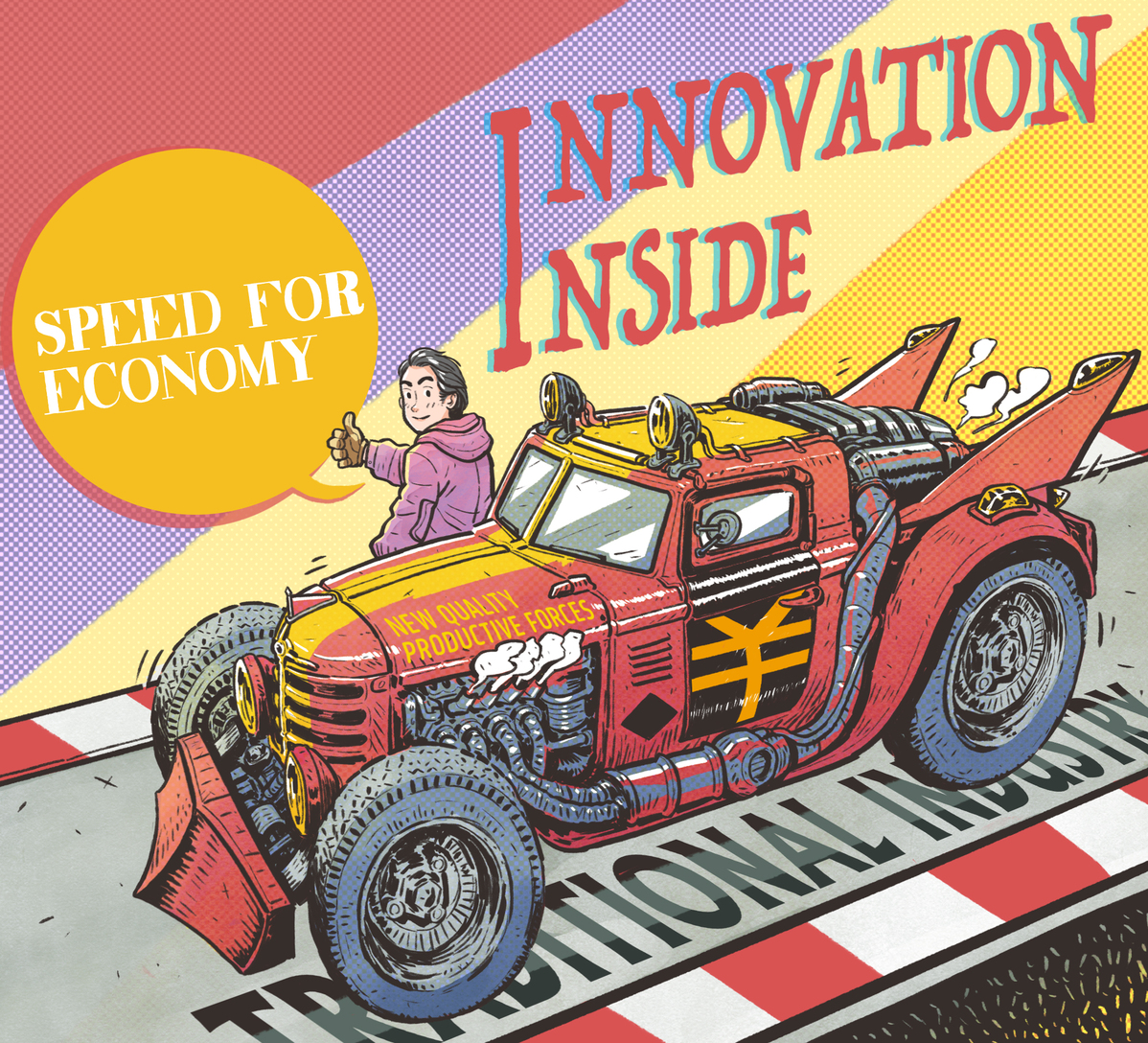
How could economic momentum shift? One key strategy is to develop new quality productive forces.
There are various interpretations of this concept, often linked to artificial intelligence, new energy vehicles and quantum computing. While these sectors are undoubtedly important, I believe that the fundamental question is whether total factor productivity can continue to rise. Only with sustained improvements in productivity can economic progress persist. Even in traditional industries, continuous technological innovation, management optimization and efficiency improvements can drive long-term growth.
Take the example of cigarette lighters produced in Shaodong, Hunan province. For 20 years, unit prices remained at 1 yuan ($0.14). Originally manufactured in Wenzhou, Zhejiang province, production eventually shifted to Shaodong, which now produces 15 billion lighters annually. This industry is highly cost-sensitive, as any slight cost increase could break the 1-yuan price point. Given the difficulty of raising prices, the industry constantly seeks lower-cost locations. Moving to Shaodong helped, but further relocation posed challenges. Cigarette lighter production involves at least 16 components, requiring a concentrated supply chain. If production moves to a lower-wage country like Laos, but suppliers remain dispersed, cost control is nearly impossible.
Currently, manufacturers have reduced labor costs to just 3 percent of production expenses — a temporary solution that may not be sustainable next year. This case illustrates that even traditional industries, thanks to technological and managerial improvements, can significantly contribute to overall economic development.
Some Western countries have questioned China's subsidy policies and State-driven approach, which are indeed worthy of discussion. However, purely from a cost perspective, competition in global markets will be a major challenge. In some cases, market shifts driven by economies of scale may make it difficult for latecomers to enter. This requires careful consideration.
On a positive note, China has demonstrated strong innovation capabilities. Looking back, early growth engine sectors like apparel and home appliances gained global significance, followed by robust developments in machinery and equipment. Now, China leads in digital economy and green energy.
During my recent visit to the US, I discussed AI and frontier technologies with US experts. Some claimed that the US and China are technologically equal, but I disagreed. While a significant gap remains, China has built considerable strength in manufacturing.
Recently, New York Times columnist Thomas Friedman visited China. In our conversation, he remarked that the US needs more Elon Musks to advance high-end manufacturing, while China needs more Taylor Swifts to drive cultural consumption. Musk relocating Tesla's factory to China underscores the country's appeal in high-end manufacturing. China's advantages include an open market, diligent and creative entrepreneurs and workers, and a comprehensive supply chain — all critical factors.
Current conditions alone may not be enough to meet future challenges. In the past, China focused on catching up. Now, innovation demands higher standards.
What exactly makes the new growth momentum "new"? China's per capita GDP has risen from $156 at the start of reform and opening-up to $12,700 today, nearing the high-income threshold. This means China is approaching the global technological frontier and must increasingly rely on its own creativity.
Harvard Professor Michael Porter has extensively studied national innovation capabilities. He identifies two key factors.
Level of investment: This includes the number of scientists, researchers and R&D funding involved in the undertaking. In AI, for instance, a report showed that the US has 60 percent of the world's AI talent, while China holds 11 percent. Given China's developing status, 11 percent is quite significant, especially since many AI experts in the US are Chinese. China's investment in innovation is growing.
Transformation of investment into high-quality innovation: Beyond investment, Porter emphasized the need for strong intellectual property protection, an open economy and support for private sector firms. Without a thriving private sector, innovation stagnates.
A major challenge lies in maintaining openness. Today's global economy makes complete self-sufficiency difficult.
Recently, I met with Mustafa Suleyman, CEO of Microsoft AI, in Beijing. He mentioned something striking about US elections. Many top executives at Microsoft — especially in AI — aren't even US citizens and thus can't vote. This highlights US openness in talent recruitment, welcoming global expertise regardless of nationality.
As China faces increasing challenges, self-reliance and innovation remain crucial. However, maintaining appropriate openness — if not maximizing it — is equally vital.
Industrial policy remains a topic of heated debate at our institute. In 2016, we hosted a high-profile debate.
However, views on industrial policy have since evolved within academia, government and the public. How should China balance government intervention and market forces? How can it reconcile economic activity with national security? A new equilibrium must be found.
The views do not necessarily reflect those of China Daily.
The writer is dean at the National School of Development, Peking University.