


Treasured legacy worth protecting
Work ensures Bingling grottoes continue to shine for future generations, Cheng Yuezhu and Ma Jingna report in Linxia, Gansu.







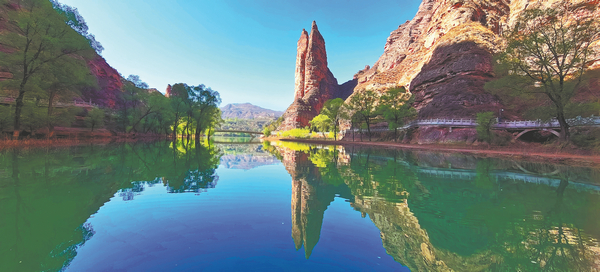
For those traveling to the venerable Bingling Temple Grottoes, the journey itself is an experience. The temple is in Yongjing county, Linxia Hui autonomous prefecture, Gansu province, just beside the Liujiaxia Reservoir on the upper reaches of the Yellow River.
The recommended way to reach the temple is to take a shuttle boat from one of the reservoir's piers, which allows visitors to see the natural spectacle of the clear green water of the Yellow River merging with the yellow murk of the Tao River.
As the boats draw near, the mountains on either side close in, revealing a red sandstone Danxia landscape. Because of the varied shapes of their peaks, the mountains are referred to as a "stone forest" and have inspired people to imagine them as characters with their own stories.
The natural setting made this an ideal site for Buddhist practitioners in search of solitude and tranquillity.
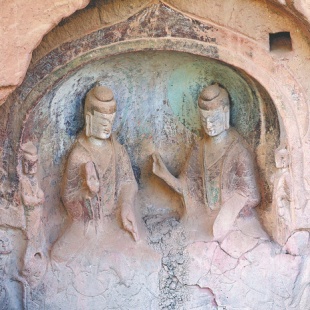
The mountains form the backdrop for Bingling Temple Grottoes. For more than a millennium, people carved stories and beliefs into the mountains with a level of craftsmanship on par with nature's grandeur.
"Cave 169 is the earliest known grotto in China with a precise historical inscription, written in the first year of the Jianhong era, which is today's 420," says Liu Zongchang, deputy director of the Bingling Temple Cultural Heritage Preservation and Research Institute's research office.
"It is an important chronological reference for the study of early Chinese grottoes. The style of sculpture and the imagery in the cave allow scholars to trace the route of the spread of Buddhism in ancient China."
For around a century, the cave was sealed off from the world. Both its construction by ancient craftsmen and rediscovery by experts in the last century were feats.
The cave is located in the cliffs above the temple's biggest Buddha statue, 40 meters above the riverbed. Visitors must climb several flights of wooden stairs beside the statue to reach it.
Unlike most grottoes deliberately carved out of the rock, this one began as a natural cave, with craftsmen modifying and reinforcing its walls, and carving niches where they saw fit.
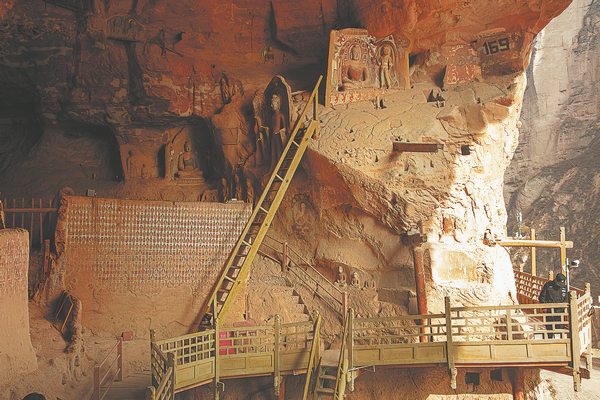
"The wooden structures at Bingling Temple, including the walkway to Cave 169, were destroyed during the wars of the late Qing Dynasty (1644-1911)," says Cao Xuewen, deputy director of the Bingling Temple Cultural Heritage Preservation and Research Institute.
It wasn't until after the founding of the People's Republic of China in 1949 that efforts were made to restore the grottoes. In 1955, the institute was established for their preservation, and in 1961, the site was designated as a national key cultural heritage protection unit.
During the preliminary field study in 1951 and official investigation in 1952, experts were unable to reach Cave 169, and could only observe it through binoculars.
In 1963, the Gansu government assembled a team of leading archaeologists for a 50-day survey. With the help of nearby villagers and the temple's monks, the team erected ladders and put up ropes, and were able to climb into the isolated cave.