Inkstone artisanship sees cultural revival
Guangdong's Duan inkstone industry is overcoming challenges by leveraging AI, social media, and commercial-tourism integration, transforming traditional craftsmanship into a modern artistic phenomenon. Wu Kunling reports from Hong Kong.







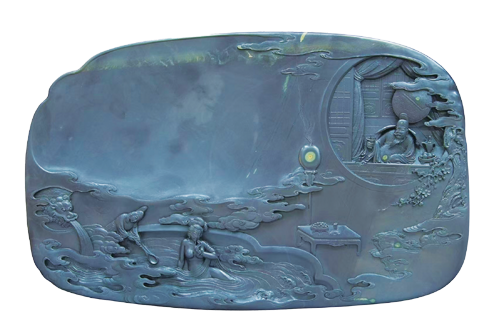
The success of the video game Black Myth: Wukong has reignited interest in Chinese culture, benefiting artisans like Liang Peiyang, a master of Duan inkstones — a premium stationery linked to Zhaoqing, Guangdong province. Liang carved Sun Wukong, the game's protagonist and a legendary Chinese figure, onto inkstones, attracting younger buyers fascinated by the Monkey King.
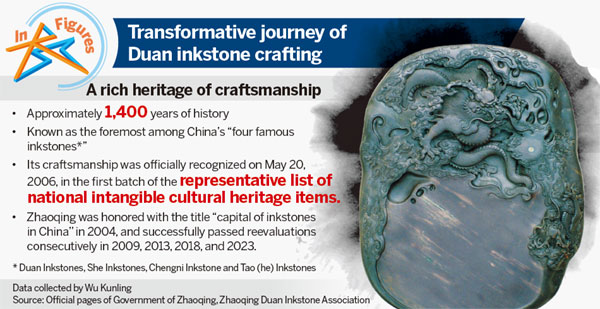
Duan inkstones, ranked among China's finest, are made from Duanxi River stone. Their low absorbency, moderate hardness, and mineral richness ensure smooth, high-quality ink, enhancing the writing experience.
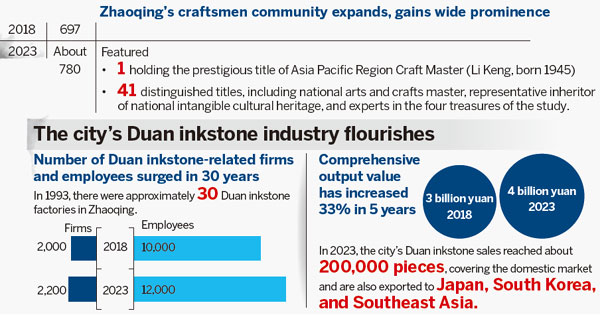
Since the Tang Dynasty (618-907), Duan inkstones have been prized across social classes. This ancient craft, recognized in 2006 as a national intangible cultural heritage, remains vibrant today. By 2024, Zhaoqing housed over 2,200 Duan inkstone businesses, employing 12,000 people and generating over 4 billion yuan ($552 million).
Family legacy
Liang, honored as a master of Chinese arts and crafts by the State Council in 2012, attributes the industry's success to innovations in techniques, themes, and business models. Born into a family of inkstone artisans dating back to at least the Ming Dynasty (1368-1644), he continues this centuries-old tradition. Following in his father's footsteps, Liang began crafting inkstones at 17 and has spent 45 years mastering the art. In the 1960s-70s, designs were simple - floral, animal, and auspicious motifs like dragons - due to limited techniques. By the late 1980s, artisans had adopted advanced tools (alloy implements, machinery) and became involved in domestic and global exchanges, elevating the craft to new heights in design and skill.
Liang asserts that far from having waned, the craft has reached unprecedented heights in design and technique.
Artisans also balance tradition with market awareness — while exports peaked in the 1980s-90s (mainly to Japan), the industry pivoted to domestic markets after Japan's economic slump, proving its adaptability.
Liang established a gallery on Zhaoqing's Dinghu Mountain in 2000, combining tourism with inkstone and tea culture. He later expanded to high-traffic locations like Beijing's Wangfujing to increase visibility. Recently, his business has shifted focus to digital platforms — live streaming and social media content now generate over 50 percent of his annual revenue.
Liang has trained over 300 students while continuing to innovate in his craft. Following his father's example, he teaches every aspect of inkstone-making, from material selection to carving techniques.
Technology the helper
Zhaoqing now fosters Duan inkstone craftsmanship through formal education programs spanning vocational to graduate levels. The new generation of artisans combine traditional skills with modern technologies like AI in production.
Li Na, an arts and crafts graduate student at Zhaoqing University, leads an 11-member team blending traditional inkstone art with modern tech. Their innovative work has won national university competitions.
The team has created cartoon characters based on inkstones, complete with unique names and personalities. These characters feature in animations and on popular merchandise like fridge magnets and watches, appealing to young consumers.
Advanced technologies are transforming production. AI assists in design and relief effects, while digital tools accelerate processes from sketching to animation.
Students are developing a comprehensive inkstone design database, seeking collaboration with museums, universities, collectors, and master artisans to convert 2D inkstone images into standardized 3D models.
Li envisions this database revolutionizing the industry — offering precise design references, optimizing machine-assisted production, and even facilitating public interaction. "Imagine museum visitors creating custom inkstones through interactive games," she says, highlighting its potential to scale up production while boosting engagement.
Li argues technology and mechanization will not replace traditional craftsmanship but rather revitalize it, serving different markets. Handcrafted inkstones appeal to collectors with their artistry and premium value, while machinemade versions attract mass consumers through affordability and innovation, she says.
With both types of inkstones complementing each other, the art of crafting Duan inkstones can be better preserved and reach new heights, Li believes.
Cultural vision
Wang Jianhua, head of Guangdong's Duan Inkstone Association, emphasizes that industry growth requires more than higher output - it needs cultural vision. As premium collectibles for niche markets, Duan inkstones demand strategic planning at the cultural industry level.
Since 2019, Zhaoqing has officially banned all mining to protect resources, a move Wang praises as rejecting unsustainable practices for long-term preservation.
Wang notes that Duan inkstone - formed through slow geological processes - is nonrenewable. Decades of unregulated mining (during the 1960s-1990s), including destructive methods like explosives, caused irreversible damage. He says meticulous research has confirmed that current stone material reserves can meet market demand.
Protecting IP rights and cultivating brand awareness are also vital in promoting the industry's scientific development. Wang established the Duan Inkstone Association and the appraisal institution in 2001 and 2002, respectively, which have issued 110,000 certificates to date. He says he believes this will dispel concerns among potential collectors and ordinary consumers, having a profound impact on promoting market growth. His association also takes the lead in evaluating titles for folk masters and selecting the inheritor of national intangible cultural heritage.
Zhaoqing has also unveiled local standards for Duan inkstones and documents on managing its intellectual property.
The industry and the government's collaborative initiatives have set unified standards for products and talent, giving rise to a group of notable local brands.
Nevertheless, Wang says he believes the industry's development should transcend that of the inkstone itself.
Zhaoqing is acclaimed as the "capital of inkstones in China" — a national-level brand — says Wang. He hopes the city can make the most of this distinctive emblem, coupled with its splendid Lingnan culture and picturesque landscapes, to strive for a fusion of cultural, commercial and tourism development around the inkstone.

At the birthplace of Duan inkstones — Baishi village — Zhaoqing has built up a national-level cultural industry showcase with a museum, an appraisal center and master studios. At the same time, tours connecting the village, abandoned Duan stone mines and local scenery have attracted thousands of tourists each year. Last year, the Duan Inkstone Museum welcomed some 110,000 visitors, including 1,500 tour groups, among them government delegations and student study teams.
"Our top priority is to further enrich such fusion. As the market flourishes, talent will return, and the cultural heritage will naturally be passed down," says Wang.
Contact the writer at amberwu@chinadailyhk.com
- Liaoning fire: Report urges legal action against restaurant operator and seven others
- Historical Han Dynasty slips go on display in Hohhot
- Shanghai unveils steps to build sci-tech innovation corridor in Yangtze River Delta
- Xiangchao concludes with Yongzhou claiming championship
- Answers
- CPC leadership meeting urges steadfast implementation of eight-point decision on improving conduct