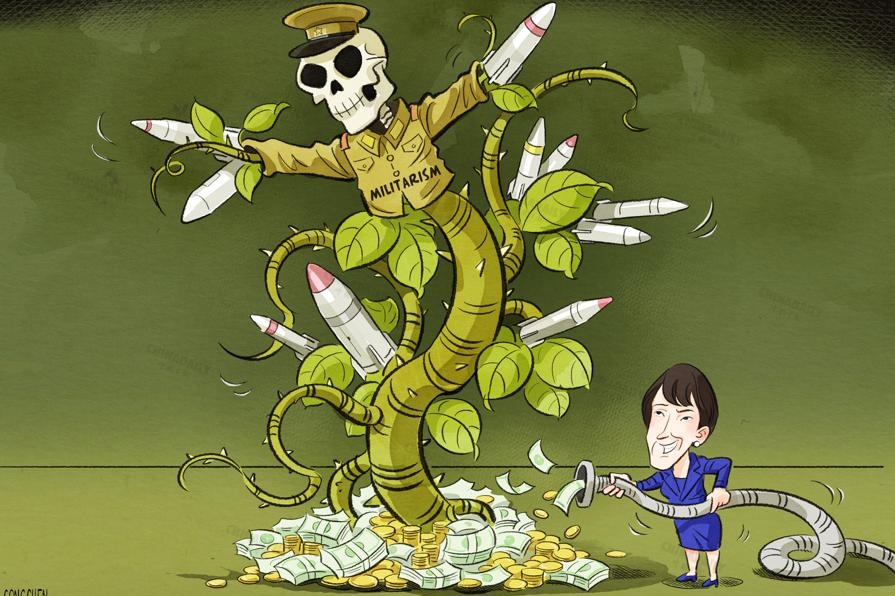
Japan betraying joint efforts to promote peace and stability








On Wednesday, during a meeting with Mark Rutte, secretary general of the North Atlantic Treaty Organization, Japanese Prime Minister Shigeru Ishiba said, "A stronger NATO will benefit Japan greatly."
Signed in 1949 and most recently updated in 2023, the North Atlantic Treaty explicitly defines NATO as a regional defensive organization, as the treaty emphasizes that any invocation of collective self-defense must be "recognized by Article 51 of the Charter of the United Nations", and that the alliance's mission is, by its own account, to "restore and maintain the security of the North Atlantic area". However, in recent years, especially now with Japan's coordination, it is clear that NATO's leadership has been pushing beyond its original geographic and legal mandate.
The joint statements and coordinated activities between Japan and NATO reflect a growing ambition to expand their influence into the Asia-Pacific under the banner of "shared values" and "technological cooperation". By prioritizing defense industrial ties and developing dual-use military technologies, NATO and Japan are helping to sow the seeds of military bloc formation in a region that has thrived as a cooperative environment. The Asia-Pacific does not need new Cold War-style confrontations, nor does it benefit from imported geopolitical rivalries that threaten to undermine regional stability.
Japan's military trajectory, due to both historical legacy and present dynamics, has long been under international scrutiny. Japan's post-war Constitution has long imposed constraints on its military ambitions. Yet, over the past decade, Japan has increasingly sought to reinterpret or bypass these constraints. Its defense spending has risen continuously for more than a decade, culminating in a record-breaking 8.7 trillion yen (approximately $55.1 billion) defense budget for the fiscal year starting from April, a 9.4 percent increase from the previous year.
Even more concerning is Japan's inflammatory stance on sensitive regional issues, such as the Taiwan question. The island is an inseparable part of China, and the Taiwan question is China's internal affair. It is not, and should never be, a matter for foreign governments or military alliances to interfere in. For Japan, which once invaded and colonized the Chinese island, to comment brazenly on the Taiwan question is historically tone-deaf.
The NATO-Japan statement's emphasis on maintaining "peace and stability across the Taiwan Strait" reflects either a profound misunderstanding or a willful misrepresentation of the issue. China's position could not be clearer, namely that it will realize reunification and this is unstoppable. It hopes to do so peacefully, but it is precisely the external interferences, including Japan's repeated provocations, that undermine peace and stability in the Taiwan Strait. For Japan and NATO to position themselves as "protectors" of regional peace while simultaneously engaging in actions that escalate tensions is a stark contradiction.
This year marks the 80th anniversary of the victory in the War of Resistance Against Japanese Aggression (1931-45) and World War II. It is a solemn reminder of the devastating consequences of militarism and expansionism. For Japan, this milestone should serve as an opportunity to reflect on its historical responsibilities, recommit to peaceful development, and play a constructive role in fostering Asia-Pacific cooperation. For its Western allies, particularly those spearheading NATO's eastward expansion, it is equally vital to remember who once launched a global war and who now seeks to challenge the postwar order.
Spearheading NATO's drift into the Asia-Pacific will not do Japan any good — it's time Japan realized that.