



All-digital museum has wartime storytelling updated







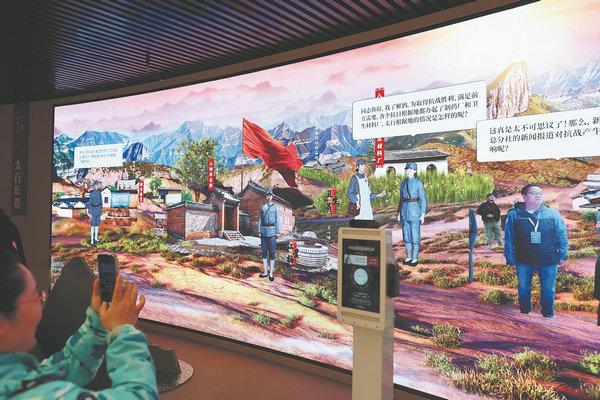
Unlike traditional institutions, the museum dedicated to the Eighth Route Army in Wuxiang county, Changzhi, Shanxi province, tells history in an innovative way, illuminating the past through modern technology. With no physical artifacts to display, it offers instead a dynamic, "growing" exhibition space powered by artificial intelligence and real-time data updates.
Opened in October 2024, the museum makes use of cutting-edge technology to bring history to life, and has attracted more than 24,000 visitors so far, according to the museum statistics. Visitors can interact with digital recreations of revolutionary heroes, listen to artificial intelligence-narrated stories, and even step into virtual battlefields. Known as one of the centers of the War of Resistance Against Japanese Aggression (1931-45) and as one of the bases of the Eighth Route Army led by the Communist Party of China, Wuxiang was once a military headquarters, which explains the museum's location.
"This isn't just a museum, it's a revolution in how we remember history," Ye Jian, the exhibition curator, says. "We call it a 'growing' museum because its database is continuously expanding, and has grown from 10 million Chinese characters to 30 million in four months."
The database powers 17 digital exhibits related to people, locations, and events.
Upon entering, visitors are greeted by a dynamic display of key moments of the Eighth Route Army's legacy. In the Heroes of Taihang section, 40 colored portraits of local heroes — like Wang Jiuhuan, who disguised herself as a man to fight, and Wang Laifa, who made and laid hundreds of landmines as the plucky village attempted to repel the Japanese invaders — come alive through AI.Their eyes blink, they smile warmly, as if bridging the past and present.
"We wondered if the photos might be too blurry, or if they wouldn't look like real people," Ye says, adding that their concerns were dispelled when they saw the reaction of the grandson of an Eighth Route Army soldier as he watched the AI-generated photo of his grandfather come to life.
"Standing before these portraits, I felt like I was seeing real people and their stories," Wang Kexin, a visitor to the exhibition, says.
Among the portraits are a few blank frames, which commemorate unknown heroes, according to Ye. "We may not have their faces, but we leave space to honor them."
For the curator, another highlight is a digital map pinpointing 1,190 historical sites, with immersive 3D battle recreations.
Clicking on the touchscreen, visitors will learn that eight brigades, 31 regiments, and 378 generals fought in Wuxiang, whose stories are commemorated. There is also visualized data about 30,000 Shanxi martyrs, with interactive charts showing their ages and locations of death.
"Li Aimin and Han Fuxiang were only 14 when they died — Wuxiang's youngest martyrs. About 85 percent of the dead were aged between 19 and 30. So many young people, lost too soon," tourist Li Fang says, tracing the screen.
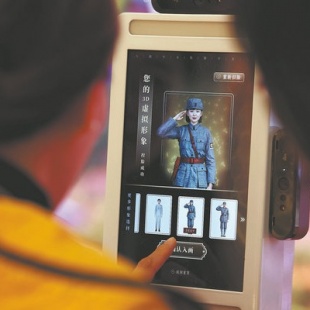
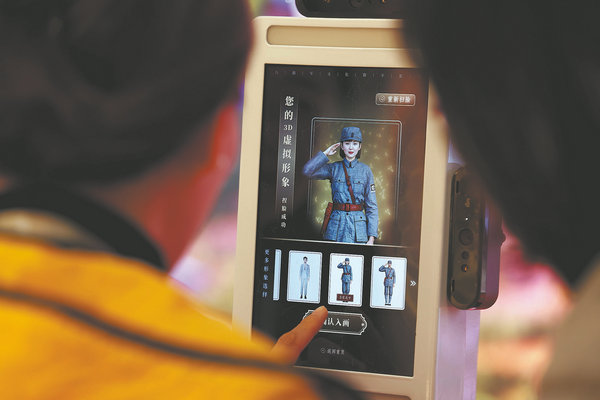
Meanwhile, a digital guide in an Eighth Route Army uniform called Yang Hongxing is a focus of curiosity.
"It is a digitized system we developed using digital technology to promote Red (revolutionary) culture. By interacting with the avatar, visitors can learn about the revolutionary history of Wuxiang," Ye says.
To engage the tech-savvy, the museum proposes new ways of exploring the Red culture. Visitors can generate custom-designed wartime posters in real-time, read e-books like Landmine Warfare, participate in quizzes by tapping on desktop screens in a classroom, scan QR codes to leave messages, and create personalized videos in the tribute theater.
"Digitization isn't just about technology, it's about connecting Red culture to today's young visitors," Ye says.
With Red culture at the root and soul of Wuxiang, Wang Shuwen, head of the county, says this year, local authorities will continue to enrich cultural and tourism offerings, improve the quality of tourism services, and enhance Red tourism, in the hopes of creating a national demonstration zone for the integrated development of Red culture tourism.




















