


Unearthing the secrets of a Central Asian crossroads
China-Uzbekistan joint excavations at ancient burial site point to the influences present in the Fergana Valley, Wang Ru reports.







Even today, silk is something of a luxury, so it is not difficult to imagine the awe it must have inspired when it was introduced from China to Europe. The fabric is as soft as a breeze and lustrous as a pearl, and this marvelous material was not created for keeping warm, but for adding glamour to life.
Maybe it's because silk was so impressive that the road it once traveled on was eventually named after it in the late 19th Century, when it became known as the Silk Road. However, because it is an organic material that decays with time, few traces of silk have ever been found at the ancient sites along the historical routes.
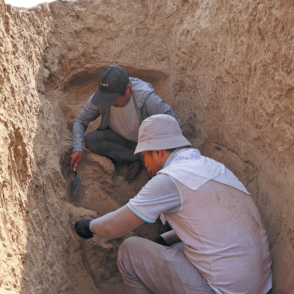
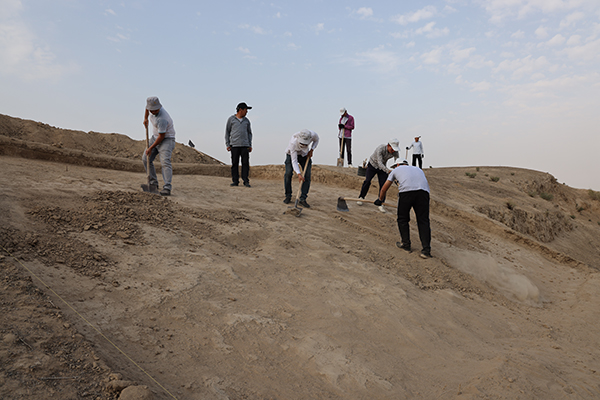
Silk, and other evidence of contact, has been found as a result of excavations carried out since last September by Chinese and Uzbekistani archaeologists at the Munchaktepa site in Uzbekistan's Fergana Valley, proving it was an important artery along the Silk Road that played a significant role in cultural communications between China, West Asia, and Europe, according to Liu Tao, a researcher at the Institute of Archaeology at the Chinese Academy of Social Sciences and leader of the Chinese team at Munchaktepa.
The site is located on a plateau east of the town of Bekabad on the banks of the Syr Darya River. It was accidentally discovered and excavated for the first time in the 1980s, when many strings of beads were unearthed in its tombs. As a result, the site was named Munchaktepa, which means "the plateau of strings of beads" in Uzbekistan.
Through research, Munchaktepa has been identified as a burial site belonging to the people who lived in the neighboring site of Balandtepa, where the remains of a city dating to the same period as Munchaktepa have been found some 30 meters away.
According to Ali Aisa, a member of the Chinese archaeological team, Munchaktepa is roughly contemporaneous with the period in China spanning the Three Kingdoms (220-280) to the Southern and Northern Dynasties (420-581).At the time, the Silk Road was the site of much trade and frequent cultural exchange.