Terracotta Warriors return to California, unveiling China's ancient past







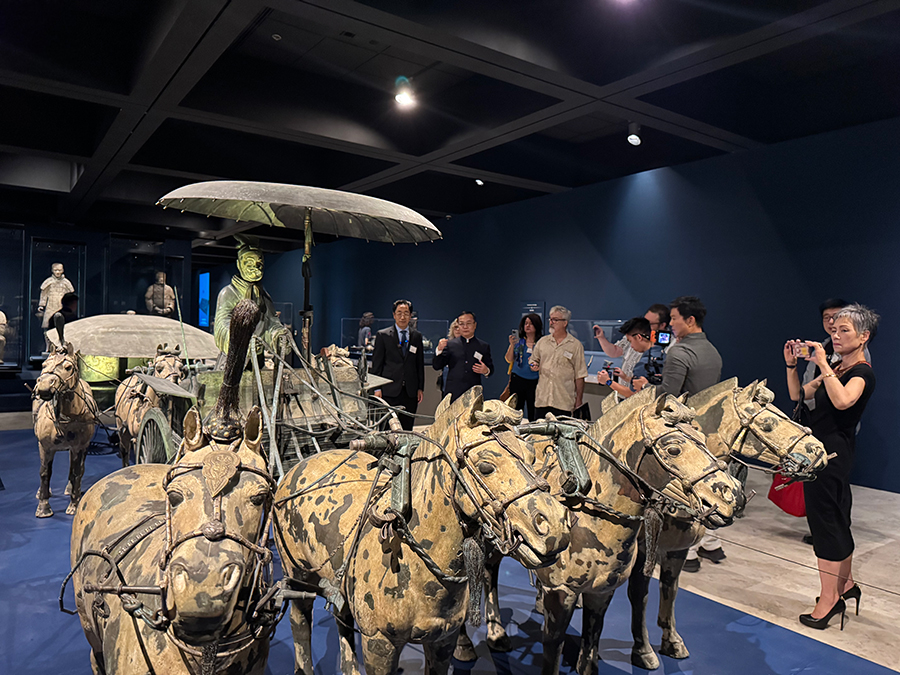
For Sean O'Harrow, president of the Bowers Museum, the return of the Terracotta Warriors to Southern California is more than a curatorial milestone — it is the continuation of a deeply personal journey that began in his youth. Guided by his father, a scholar of Chinese and Vietnamese philology, O'Harrow first visited Xi'an and Shanxi province as a teenager, an experience that left a lasting impression.
"My father said that an educated person must know about Chinese history, and to know China, one must visit Xi'an and Shanxi province," O'Harrow told China Daily. "We visited Xi'an for the first time many, many years ago, and it made me understand the importance and scale of Chinese history. Everything I saw blew my mind. It was an unforgettable experience that changed my life forever".
Decades later, O'Harrow now proudly welcomes the Terracotta Warriors back to the Bowers Museum in Santa Ana for a third time. The museum previously hosted the iconic artifacts in 2008 and 2011. But this year's exhibition, World of the Terracotta Warriors: New Archaeological Discoveries in Shaanxi in the 21st Century, goes far beyond previous displays by tracing the origins of Chinese civilization and offering North American audiences a window into over two millennia of history.
Opening on May 24 and running through October 19, the exhibition marks the 50th anniversary of the discovery of the Terracotta Army, which is widely regarded as one of the greatest archaeological finds of the 20th century. It features more than 110 newly excavated artifacts from across Shaanxi province, many of which are being shown in North America for the first time.
"We aim to present the latest archaeological discoveries from Shaanxi and explore how the Qin Empire was formed," said Jiao Tianlong, chief curator at the Bowers Museum. "This collection offers fresh insights into how the Qin unified China and the ancient civilizations that preceded it".
The immersive journey begins with relics from Shimao, one of the earliest known fortified cities in China, dating back to around 2300 BCE. From there, visitors are guided through the Shang and Zhou dynasties, leading up to the Qin Dynasty and the life-sized terracotta warriors that famously guarded the tomb of Emperor Qinshihuang after he died in 210 BCE.
In addition to the iconic soldiers, the exhibition showcases exquisitely crafted chariots, ceremonial jade and gold ornaments, ritual bronze vessels, and ornate fittings from royal tombs. These artifacts not only reflect the remarkable artistry of their time but also offer insight into the political, military, and cultural development of early Chinese society.
Mark Bustamante, director of Special Exhibition Programs at the museum, noted that this year's show goes deeper into the historical timeline. "We're really excited because it reaches back another 2,000 years into the origins of China," he said. "It looks at how different powers and cultures helped shape the nation by introducing technologies like bronze vessels and chariots, which culminated in the unification under Qinshihuang".
The exhibition is also distinguished by its use of modern technology. Through interactive digital elements, visitors can engage with the artifacts in new ways, including a painting station that allows them to color terracotta warriors using traditional palettes once used on the original figures.
For Anne Shih, chairwoman of the Bowers Museum Board of Governors, the exhibition is the fulfillment of a long-awaited dream. "I felt so proud to make this dream come true again," she told China Daily. "We hope this will foster even closer ties between the people of China and the US. This exhibition is a powerful bridge for cultural exchange and mutual understanding".
On the preview day on May 23, many attendees expressed awe and appreciation for the richness of Chinese civilization. "It's unbelievable that we have this remarkable history here in Orange County," said Maria Hall Brown, senior director at PBS SoCal. "Looking at the craftsmanship and the life that was lived thousands of years ago, we can truly educate ourselves and appreciate another part of the world in a sincere way".
Historian and author Charles Spratley echoed those sentiments. "This exhibition brings Chinese culture and history to life in a very tangible way," he said. "It shows how East and West are connected through shared elements like armor, jewelry, and chariots. In the end, we are one people."
O'Harrow emphasized that the exhibition also highlights the long history of global connectivity, particularly through ancient trade routes. "This exhibition tells us that humans have engaged in commercial and cultural exchanges for thousands of years, not just since World War II," he said. "The connections between China and Central Asia are a perfect example of that".
The exhibition is jointly organized by the Bowers Museum and the Emperor Qinshihuang's Mausoleum Site Museum, with support from the Shaanxi Provincial Cultural Heritage Administration.
"Through this exhibition, we hope to offer the North American public a deeper and more comprehensive understanding of China and its ancient civilization," said Li Gang, director of the Emperor Qinshihuang's Mausoleum Site Museum. "By building a bridge between China and the United States, we aim to promote lasting cultural exchange".